

3 T 2g (1.05 eV),
3 T 1g (1.7 eV), and another
3
T 1g (3.0 eV), and this is approximately
what is observed.
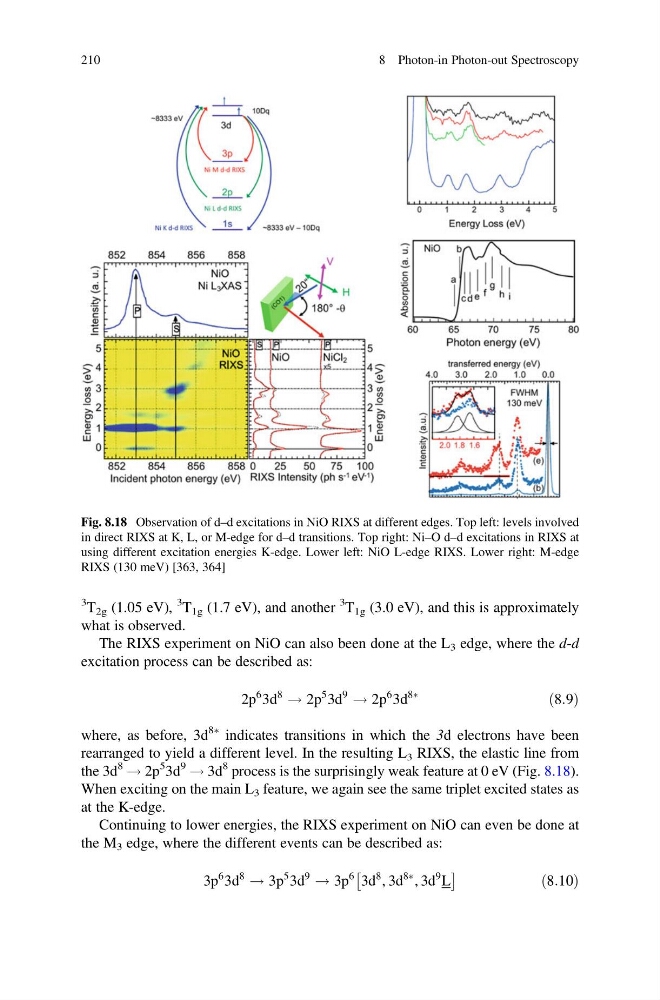
The RIXS experiment on NiO can also been done at the L 3 edge, where the d-d
excitation process can be described as:
2p
6 3d
8
! 2p
5 3d
9
! 2p
6 3d
8Ã
ð8:9Þ
where, as before, 3d
8Ã indicates transitions in which the 3d electrons have been
rearranged to yield a different level. In the resulting L 3 RIXS, the elastic line from
the 3d
8
! 2p
5 3d
9
! 3d
8 process is the surprisingly weak feature at 0 eV (Fig. 8.18).
When exciting on the main L 3 feature, we again see the same triplet excited states as
at the K-edge.
Continuing to lower energies, the RIXS experiment on NiO can even be done at
the M 3 edge, where the different events can be described as:
3p
6 3d
8
! 3p
5 3d
9
! 3p
6 3d
8 , 3d
8Ã , 3d
9 L
Â
Ã
ð8:10Þ
Fig. 8.18 Observation of d–d excitations in NiO RIXS at different edges. Top left: levels involved
in direct RIXS at K, L, or M-edge for d–d transitions. Top right: Ni–O d–d excitations in RIXS at
using different excitation energies K-edge. Lower left: NiO L-edge RIXS. Lower right: M-edge
RIXS (130 meV) [363, 364]
210
8 Photon-in Photon-out Spectroscopy
3 T 1g (1.7 eV), and another
3
T 1g (3.0 eV), and this is approximately
what is observed.
The RIXS experiment on NiO can also been done at the L 3 edge, where the d-d
excitation process can be described as:
2p
6 3d
8
! 2p
5 3d
9
! 2p
6 3d
8Ã
ð8:9Þ
where, as before, 3d
8Ã indicates transitions in which the 3d electrons have been
rearranged to yield a different level. In the resulting L 3 RIXS, the elastic line from
the 3d
8
! 2p
5 3d
9
! 3d
8 process is the surprisingly weak feature at 0 eV (Fig. 8.18).
When exciting on the main L 3 feature, we again see the same triplet excited states as
at the K-edge.
Continuing to lower energies, the RIXS experiment on NiO can even be done at
the M 3 edge, where the different events can be described as:
3p
6 3d
8
! 3p
5 3d
9
! 3p
6 3d
8 , 3d
8Ã , 3d
9 L
Â
Ã
ð8:10Þ
Fig. 8.18 Observation of d–d excitations in NiO RIXS at different edges. Top left: levels involved
in direct RIXS at K, L, or M-edge for d–d transitions. Top right: Ni–O d–d excitations in RIXS at
using different excitation energies K-edge. Lower left: NiO L-edge RIXS. Lower right: M-edge
RIXS (130 meV) [363, 364]
210
8 Photon-in Photon-out Spectroscopy