

L-edge transitions can occur to excited states with that same ligand hole, which can
then emit a photon to yield a final state that is the same as an optical LMCT:
α2p
6 3d
8
þ β2p
6 3d
9 L ! 2p
5 3d
10 L ! α
´ 2p
6 3d
8
þ β
´ 2p
6 3d
9 L
ð8:7Þ
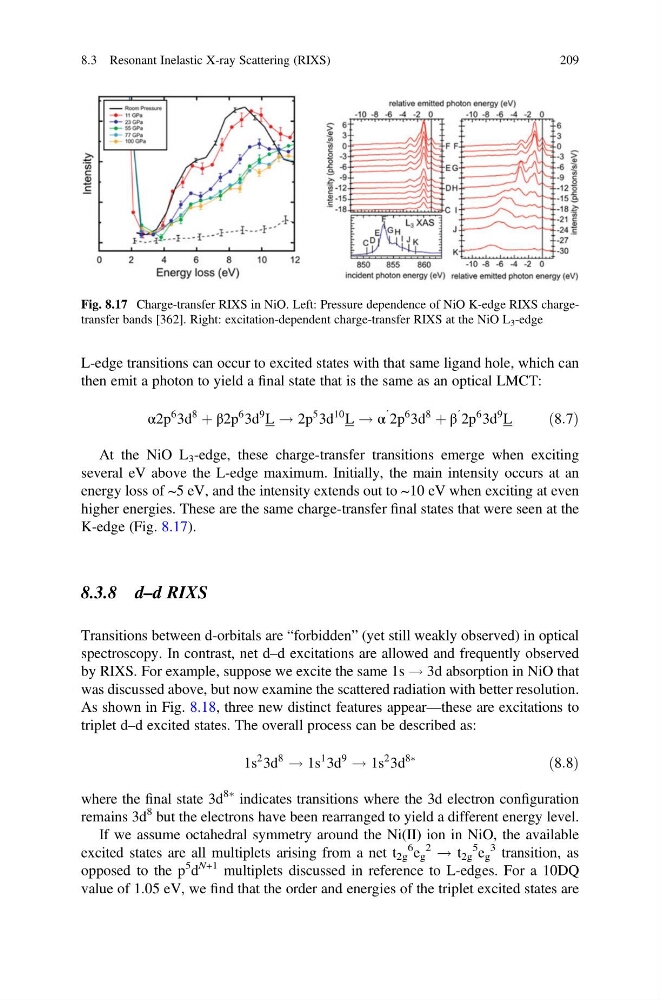
At the NiO L 3 -edge, these charge-transfer transitions emerge when exciting
several eV above the L-edge maximum. Initially, the main intensity occurs at an
energy loss of ~5 eV, and the intensity extends out to ~10 eV when exciting at even
higher energies. These are the same charge-transfer final states that were seen at the
K-edge (Fig. 8.17).
8.3.8 d–d RIXS
Transitions between d-orbitals are “forbidden” (yet still weakly observed) in optical
spectroscopy. In contrast, net d–d excitations are allowed and frequently observed
by RIXS. For example, suppose we excite the same 1s ! 3d absorption in NiO that
was discussed above, but now examine the scattered radiation with better resolution.
As shown in Fig. 8.18, three new distinct features appear—these are excitations to
triplet d–d excited states. The overall process can be described as:
1s
2 3d
8
! 1s
1 3d
9
! 1s
2 3d
8Ã
ð8:8Þ
where the final state 3d
8Ã indicates transitions where the 3d electron configuration
remains 3d
8 but the electrons have been rearranged to yield a different energy level.
If we assume octahedral symmetry around the Ni(II) ion in NiO, the available
excited states are all multiplets arising from a net t 2g
6 e g
2
! t 2g
5 e g
3 transition, as
opposed to the p
5 d
N+1 multiplets discussed in reference to L-edges. For a 10DQ
value of 1.05 eV, we find that the order and energies of the triplet excited states are
Fig. 8.17 Charge-transfer RIXS in NiO. Left: Pressure dependence of NiO K-edge RIXS chargetransfer bands [362]. Right: excitation-dependent charge-transfer RIXS at the NiO L 3 -edge
8.3 Resonant Inelastic X-ray Scattering (RIXS)
209
then emit a photon to yield a final state that is the same as an optical LMCT:
α2p
6 3d
8
þ β2p
6 3d
9 L ! 2p
5 3d
10 L ! α
´ 2p
6 3d
8
þ β
´ 2p
6 3d
9 L
ð8:7Þ
At the NiO L 3 -edge, these charge-transfer transitions emerge when exciting
several eV above the L-edge maximum. Initially, the main intensity occurs at an
energy loss of ~5 eV, and the intensity extends out to ~10 eV when exciting at even
higher energies. These are the same charge-transfer final states that were seen at the
K-edge (Fig. 8.17).
8.3.8 d–d RIXS
Transitions between d-orbitals are “forbidden” (yet still weakly observed) in optical
spectroscopy. In contrast, net d–d excitations are allowed and frequently observed
by RIXS. For example, suppose we excite the same 1s ! 3d absorption in NiO that
was discussed above, but now examine the scattered radiation with better resolution.
As shown in Fig. 8.18, three new distinct features appear—these are excitations to
triplet d–d excited states. The overall process can be described as:
1s
2 3d
8
! 1s
1 3d
9
! 1s
2 3d
8Ã
ð8:8Þ
where the final state 3d
8Ã indicates transitions where the 3d electron configuration
remains 3d
8 but the electrons have been rearranged to yield a different energy level.
If we assume octahedral symmetry around the Ni(II) ion in NiO, the available
excited states are all multiplets arising from a net t 2g
6 e g
2
! t 2g
5 e g
3 transition, as
opposed to the p
5 d
N+1 multiplets discussed in reference to L-edges. For a 10DQ
value of 1.05 eV, we find that the order and energies of the triplet excited states are
Fig. 8.17 Charge-transfer RIXS in NiO. Left: Pressure dependence of NiO K-edge RIXS chargetransfer bands [362]. Right: excitation-dependent charge-transfer RIXS at the NiO L 3 -edge
8.3 Resonant Inelastic X-ray Scattering (RIXS)
209