

8.3.6 K-L RIXS
In our treatment of X-ray fluorescence, one of the processes we described involved
knocking out a 1s core electron and then filling that hole with an electron from a 2p
or 3p orbital, to yield Kα or Kβ fluorescence, respectively. What happens if instead
of ejecting the 1s electron into the continuum, one instead promotes the electron into
a vacant 3d orbital? If the core hole is then filled by a 2p or 3p electron, the final state
will then be the same as that achieved by the soft X-ray absorption at the L- or
M-edges discussed in Chap. 6!
1s
2 3d
n
! 1s
1 3d
nþ1
! 1s
2 2p
5 3d
nþ1 or 1s
2 3d
n
! 1s
1 3d
nþ1
! 1s
2 3p
5 3d
nþ1
ð8:5Þ
Given all the difficulties of working in the soft X-ray region, K-L or K-M RIXS is
an attractive way to obtain comparable information. An example of such spectra for
NiF 2 using the Ni K-edge is shown in Fig. 8.16 [361].
8.3.7 Charge-Transfer RIXS
Earlier in this chapter, we discussed “valence-to-core” fluorescence involving bands
or orbitals that are mostly ligand in character. These transitions can also occur when
exciting into the d-orbitals at a transition metal edge, and the resulting final state is
the same as a “ligand-to-metal charge transfer” (“LMCT”) transition seen in the
UV-visible region:
1s
2 3d
n
! 1s
1 3d
nþ1
! 1s
2 L3d
nþ1
ð8:6Þ
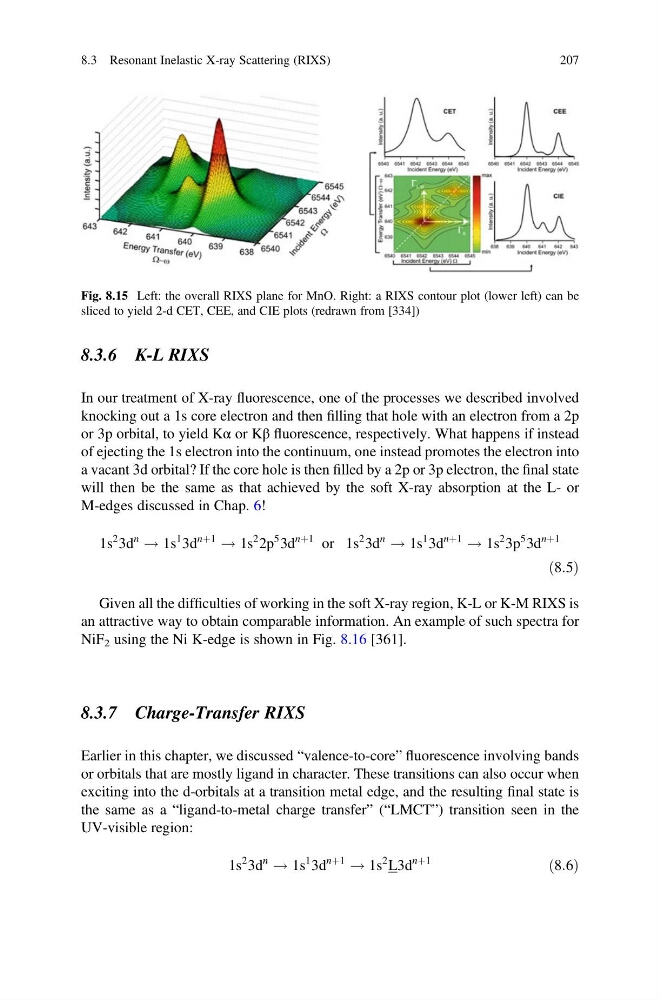
Fig. 8.15 Left: the overall RIXS plane for MnO. Right: a RIXS contour plot (lower left) can be
sliced to yield 2-d CET, CEE, and CIE plots (redrawn from [334])
8.3 Resonant Inelastic X-ray Scattering (RIXS)
207
In our treatment of X-ray fluorescence, one of the processes we described involved
knocking out a 1s core electron and then filling that hole with an electron from a 2p
or 3p orbital, to yield Kα or Kβ fluorescence, respectively. What happens if instead
of ejecting the 1s electron into the continuum, one instead promotes the electron into
a vacant 3d orbital? If the core hole is then filled by a 2p or 3p electron, the final state
will then be the same as that achieved by the soft X-ray absorption at the L- or
M-edges discussed in Chap. 6!
1s
2 3d
n
! 1s
1 3d
nþ1
! 1s
2 2p
5 3d
nþ1 or 1s
2 3d
n
! 1s
1 3d
nþ1
! 1s
2 3p
5 3d
nþ1
ð8:5Þ
Given all the difficulties of working in the soft X-ray region, K-L or K-M RIXS is
an attractive way to obtain comparable information. An example of such spectra for
NiF 2 using the Ni K-edge is shown in Fig. 8.16 [361].
8.3.7 Charge-Transfer RIXS
Earlier in this chapter, we discussed “valence-to-core” fluorescence involving bands
or orbitals that are mostly ligand in character. These transitions can also occur when
exciting into the d-orbitals at a transition metal edge, and the resulting final state is
the same as a “ligand-to-metal charge transfer” (“LMCT”) transition seen in the
UV-visible region:
1s
2 3d
n
! 1s
1 3d
nþ1
! 1s
2 L3d
nþ1
ð8:6Þ
Fig. 8.15 Left: the overall RIXS plane for MnO. Right: a RIXS contour plot (lower left) can be
sliced to yield 2-d CET, CEE, and CIE plots (redrawn from [334])
8.3 Resonant Inelastic X-ray Scattering (RIXS)
207