

The fundamental point to understand about RIXS is that it is a two-photon
process. As shown in Fig. 8.13, the incoming photon has a certain energy ω and
momentum ħ k
!
, and a given polarization, and the outgoing photon will have energy
ω, momentum ħ k
! 0
, and perhaps a different polarization. The difference in energy,
ΔE ¼ ω À Ω, and the difference in momentum, ħQ
! ¼ ħ k
! 0 À ħ k
!
, reflect transfer to
the sample as an excitation that can propagate through a material. These excitations
can involve vibrations (phonons), magnetic fluctuations (magnons), or d–d or
charge-transfer electronic excitations. The fact that X-rays can have significant
momentum as well as energy makes RIXS somewhat different from Raman spectroscopy with visible light, where the photons have so little momentum that for most
cases it can be ignored. Below we give a very cursory introduction to the theory of
how RIXS works. Our explanation is rudimentary because compared to X-ray
absorption, resonant inelastic X-ray scattering is complicated.
8.3.3 Direct RIXS
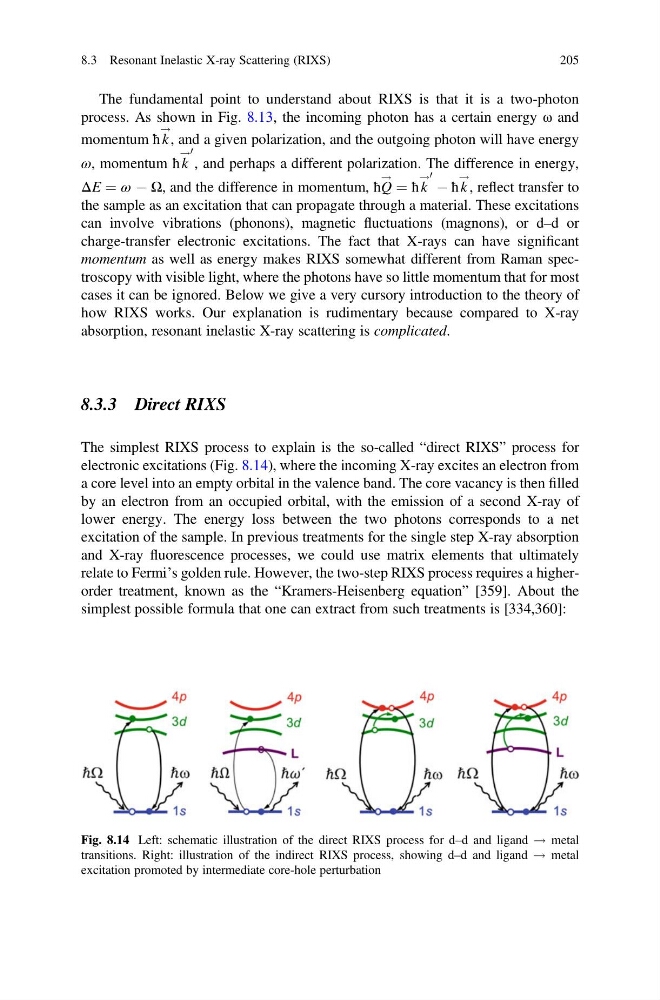
The simplest RIXS process to explain is the so-called “direct RIXS” process for
electronic excitations (Fig. 8.14), where the incoming X-ray excites an electron from
a core level into an empty orbital in the valence band. The core vacancy is then filled
by an electron from an occupied orbital, with the emission of a second X-ray of
lower energy. The energy loss between the two photons corresponds to a net
excitation of the sample. In previous treatments for the single step X-ray absorption
and X-ray fluorescence processes, we could use matrix elements that ultimately
relate to Fermi’s golden rule. However, the two-step RIXS process requires a higherorder treatment, known as the “Kramers-Heisenberg equation” [359]. About the
simplest possible formula that one can extract from such treatments is [334,360]:
Fig. 8.14 Left: schematic illustration of the direct RIXS process for d–d and ligand ! metal
transitions. Right: illustration of the indirect RIXS process, showing d–d and ligand ! metal
excitation promoted by intermediate core-hole perturbation
8.3 Resonant Inelastic X-ray Scattering (RIXS)
205
process. As shown in Fig. 8.13, the incoming photon has a certain energy ω and
momentum ħ k
!
, and a given polarization, and the outgoing photon will have energy
ω, momentum ħ k
! 0
, and perhaps a different polarization. The difference in energy,
ΔE ¼ ω À Ω, and the difference in momentum, ħQ
! ¼ ħ k
! 0 À ħ k
!
, reflect transfer to
the sample as an excitation that can propagate through a material. These excitations
can involve vibrations (phonons), magnetic fluctuations (magnons), or d–d or
charge-transfer electronic excitations. The fact that X-rays can have significant
momentum as well as energy makes RIXS somewhat different from Raman spectroscopy with visible light, where the photons have so little momentum that for most
cases it can be ignored. Below we give a very cursory introduction to the theory of
how RIXS works. Our explanation is rudimentary because compared to X-ray
absorption, resonant inelastic X-ray scattering is complicated.
8.3.3 Direct RIXS
The simplest RIXS process to explain is the so-called “direct RIXS” process for
electronic excitations (Fig. 8.14), where the incoming X-ray excites an electron from
a core level into an empty orbital in the valence band. The core vacancy is then filled
by an electron from an occupied orbital, with the emission of a second X-ray of
lower energy. The energy loss between the two photons corresponds to a net
excitation of the sample. In previous treatments for the single step X-ray absorption
and X-ray fluorescence processes, we could use matrix elements that ultimately
relate to Fermi’s golden rule. However, the two-step RIXS process requires a higherorder treatment, known as the “Kramers-Heisenberg equation” [359]. About the
simplest possible formula that one can extract from such treatments is [334,360]:
Fig. 8.14 Left: schematic illustration of the direct RIXS process for d–d and ligand ! metal
transitions. Right: illustration of the indirect RIXS process, showing d–d and ligand ! metal
excitation promoted by intermediate core-hole perturbation
8.3 Resonant Inelastic X-ray Scattering (RIXS)
205