

ultraviolet photons. Since such radiation is available in a typical chemistry lab, why
bother with RIXS and the synchrotron? The cases where there are good arguments
for RIXS generally involve situations where the simpler experiment either is not
feasible or does not provide the required information, such as:
• A need for element selectivity.
• Interest in the q (momentum) dependence of excitations.
• Transitions forbidden by conventional selection rules.
• Experimental constraints such as windows or pressure cells.
8.3.2 The RIXS Experiment
One of the beautiful attributes of the RIXS technique is that the intrinsic resolution
only depends on the final-state lifetime. This compares with absorption and conventional fluorescence where the linewidths depend on the lifetimes of the core hole(s)
involved. To observe this enhanced resolution of a RIXS measurement, one needs
two devices with comparable resolution, a monochromator for the incident radiation
and an analyzer for the scattered radiation. Since the scatter comes out in all
directions, the design of the analyzer is more difficult, especially when one is trying
to achieve both high efficiency and good energy resolution. In Chap. 4 we saw the
different solutions used for soft and hard X-rays.
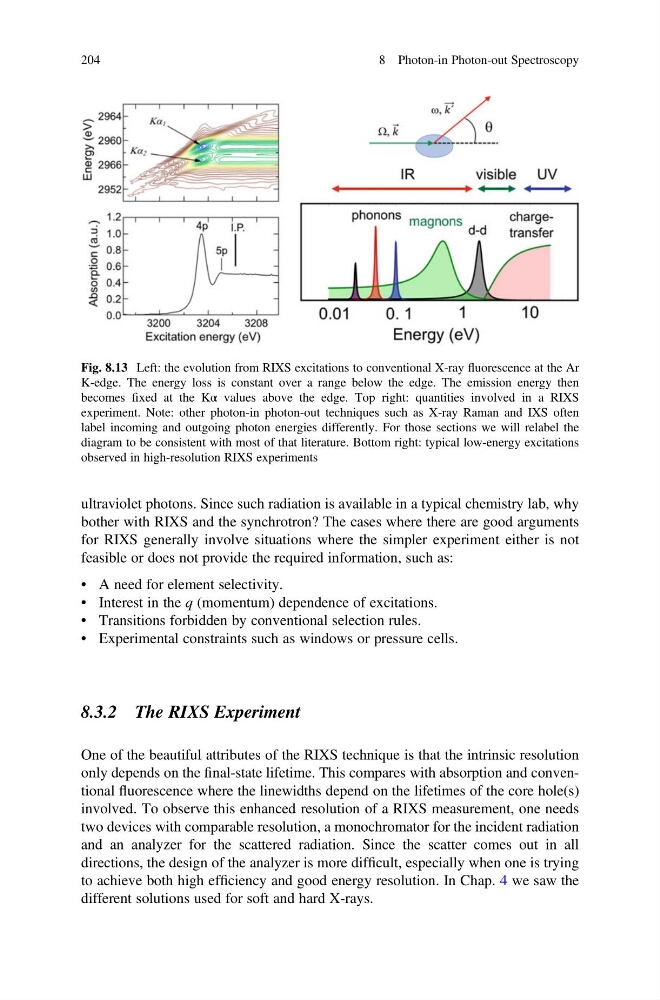
Fig. 8.13 Left: the evolution from RIXS excitations to conventional X-ray fluorescence at the Ar
K-edge. The energy loss is constant over a range below the edge. The emission energy then
becomes fixed at the Kα values above the edge. Top right: quantities involved in a RIXS
experiment. Note: other photon-in photon-out techniques such as X-ray Raman and IXS often
label incoming and outgoing photon energies differently. For those sections we will relabel the
diagram to be consistent with most of that literature. Bottom right: typical low-energy excitations
observed in high-resolution RIXS experiments
204
8 Photon-in Photon-out Spectroscopy
bother with RIXS and the synchrotron? The cases where there are good arguments
for RIXS generally involve situations where the simpler experiment either is not
feasible or does not provide the required information, such as:
• A need for element selectivity.
• Interest in the q (momentum) dependence of excitations.
• Transitions forbidden by conventional selection rules.
• Experimental constraints such as windows or pressure cells.
8.3.2 The RIXS Experiment
One of the beautiful attributes of the RIXS technique is that the intrinsic resolution
only depends on the final-state lifetime. This compares with absorption and conventional fluorescence where the linewidths depend on the lifetimes of the core hole(s)
involved. To observe this enhanced resolution of a RIXS measurement, one needs
two devices with comparable resolution, a monochromator for the incident radiation
and an analyzer for the scattered radiation. Since the scatter comes out in all
directions, the design of the analyzer is more difficult, especially when one is trying
to achieve both high efficiency and good energy resolution. In Chap. 4 we saw the
different solutions used for soft and hard X-rays.
Fig. 8.13 Left: the evolution from RIXS excitations to conventional X-ray fluorescence at the Ar
K-edge. The energy loss is constant over a range below the edge. The emission energy then
becomes fixed at the Kα values above the edge. Top right: quantities involved in a RIXS
experiment. Note: other photon-in photon-out techniques such as X-ray Raman and IXS often
label incoming and outgoing photon energies differently. For those sections we will relabel the
diagram to be consistent with most of that literature. Bottom right: typical low-energy excitations
observed in high-resolution RIXS experiments
204
8 Photon-in Photon-out Spectroscopy