

8.3 Resonant Inelastic X-ray Scattering (RIXS)
Resonant inelastic X-ray scattering (“RIXS”) is a technique similar to conventional
resonance Raman spectroscopy, except that the incident and scattered photons are
2–3 orders of magnitude higher in energy. The experiment also resembles the X-ray
fluorescence measurements described earlier in this chapter, but in RIXS the corelevel electron is excited (with energy/frequency Ω) into a vacant localized state, as
opposed to creating a photoelectron wave in the continuum. In RIXS the system
decays by emission of the second photon (with energy ω), without dissipation of
energy into other channels. The energy loss for the radiation emitted occurs at fixed
energies that reveal discrete excitations of the sample (Fig. 8.13).
In Fig. 8.13 we show that there are many different types of excitations that can be
seen in a RIXS experiment, and they can be excited from a variety of core levels
[358]. With current instruments, it is possible to resolve energy losses from >10 eV
down to less than 100 meV. This makes the technique sensitive to the charge transfer
and d–d transitions that a chemist would normally see in the UV and visible region.
One can also see spin-flips (magnons) for systems with relatively large J values.
Finally, in favorable cases, molecular vibrations (phonons) can been seen by RIXS.
As new RIXS instruments push toward meV resolution, there will be many more
experiments using RIXS in the manner of a conventional resonance Raman
experiment.
8.3.1 Why RIXS?
A quick look at Fig. 8.13 reveals that the range of energy transfers involved in
typical RIXS experiments corresponds to the energies of infrared through visible to
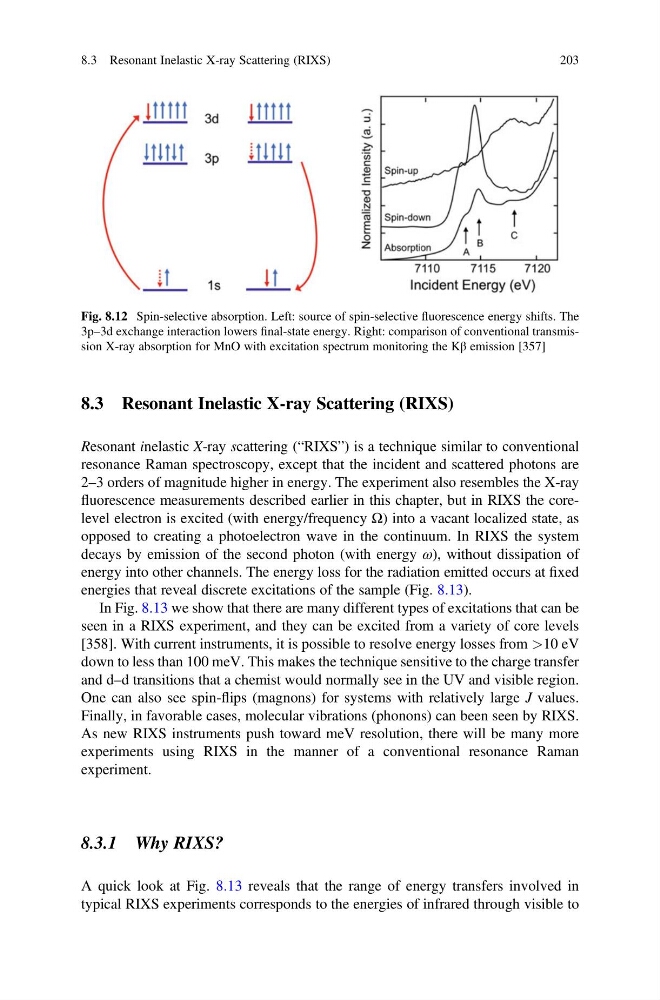
Fig. 8.12 Spin-selective absorption. Left: source of spin-selective fluorescence energy shifts. The
3p–3d exchange interaction lowers final-state energy. Right: comparison of conventional transmission X-ray absorption for MnO with excitation spectrum monitoring the Kβ emission [357]
8.3 Resonant Inelastic X-ray Scattering (RIXS)
203
Resonant inelastic X-ray scattering (“RIXS”) is a technique similar to conventional
resonance Raman spectroscopy, except that the incident and scattered photons are
2–3 orders of magnitude higher in energy. The experiment also resembles the X-ray
fluorescence measurements described earlier in this chapter, but in RIXS the corelevel electron is excited (with energy/frequency Ω) into a vacant localized state, as
opposed to creating a photoelectron wave in the continuum. In RIXS the system
decays by emission of the second photon (with energy ω), without dissipation of
energy into other channels. The energy loss for the radiation emitted occurs at fixed
energies that reveal discrete excitations of the sample (Fig. 8.13).
In Fig. 8.13 we show that there are many different types of excitations that can be
seen in a RIXS experiment, and they can be excited from a variety of core levels
[358]. With current instruments, it is possible to resolve energy losses from >10 eV
down to less than 100 meV. This makes the technique sensitive to the charge transfer
and d–d transitions that a chemist would normally see in the UV and visible region.
One can also see spin-flips (magnons) for systems with relatively large J values.
Finally, in favorable cases, molecular vibrations (phonons) can been seen by RIXS.
As new RIXS instruments push toward meV resolution, there will be many more
experiments using RIXS in the manner of a conventional resonance Raman
experiment.
8.3.1 Why RIXS?
A quick look at Fig. 8.13 reveals that the range of energy transfers involved in
typical RIXS experiments corresponds to the energies of infrared through visible to
Fig. 8.12 Spin-selective absorption. Left: source of spin-selective fluorescence energy shifts. The
3p–3d exchange interaction lowers final-state energy. Right: comparison of conventional transmission X-ray absorption for MnO with excitation spectrum monitoring the Kβ emission [357]
8.3 Resonant Inelastic X-ray Scattering (RIXS)
203