

1.3 Brightness: A Figure of Merit
Just like people, some light sources are dim, and some are bright. We all have an
intuitive sense of brightness. A computer projector emits more photons than an
argon laser, yet while lasers require special eye protection and safety classes, we
don’t have to be certified to show powerpoint presentations (at least not yet). An
electrical space heater emits more power than many beamlines, but a space heater
cannot drill though metal as can happen with a focused synchrotron beam.
Brightness is associated with the effectiveness and usability of the radiation and it
is a figure of merit commonly used to compare X-ray sources. In X-ray optics, it has
a formal definition—the brightness ℬ is the flux ℱ in photons per unit time per unit
solid angle per unit area of source (Fig. 1.3):
ℬ ¼
d
4
ℱ
dθdψdxdy
ffi
ℱ photons s
À1
½
ΔΩ mrad
2
Â
Ã
ΔA mm 2
½
ð1:1Þ
For most applications, one cares about the number of photons in a particular
energy range, so an even more important quantity is the “spectral brightness” ℬ s
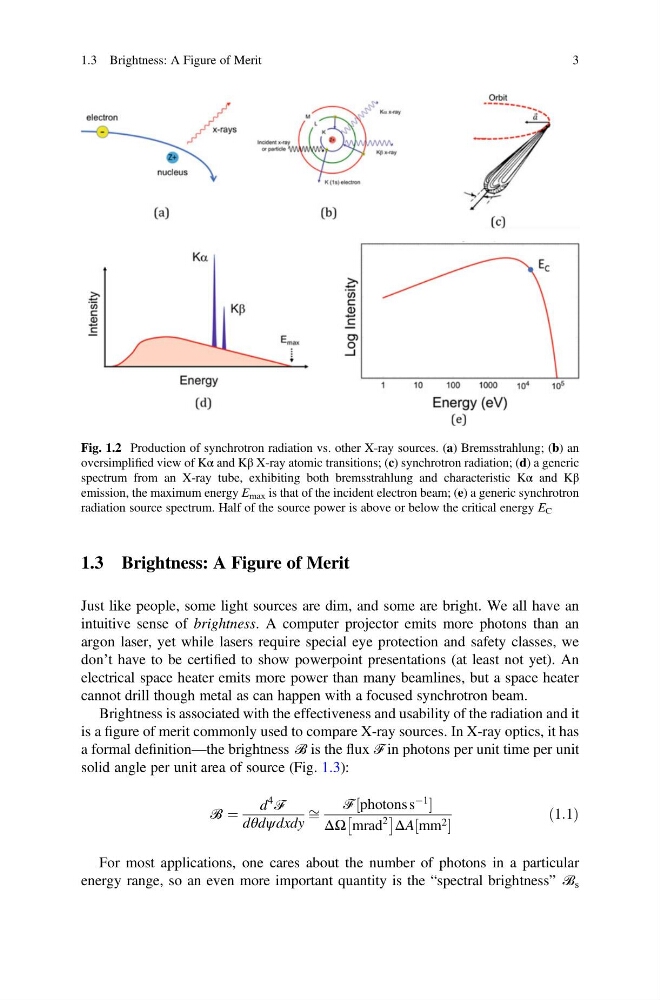
Fig. 1.2 Production of synchrotron radiation vs. other X-ray sources. (a) Bremsstrahlung; (b) an
oversimplified view of Kα and Kβ X-ray atomic transitions; (c) synchrotron radiation; (d) a generic
spectrum from an X-ray tube, exhibiting both bremsstrahlung and characteristic Kα and Kβ
emission, the maximum energy E max is that of the incident electron beam; (e) a generic synchrotron
radiation source spectrum. Half of the source power is above or below the critical energy E C
1.3 Brightness: A Figure of Merit
3
Just like people, some light sources are dim, and some are bright. We all have an
intuitive sense of brightness. A computer projector emits more photons than an
argon laser, yet while lasers require special eye protection and safety classes, we
don’t have to be certified to show powerpoint presentations (at least not yet). An
electrical space heater emits more power than many beamlines, but a space heater
cannot drill though metal as can happen with a focused synchrotron beam.
Brightness is associated with the effectiveness and usability of the radiation and it
is a figure of merit commonly used to compare X-ray sources. In X-ray optics, it has
a formal definition—the brightness ℬ is the flux ℱ in photons per unit time per unit
solid angle per unit area of source (Fig. 1.3):
ℬ ¼
d
4
ℱ
dθdψdxdy
ffi
ℱ photons s
À1
½
ΔΩ mrad
2
Â
Ã
ΔA mm 2
½
ð1:1Þ
For most applications, one cares about the number of photons in a particular
energy range, so an even more important quantity is the “spectral brightness” ℬ s
Fig. 1.2 Production of synchrotron radiation vs. other X-ray sources. (a) Bremsstrahlung; (b) an
oversimplified view of Kα and Kβ X-ray atomic transitions; (c) synchrotron radiation; (d) a generic
spectrum from an X-ray tube, exhibiting both bremsstrahlung and characteristic Kα and Kβ
emission, the maximum energy E max is that of the incident electron beam; (e) a generic synchrotron
radiation source spectrum. Half of the source power is above or below the critical energy E C
1.3 Brightness: A Figure of Merit
3