

(Eq. 1.2). It is usually clear from the context whether the quantity referred to is
brightness or spectral brightness, so we will drop the subscript unless it is needed for
clarity. In practical units, X-ray spectral brightness is usually reported as:
ℬ s ¼
photons s
À1
mm 2
ð
Þ mrad
2
À
Á
0:1%ΔE=E
ð
Þ
ð1:2Þ
1.3.1 Spectral Brightness of a Blackbody Source
Why not just use a very hot lamp as our X-ray source? To make such a comparison,
we use a formula derived by Attwood for the brightness of a blackbody:
ℬ s ¼ 3:146 Â 10
11
Â
kT
eV
3
Â
ħω=kT
ð
Þ
3
exp ħω=kT
ð
ÞÀ1
Â
photons=s
mm 2 Â mrad
2
 0:1%ΔE=E
ð
Þ
ð1:3Þ
If we plug in the temperature for the surface of our sun, 5778 K, this corresponds
to ~0.498 eV (see Appendix A for conversion factors), and we find that the
maximum brightness is at 1.4 eV (or 8860 Å) with a value of ~4 Â 10
10 photons s
À1 mrad
À2 mm
À2 /(0.1%ΔE/E). In the X-ray range, a synchrotron will have a
spectral brightness more than ten orders of magnitude higher! Despite the fact that
the sun puts out a prodigious amount of energy, it is not a very “bright” source.
Brightness and spectral brightness are useful terms for comparing sources
because they are not changed by ideal optical elements such as lenses and mirrors.
(The inevitable losses in real optical elements can only diminish brightness.) Once
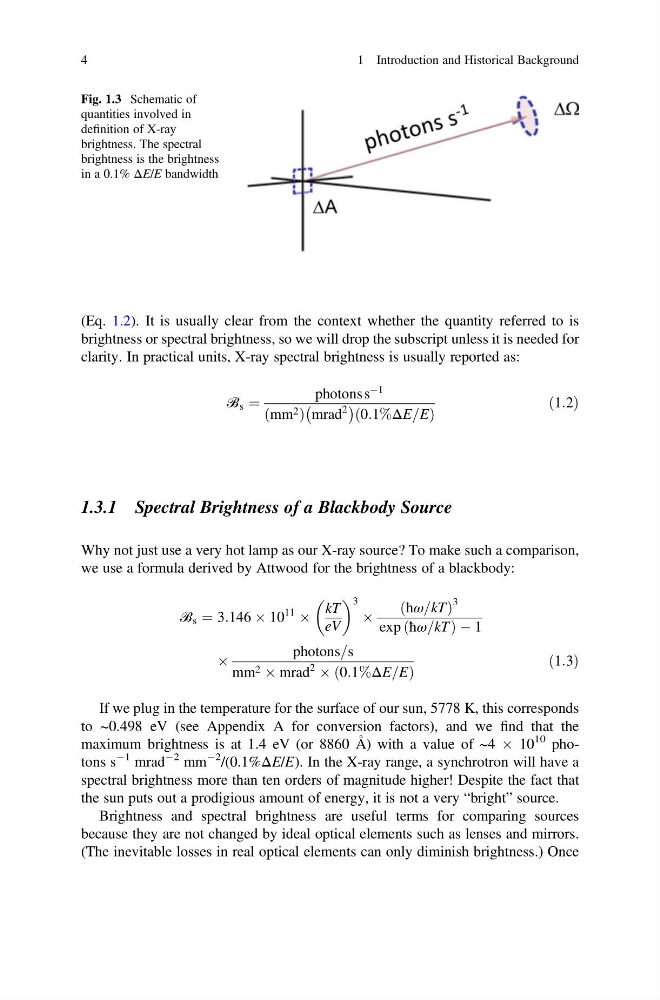
Fig. 1.3 Schematic of
quantities involved in
definition of X-ray
brightness. The spectral
brightness is the brightness
in a 0.1% ΔE/E bandwidth
4
1 Introduction and Historical Background
brightness or spectral brightness, so we will drop the subscript unless it is needed for
clarity. In practical units, X-ray spectral brightness is usually reported as:
ℬ s ¼
photons s
À1
mm 2
ð
Þ mrad
2
À
Á
0:1%ΔE=E
ð
Þ
ð1:2Þ
1.3.1 Spectral Brightness of a Blackbody Source
Why not just use a very hot lamp as our X-ray source? To make such a comparison,
we use a formula derived by Attwood for the brightness of a blackbody:
ℬ s ¼ 3:146 Â 10
11
Â
kT
eV
3
Â
ħω=kT
ð
Þ
3
exp ħω=kT
ð
ÞÀ1
Â
photons=s
mm 2 Â mrad
2
 0:1%ΔE=E
ð
Þ
ð1:3Þ
If we plug in the temperature for the surface of our sun, 5778 K, this corresponds
to ~0.498 eV (see Appendix A for conversion factors), and we find that the
maximum brightness is at 1.4 eV (or 8860 Å) with a value of ~4 Â 10
10 photons s
À1 mrad
À2 mm
À2 /(0.1%ΔE/E). In the X-ray range, a synchrotron will have a
spectral brightness more than ten orders of magnitude higher! Despite the fact that
the sun puts out a prodigious amount of energy, it is not a very “bright” source.
Brightness and spectral brightness are useful terms for comparing sources
because they are not changed by ideal optical elements such as lenses and mirrors.
(The inevitable losses in real optical elements can only diminish brightness.) Once
Fig. 1.3 Schematic of
quantities involved in
definition of X-ray
brightness. The spectral
brightness is the brightness
in a 0.1% ΔE/E bandwidth
4
1 Introduction and Historical Background