

HERXRF has also seen applications in bioinorganic chemistry. The Kβ spectrum
has been used to monitor the oxidation states of Mn in photosystem II (PSII)
[349, 350], while the valence ! core region was used to identify oxygen ligation
in PSII [351] and a carbide ligand for the FeMo cofactor in nitrogenase [352].
8.2.10.2 HERFD: Resolution Sharpening
One limitation of conventional XANES spectroscopy is that absorption edges are
significantly broadened by the core-hole lifetime. Hämäläinen and coworkers
showed that this broadening could be overcome by measuring both the exciting
and emitted radiation with high resolution [353], and in one analysis the new
resolution Γ exp is reduced according to the expression below, where Γ n is the
intermediate-state lifetime (Γ n ) and Γ f is the final-state lifetime [354]:
Γ exp ffi
1
ffiffiffiffiffiffiffiffiffiffiffiffiffiffiffiffiffiffiffiffiffiffiffiffiffiffiffiffiffiffiffiffiffiffiffiffi
1=Γ n
ð
Þ
2 þ 1=Γ f
ð
Þ
2
q
ð8:3Þ
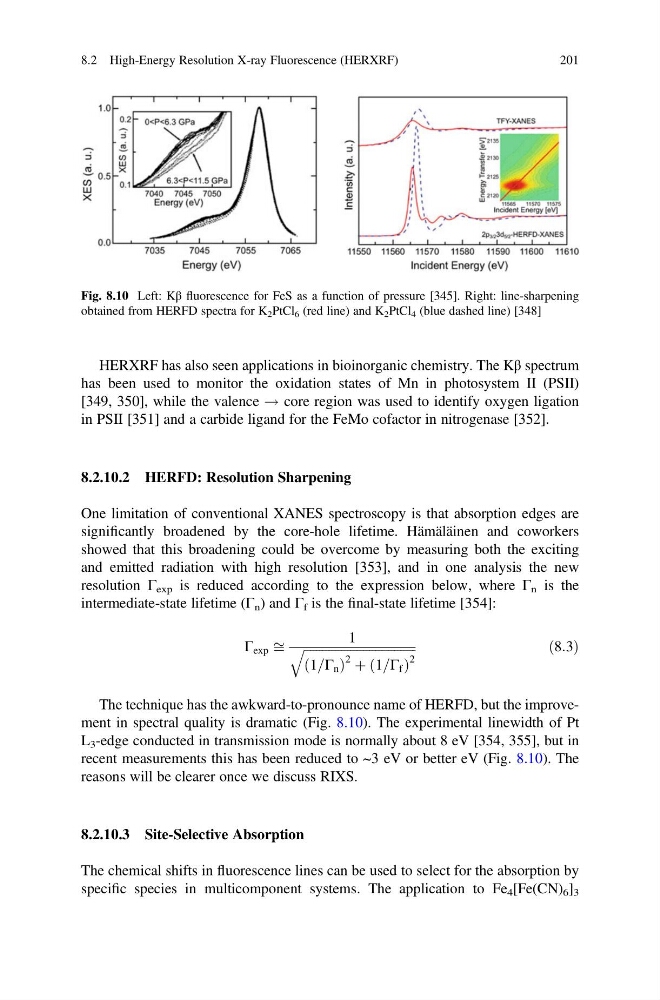
The technique has the awkward-to-pronounce name of HERFD, but the improvement in spectral quality is dramatic (Fig. 8.10). The experimental linewidth of Pt
L 3 -edge conducted in transmission mode is normally about 8 eV [354, 355], but in
recent measurements this has been reduced to ~3 eV or better eV (Fig. 8.10). The
reasons will be clearer once we discuss RIXS.
8.2.10.3 Site-Selective Absorption
The chemical shifts in fluorescence lines can be used to select for the absorption by
specific species in multicomponent systems. The application to Fe 4 [Fe(CN) 6 ] 3
Fig. 8.10 Left: Kβ fluorescence for FeS as a function of pressure [345]. Right: line-sharpening
obtained from HERFD spectra for K 2 PtCl 6 (red line) and K 2 PtCl 4 (blue dashed line) [348]
8.2 High-Energy Resolution X-ray Fluorescence (HERXRF)
201
has been used to monitor the oxidation states of Mn in photosystem II (PSII)
[349, 350], while the valence ! core region was used to identify oxygen ligation
in PSII [351] and a carbide ligand for the FeMo cofactor in nitrogenase [352].
8.2.10.2 HERFD: Resolution Sharpening
One limitation of conventional XANES spectroscopy is that absorption edges are
significantly broadened by the core-hole lifetime. Hämäläinen and coworkers
showed that this broadening could be overcome by measuring both the exciting
and emitted radiation with high resolution [353], and in one analysis the new
resolution Γ exp is reduced according to the expression below, where Γ n is the
intermediate-state lifetime (Γ n ) and Γ f is the final-state lifetime [354]:
Γ exp ffi
1
ffiffiffiffiffiffiffiffiffiffiffiffiffiffiffiffiffiffiffiffiffiffiffiffiffiffiffiffiffiffiffiffiffiffiffiffi
1=Γ n
ð
Þ
2 þ 1=Γ f
ð
Þ
2
q
ð8:3Þ
The technique has the awkward-to-pronounce name of HERFD, but the improvement in spectral quality is dramatic (Fig. 8.10). The experimental linewidth of Pt
L 3 -edge conducted in transmission mode is normally about 8 eV [354, 355], but in
recent measurements this has been reduced to ~3 eV or better eV (Fig. 8.10). The
reasons will be clearer once we discuss RIXS.
8.2.10.3 Site-Selective Absorption
The chemical shifts in fluorescence lines can be used to select for the absorption by
specific species in multicomponent systems. The application to Fe 4 [Fe(CN) 6 ] 3
Fig. 8.10 Left: Kβ fluorescence for FeS as a function of pressure [345]. Right: line-sharpening
obtained from HERFD spectra for K 2 PtCl 6 (red line) and K 2 PtCl 4 (blue dashed line) [348]
8.2 High-Energy Resolution X-ray Fluorescence (HERXRF)
201