

8.2.8 Multi-electron Excitations
So far we have assumed that core-hole creation results in one-electron excitations.
However, a fraction of absorption events results in excitation of a second electron.
These are usually valence electrons, and the loss of EXAFS intensity from multielectron excitations was discussed in Chap. 6. In a more extreme case, a second core
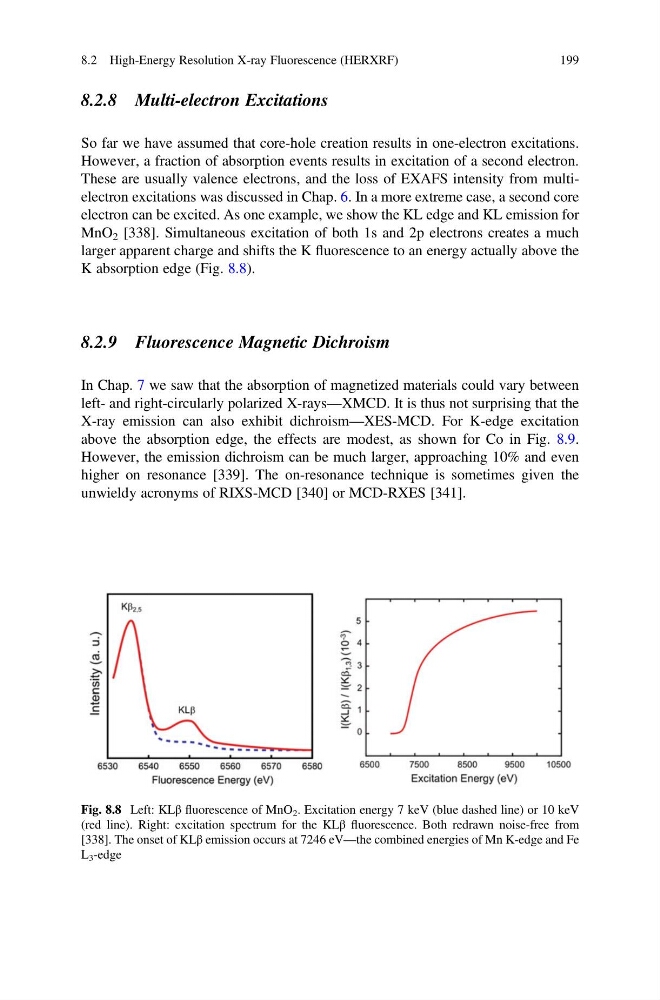
electron can be excited. As one example, we show the KL edge and KL emission for
MnO 2 [338]. Simultaneous excitation of both 1s and 2p electrons creates a much
larger apparent charge and shifts the K fluorescence to an energy actually above the
K absorption edge (Fig. 8.8).
8.2.9 Fluorescence Magnetic Dichroism
In Chap. 7 we saw that the absorption of magnetized materials could vary between
left- and right-circularly polarized X-rays—XMCD. It is thus not surprising that the
X-ray emission can also exhibit dichroism—XES-MCD. For K-edge excitation
above the absorption edge, the effects are modest, as shown for Co in Fig. 8.9.
However, the emission dichroism can be much larger, approaching 10% and even
higher on resonance [339]. The on-resonance technique is sometimes given the
unwieldy acronyms of RIXS-MCD [340] or MCD-RXES [341].
Fig. 8.8 Left: KLβ fluorescence of MnO 2 . Excitation energy 7 keV (blue dashed line) or 10 keV
(red line). Right: excitation spectrum for the KLβ fluorescence. Both redrawn noise-free from
[338]. The onset of KLβ emission occurs at 7246 eV—the combined energies of Mn K-edge and Fe
L 3 -edge
8.2 High-Energy Resolution X-ray Fluorescence (HERXRF)
199
So far we have assumed that core-hole creation results in one-electron excitations.
However, a fraction of absorption events results in excitation of a second electron.
These are usually valence electrons, and the loss of EXAFS intensity from multielectron excitations was discussed in Chap. 6. In a more extreme case, a second core
electron can be excited. As one example, we show the KL edge and KL emission for
MnO 2 [338]. Simultaneous excitation of both 1s and 2p electrons creates a much
larger apparent charge and shifts the K fluorescence to an energy actually above the
K absorption edge (Fig. 8.8).
8.2.9 Fluorescence Magnetic Dichroism
In Chap. 7 we saw that the absorption of magnetized materials could vary between
left- and right-circularly polarized X-rays—XMCD. It is thus not surprising that the
X-ray emission can also exhibit dichroism—XES-MCD. For K-edge excitation
above the absorption edge, the effects are modest, as shown for Co in Fig. 8.9.
However, the emission dichroism can be much larger, approaching 10% and even
higher on resonance [339]. The on-resonance technique is sometimes given the
unwieldy acronyms of RIXS-MCD [340] or MCD-RXES [341].
Fig. 8.8 Left: KLβ fluorescence of MnO 2 . Excitation energy 7 keV (blue dashed line) or 10 keV
(red line). Right: excitation spectrum for the KLβ fluorescence. Both redrawn noise-free from
[338]. The onset of KLβ emission occurs at 7246 eV—the combined energies of Mn K-edge and Fe
L 3 -edge
8.2 High-Energy Resolution X-ray Fluorescence (HERXRF)
199