

character, but mixed with a small amount of metal 4p character. These give rise to
weak transitions very close to the absorption edge energy. They are sometimes
clumsily labeled Kβ 2,5 features, but in most cases, they are better described as
valence ! core transitions.
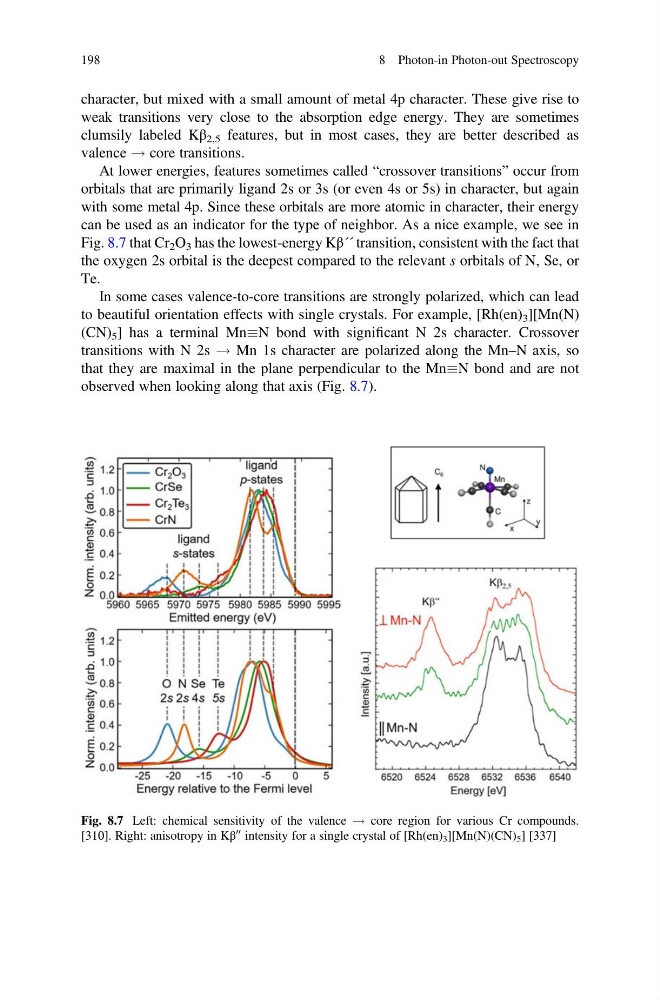
At lower energies, features sometimes called “crossover transitions” occur from
orbitals that are primarily ligand 2s or 3s (or even 4s or 5s) in character, but again
with some metal 4p. Since these orbitals are more atomic in character, their energy
can be used as an indicator for the type of neighbor. As a nice example, we see in
Fig. 8.7 that Cr 2 O 3 has the lowest-energy Kβ´´ transition, consistent with the fact that
the oxygen 2s orbital is the deepest compared to the relevant s orbitals of N, Se, or
Te.
In some cases valence-to-core transitions are strongly polarized, which can lead
to beautiful orientation effects with single crystals. For example, [Rh(en) 3 ][Mn(N)
(CN) 5 ] has a terminal MnN bond with significant N 2s character. Crossover
transitions with N 2s ! Mn 1s character are polarized along the Mn–N axis, so
that they are maximal in the plane perpendicular to the MnN bond and are not
observed when looking along that axis (Fig. 8.7).
Fig. 8.7 Left: chemical sensitivity of the valence ! core region for various Cr compounds.
[310]. Right: anisotropy in Kβ
00 intensity for a single crystal of [Rh(en) 3 ][Mn(N)(CN) 5 ] [337]
198
8 Photon-in Photon-out Spectroscopy
weak transitions very close to the absorption edge energy. They are sometimes
clumsily labeled Kβ 2,5 features, but in most cases, they are better described as
valence ! core transitions.
At lower energies, features sometimes called “crossover transitions” occur from
orbitals that are primarily ligand 2s or 3s (or even 4s or 5s) in character, but again
with some metal 4p. Since these orbitals are more atomic in character, their energy
can be used as an indicator for the type of neighbor. As a nice example, we see in
Fig. 8.7 that Cr 2 O 3 has the lowest-energy Kβ´´ transition, consistent with the fact that
the oxygen 2s orbital is the deepest compared to the relevant s orbitals of N, Se, or
Te.
In some cases valence-to-core transitions are strongly polarized, which can lead
to beautiful orientation effects with single crystals. For example, [Rh(en) 3 ][Mn(N)
(CN) 5 ] has a terminal MnN bond with significant N 2s character. Crossover
transitions with N 2s ! Mn 1s character are polarized along the Mn–N axis, so
that they are maximal in the plane perpendicular to the MnN bond and are not
observed when looking along that axis (Fig. 8.7).
Fig. 8.7 Left: chemical sensitivity of the valence ! core region for various Cr compounds.
[310]. Right: anisotropy in Kβ
00 intensity for a single crystal of [Rh(en) 3 ][Mn(N)(CN) 5 ] [337]
198
8 Photon-in Photon-out Spectroscopy