

8.2.6 Configuration Interaction
Another source of fluorescence fine structure is “configuration interaction.” For the
Mn systems discussed above, we ignored the effects of the core hole on the energy
ordering of the valence-electron configurations. However, as one moves to the right
in the periodic table, or as the bonding becomes more covalent, situations arise
where the ordering of the configurations changes. This is because the 3d electrons
are pulled down more by the new potential than are the 4s and 4p electrons (or the
ligand electrons). Thus, the intermediate-state configurations will be different from
the ground-state configurations.
For the case of Ni(II), it turns out that three configurations have to be considered:
1s
1 3d
8
þ 1s
1 3d
9 L þ 1s
1 3d
10 L L
0
! 3p
5 3d
8
þ 3p
5 3d
9 L þ 3p
5 3d
10 L L
0
ð8:2Þ
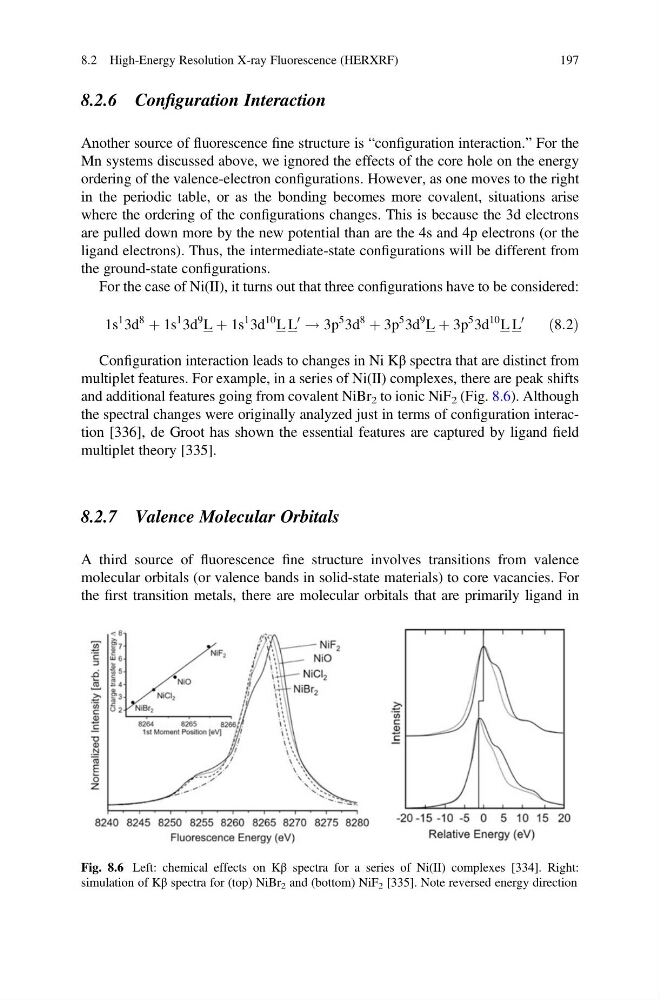
Configuration interaction leads to changes in Ni Kβ spectra that are distinct from
multiplet features. For example, in a series of Ni(II) complexes, there are peak shifts
and additional features going from covalent NiBr 2 to ionic NiF 2 (Fig. 8.6). Although
the spectral changes were originally analyzed just in terms of configuration interaction [336], de Groot has shown the essential features are captured by ligand field
multiplet theory [335].
8.2.7 Valence Molecular Orbitals
A third source of fluorescence fine structure involves transitions from valence
molecular orbitals (or valence bands in solid-state materials) to core vacancies. For
the first transition metals, there are molecular orbitals that are primarily ligand in
Fig. 8.6 Left: chemical effects on Kβ spectra for a series of Ni(II) complexes [334]. Right:
simulation of Kβ spectra for (top) NiBr 2 and (bottom) NiF 2 [335]. Note reversed energy direction
8.2 High-Energy Resolution X-ray Fluorescence (HERXRF)
197
Another source of fluorescence fine structure is “configuration interaction.” For the
Mn systems discussed above, we ignored the effects of the core hole on the energy
ordering of the valence-electron configurations. However, as one moves to the right
in the periodic table, or as the bonding becomes more covalent, situations arise
where the ordering of the configurations changes. This is because the 3d electrons
are pulled down more by the new potential than are the 4s and 4p electrons (or the
ligand electrons). Thus, the intermediate-state configurations will be different from
the ground-state configurations.
For the case of Ni(II), it turns out that three configurations have to be considered:
1s
1 3d
8
þ 1s
1 3d
9 L þ 1s
1 3d
10 L L
0
! 3p
5 3d
8
þ 3p
5 3d
9 L þ 3p
5 3d
10 L L
0
ð8:2Þ
Configuration interaction leads to changes in Ni Kβ spectra that are distinct from
multiplet features. For example, in a series of Ni(II) complexes, there are peak shifts
and additional features going from covalent NiBr 2 to ionic NiF 2 (Fig. 8.6). Although
the spectral changes were originally analyzed just in terms of configuration interaction [336], de Groot has shown the essential features are captured by ligand field
multiplet theory [335].
8.2.7 Valence Molecular Orbitals
A third source of fluorescence fine structure involves transitions from valence
molecular orbitals (or valence bands in solid-state materials) to core vacancies. For
the first transition metals, there are molecular orbitals that are primarily ligand in
Fig. 8.6 Left: chemical effects on Kβ spectra for a series of Ni(II) complexes [334]. Right:
simulation of Kβ spectra for (top) NiBr 2 and (bottom) NiF 2 [335]. Note reversed energy direction
8.2 High-Energy Resolution X-ray Fluorescence (HERXRF)
197