

Stöhr and König have argued that hT z i angular averages to zero when combining 3
orthogonal dichroism measurements [318], so the last term in Eq. 7.8 can often be
omitted. The quantities involved in sum rule analysis are illustrated graphically in
Fig. 7.17.
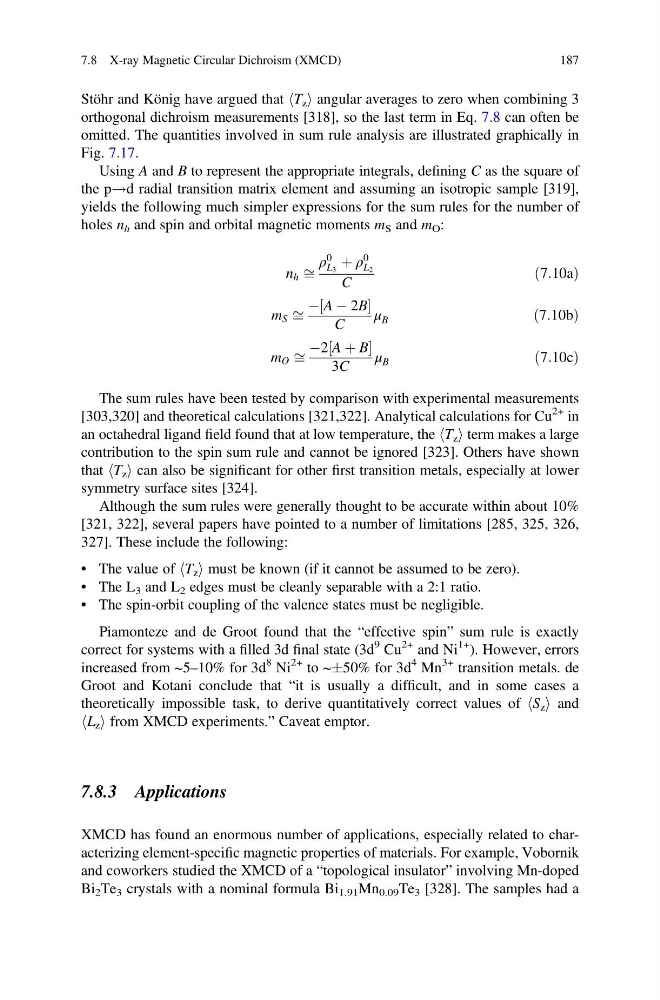
Using A and B to represent the appropriate integrals, defining C as the square of
the p!d radial transition matrix element and assuming an isotropic sample [319],
yields the following much simpler expressions for the sum rules for the number of
holes n h and spin and orbital magnetic moments m S and m O :
n h ffi
ρ
0
L 3
þ ρ
0
L 2
C
ð7:10aÞ
m S ffi
À A À 2B
½
C
μ B
ð7:10bÞ
m O ffi
À2 A þ B
½
3C
μ B
ð7:10cÞ
The sum rules have been tested by comparison with experimental measurements
[303,320] and theoretical calculations [321,322]. Analytical calculations for Cu
2+ in
an octahedral ligand field found that at low temperature, the hT z i term makes a large
contribution to the spin sum rule and cannot be ignored [323]. Others have shown
that hT z i can also be significant for other first transition metals, especially at lower
symmetry surface sites [324].
Although the sum rules were generally thought to be accurate within about 10%
[321, 322], several papers have pointed to a number of limitations [285, 325, 326,
327]. These include the following:
• The value of hT z i must be known (if it cannot be assumed to be zero).
• The L 3 and L 2 edges must be cleanly separable with a 2:1 ratio.
• The spin-orbit coupling of the valence states must be negligible.
Piamonteze and de Groot found that the “effective spin” sum rule is exactly
correct for systems with a filled 3d final state (3d
9 Cu
2+ and Ni
1+ ). However, errors
increased from ~5–10% for 3d
8 Ni
2+ to ~Æ50% for 3d
4 Mn
3+ transition metals. de
Groot and Kotani conclude that “it is usually a difficult, and in some cases a
theoretically impossible task, to derive quantitatively correct values of hS z i and
hL z i from XMCD experiments.” Caveat emptor.
7.8.3 Applications
XMCD has found an enormous number of applications, especially related to characterizing element-specific magnetic properties of materials. For example, Vobornik
and coworkers studied the XMCD of a “topological insulator” involving Mn-doped
Bi 2 Te 3 crystals with a nominal formula Bi 1.91 Mn 0.09 Te 3 [328]. The samples had a
7.8 X-ray Magnetic Circular Dichroism (XMCD)
187
orthogonal dichroism measurements [318], so the last term in Eq. 7.8 can often be
omitted. The quantities involved in sum rule analysis are illustrated graphically in
Fig. 7.17.
Using A and B to represent the appropriate integrals, defining C as the square of
the p!d radial transition matrix element and assuming an isotropic sample [319],
yields the following much simpler expressions for the sum rules for the number of
holes n h and spin and orbital magnetic moments m S and m O :
n h ffi
ρ
0
L 3
þ ρ
0
L 2
C
ð7:10aÞ
m S ffi
À A À 2B
½
C
μ B
ð7:10bÞ
m O ffi
À2 A þ B
½
3C
μ B
ð7:10cÞ
The sum rules have been tested by comparison with experimental measurements
[303,320] and theoretical calculations [321,322]. Analytical calculations for Cu
2+ in
an octahedral ligand field found that at low temperature, the hT z i term makes a large
contribution to the spin sum rule and cannot be ignored [323]. Others have shown
that hT z i can also be significant for other first transition metals, especially at lower
symmetry surface sites [324].
Although the sum rules were generally thought to be accurate within about 10%
[321, 322], several papers have pointed to a number of limitations [285, 325, 326,
327]. These include the following:
• The value of hT z i must be known (if it cannot be assumed to be zero).
• The L 3 and L 2 edges must be cleanly separable with a 2:1 ratio.
• The spin-orbit coupling of the valence states must be negligible.
Piamonteze and de Groot found that the “effective spin” sum rule is exactly
correct for systems with a filled 3d final state (3d
9 Cu
2+ and Ni
1+ ). However, errors
increased from ~5–10% for 3d
8 Ni
2+ to ~Æ50% for 3d
4 Mn
3+ transition metals. de
Groot and Kotani conclude that “it is usually a difficult, and in some cases a
theoretically impossible task, to derive quantitatively correct values of hS z i and
hL z i from XMCD experiments.” Caveat emptor.
7.8.3 Applications
XMCD has found an enormous number of applications, especially related to characterizing element-specific magnetic properties of materials. For example, Vobornik
and coworkers studied the XMCD of a “topological insulator” involving Mn-doped
Bi 2 Te 3 crystals with a nominal formula Bi 1.91 Mn 0.09 Te 3 [328]. The samples had a
7.8 X-ray Magnetic Circular Dichroism (XMCD)
187