

systems with a range of crystal field and spin-orbital coupling strengths [227,317], so
for many systems, one can check beforehand to see if XMCD will be useful.
7.8.2.3 Sum Rule Analysis
Sum rules are equations based on integrated spectra, and they allow derivation of
valuable information without resort to simulation or fitting techniques. For example,
most chemists are familiar with the Kuhn-Thomas sum rule, which states that the
sum of oscillator strengths for transitions from the ground state to the kth excited
state f 0k is equal to the number of electrons N e [229].
The first X-ray sum rule was mentioned earlier—the integrated intensity over
particular absorption edges reflects the number of empty states with the appropriate
symmetry for the transition [299, 300]. For XMCD, there are two new sum rules
involving projections of the spin hS z i and orbital hL z i angular momentum of the
absorbing species.
As one example, using the nomenclature of van der Laan (see ref. 8 at end of
chapter), the “spin sum rule” for L 2,3 -edges of d-metals can be written as:
ρ
1
L 3
À 2ρ
1
L 2
ρ
0
L 3
þ ρ
0
L 2
¼
2
3
S Z
h i
n h
þ
7
3
T Z
h i
n h
ð7:8Þ
and the “orbital angular momentum sum rule” can be written as:
ρ
1
L 3
þ ρ
1
L 2
ρ
0
L 3
þ ρ
0
L 2
¼
1
2
L Z
h i
n h
ð7:9Þ
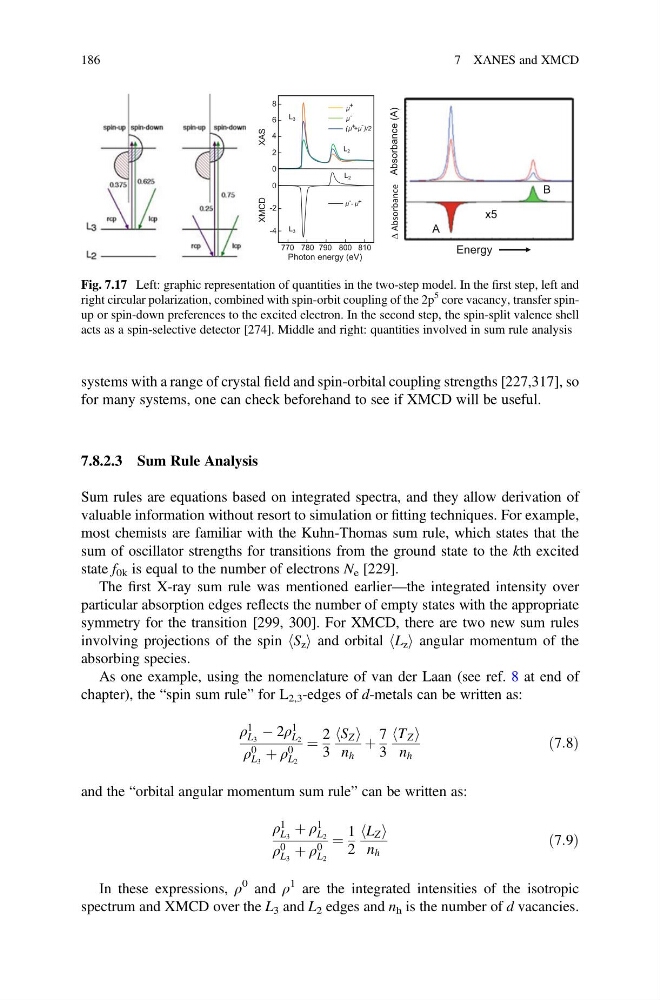
In these expressions, ρ
0 and ρ
1 are the integrated intensities of the isotropic
spectrum and XMCD over the L 3 and L 2 edges and n h is the number of d vacancies.
770 780 790 800 810
Photon energy (eV)
XMCD
XAS
-4
-2
0
0
2
4
6
8
µ +
µ -
( µ +µ )/2
+ -
L2
L2
L3
L3
A
B
+
-
µ - µ
Absorbance (A)
∆
Absorbance
B
A
x5
Energy
Fig. 7.17 Left: graphic representation of quantities in the two-step model. In the first step, left and
right circular polarization, combined with spin-orbit coupling of the 2p
5 core vacancy, transfer spinup or spin-down preferences to the excited electron. In the second step, the spin-split valence shell
acts as a spin-selective detector [274]. Middle and right: quantities involved in sum rule analysis
186
7 XANES and XMCD
for many systems, one can check beforehand to see if XMCD will be useful.
7.8.2.3 Sum Rule Analysis
Sum rules are equations based on integrated spectra, and they allow derivation of
valuable information without resort to simulation or fitting techniques. For example,
most chemists are familiar with the Kuhn-Thomas sum rule, which states that the
sum of oscillator strengths for transitions from the ground state to the kth excited
state f 0k is equal to the number of electrons N e [229].
The first X-ray sum rule was mentioned earlier—the integrated intensity over
particular absorption edges reflects the number of empty states with the appropriate
symmetry for the transition [299, 300]. For XMCD, there are two new sum rules
involving projections of the spin hS z i and orbital hL z i angular momentum of the
absorbing species.
As one example, using the nomenclature of van der Laan (see ref. 8 at end of
chapter), the “spin sum rule” for L 2,3 -edges of d-metals can be written as:
ρ
1
L 3
À 2ρ
1
L 2
ρ
0
L 3
þ ρ
0
L 2
¼
2
3
S Z
h i
n h
þ
7
3
T Z
h i
n h
ð7:8Þ
and the “orbital angular momentum sum rule” can be written as:
ρ
1
L 3
þ ρ
1
L 2
ρ
0
L 3
þ ρ
0
L 2
¼
1
2
L Z
h i
n h
ð7:9Þ
In these expressions, ρ
0 and ρ
1 are the integrated intensities of the isotropic
spectrum and XMCD over the L 3 and L 2 edges and n h is the number of d vacancies.
770 780 790 800 810
Photon energy (eV)
XMCD
XAS
-4
-2
0
0
2
4
6
8
µ +
µ -
( µ +µ )/2
+ -
L2
L2
L3
L3
A
B
+
-
µ - µ
Absorbance (A)
∆
Absorbance
B
A
x5
Energy
Fig. 7.17 Left: graphic representation of quantities in the two-step model. In the first step, left and
right circular polarization, combined with spin-orbit coupling of the 2p
5 core vacancy, transfer spinup or spin-down preferences to the excited electron. In the second step, the spin-split valence shell
acts as a spin-selective detector [274]. Middle and right: quantities involved in sum rule analysis
186
7 XANES and XMCD