

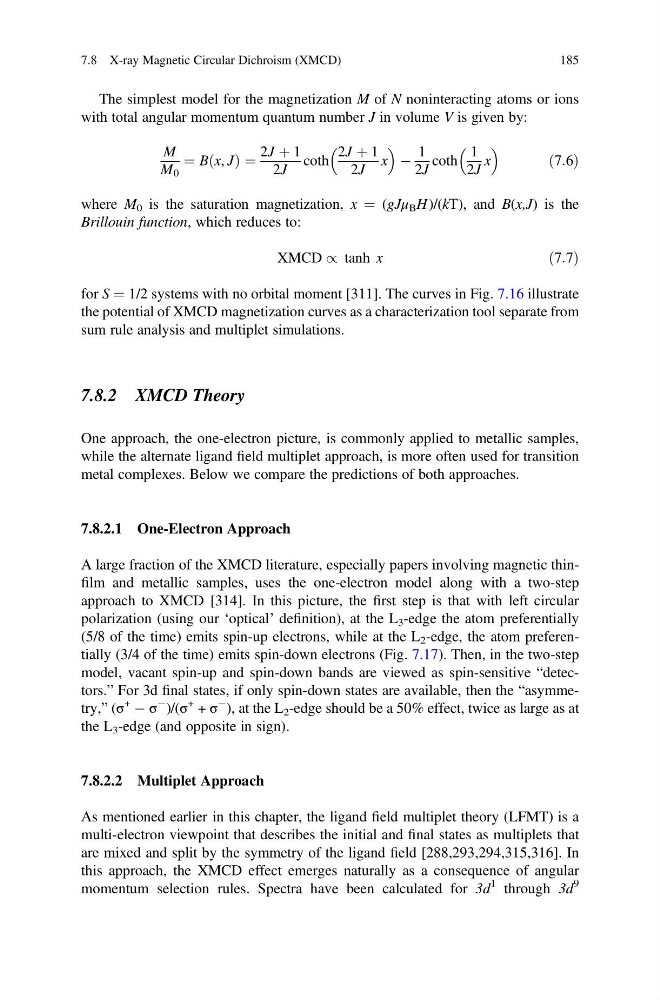
The simplest model for the magnetization M of N noninteracting atoms or ions
with total angular momentum quantum number J in volume V is given by:
M
M 0
¼ B x, J
ð Þ ¼
2J þ 1
2J
coth
2J þ 1
2J
x
À
1
2J
coth
1
2J
x
ð7:6Þ
where M 0 is the saturation magnetization, x ¼ (gJμ B H )/(kT), and B(x,J) is the
Brillouin function, which reduces to:
XMCD / tanh x
ð7:7Þ
for S ¼ 1/2 systems with no orbital moment [311]. The curves in Fig. 7.16 illustrate
the potential of XMCD magnetization curves as a characterization tool separate from
sum rule analysis and multiplet simulations.
7.8.2 XMCD Theory
One approach, the one-electron picture, is commonly applied to metallic samples,
while the alternate ligand field multiplet approach, is more often used for transition
metal complexes. Below we compare the predictions of both approaches.
7.8.2.1 One-Electron Approach
A large fraction of the XMCD literature, especially papers involving magnetic thinfilm and metallic samples, uses the one-electron model along with a two-step
approach to XMCD [314]. In this picture, the first step is that with left circular
polarization (using our ‘optical’ definition), at the L 3 -edge the atom preferentially
(5/8 of the time) emits spin-up electrons, while at the L 2 -edge, the atom preferentially (3/4 of the time) emits spin-down electrons (Fig. 7.17). Then, in the two-step
model, vacant spin-up and spin-down bands are viewed as spin-sensitive “detectors.” For 3d final states, if only spin-down states are available, then the “asymmetry,” (σ
+ À σ
À )/(σ
+ + σ
À ), at the L 2 -edge should be a 50% effect, twice as large as at
the L 3 -edge (and opposite in sign).
7.8.2.2 Multiplet Approach
As mentioned earlier in this chapter, the ligand field multiplet theory (LFMT) is a
multi-electron viewpoint that describes the initial and final states as multiplets that
are mixed and split by the symmetry of the ligand field [288,293,294,315,316]. In
this approach, the XMCD effect emerges naturally as a consequence of angular
momentum selection rules. Spectra have been calculated for 3d
1 through 3d
9
7.8 X-ray Magnetic Circular Dichroism (XMCD)
185
with total angular momentum quantum number J in volume V is given by:
M
M 0
¼ B x, J
ð Þ ¼
2J þ 1
2J
coth
2J þ 1
2J
x
À
1
2J
coth
1
2J
x
ð7:6Þ
where M 0 is the saturation magnetization, x ¼ (gJμ B H )/(kT), and B(x,J) is the
Brillouin function, which reduces to:
XMCD / tanh x
ð7:7Þ
for S ¼ 1/2 systems with no orbital moment [311]. The curves in Fig. 7.16 illustrate
the potential of XMCD magnetization curves as a characterization tool separate from
sum rule analysis and multiplet simulations.
7.8.2 XMCD Theory
One approach, the one-electron picture, is commonly applied to metallic samples,
while the alternate ligand field multiplet approach, is more often used for transition
metal complexes. Below we compare the predictions of both approaches.
7.8.2.1 One-Electron Approach
A large fraction of the XMCD literature, especially papers involving magnetic thinfilm and metallic samples, uses the one-electron model along with a two-step
approach to XMCD [314]. In this picture, the first step is that with left circular
polarization (using our ‘optical’ definition), at the L 3 -edge the atom preferentially
(5/8 of the time) emits spin-up electrons, while at the L 2 -edge, the atom preferentially (3/4 of the time) emits spin-down electrons (Fig. 7.17). Then, in the two-step
model, vacant spin-up and spin-down bands are viewed as spin-sensitive “detectors.” For 3d final states, if only spin-down states are available, then the “asymmetry,” (σ
+ À σ
À )/(σ
+ + σ
À ), at the L 2 -edge should be a 50% effect, twice as large as at
the L 3 -edge (and opposite in sign).
7.8.2.2 Multiplet Approach
As mentioned earlier in this chapter, the ligand field multiplet theory (LFMT) is a
multi-electron viewpoint that describes the initial and final states as multiplets that
are mixed and split by the symmetry of the ligand field [288,293,294,315,316]. In
this approach, the XMCD effect emerges naturally as a consequence of angular
momentum selection rules. Spectra have been calculated for 3d
1 through 3d
9
7.8 X-ray Magnetic Circular Dichroism (XMCD)
185