

7.8.1.1 Sources of Circularly Polarized X-rays
The bend magnets of a storage ring are the simplest sources of circular polarization.
As described in Chap. 3, by viewing the electron beam off-axis, one observes a
charge accelerated in an elliptical orbit. A bend magnet beamline can thus have left
and right circular polarization by collecting radiation above and below the orbital
plane. However, circular polarization comes at the price of lower intensity, and
nowadays most soft X-ray XMCD beamlines use elliptically polarized undulators
(EPUs) as much brighter sources of variable circular polarization.
In the hard X-ray region, one problem is that crystal monochromators tend to
convert circular polarization back to linear polarization, especially when the Bragg
angle approaches 45
. For example, on ESRF beamline 12, the degree of circular
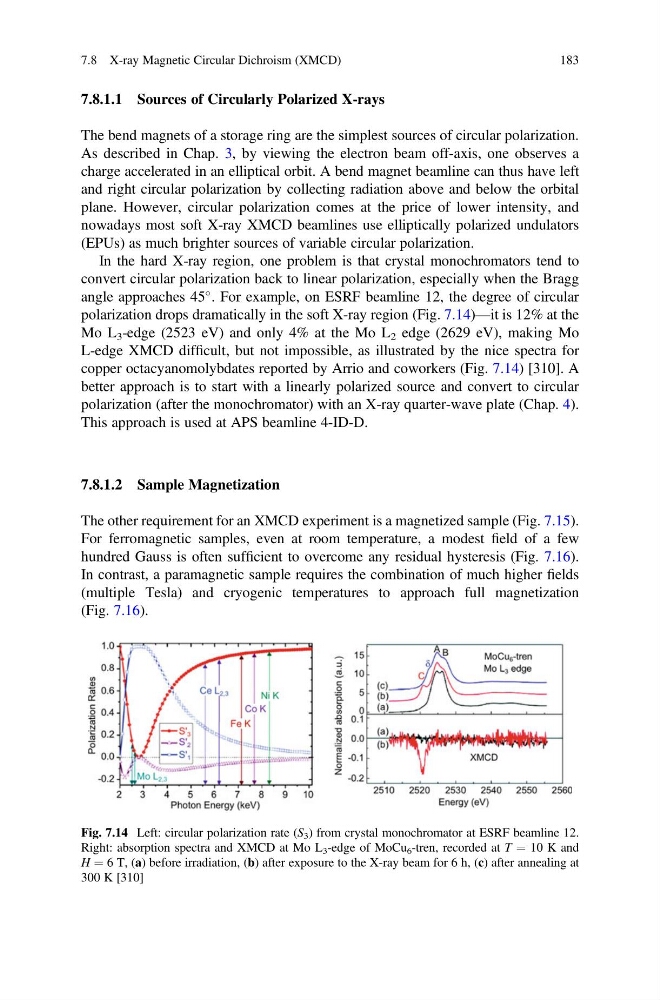
polarization drops dramatically in the soft X-ray region (Fig. 7.14)—it is 12% at the
Mo L 3 -edge (2523 eV) and only 4% at the Mo L 2 edge (2629 eV), making Mo
L-edge XMCD difficult, but not impossible, as illustrated by the nice spectra for
copper octacyanomolybdates reported by Arrio and coworkers (Fig. 7.14) [310]. A
better approach is to start with a linearly polarized source and convert to circular
polarization (after the monochromator) with an X-ray quarter-wave plate (Chap. 4).
This approach is used at APS beamline 4-ID-D.
7.8.1.2 Sample Magnetization
The other requirement for an XMCD experiment is a magnetized sample (Fig. 7.15).
For ferromagnetic samples, even at room temperature, a modest field of a few
hundred Gauss is often sufficient to overcome any residual hysteresis (Fig. 7.16).
In contrast, a paramagnetic sample requires the combination of much higher fields
(multiple Tesla) and cryogenic temperatures to approach full magnetization
(Fig. 7.16).
Fig. 7.14 Left: circular polarization rate (S 3 ) from crystal monochromator at ESRF beamline 12.
Right: absorption spectra and XMCD at Mo L 3 -edge of MoCu 6 -tren, recorded at T ¼ 10 K and
H ¼ 6 T, (a) before irradiation, (b) after exposure to the X-ray beam for 6 h, (c) after annealing at
300 K [310]
7.8 X-ray Magnetic Circular Dichroism (XMCD)
183
The bend magnets of a storage ring are the simplest sources of circular polarization.
As described in Chap. 3, by viewing the electron beam off-axis, one observes a
charge accelerated in an elliptical orbit. A bend magnet beamline can thus have left
and right circular polarization by collecting radiation above and below the orbital
plane. However, circular polarization comes at the price of lower intensity, and
nowadays most soft X-ray XMCD beamlines use elliptically polarized undulators
(EPUs) as much brighter sources of variable circular polarization.
In the hard X-ray region, one problem is that crystal monochromators tend to
convert circular polarization back to linear polarization, especially when the Bragg
angle approaches 45
. For example, on ESRF beamline 12, the degree of circular
polarization drops dramatically in the soft X-ray region (Fig. 7.14)—it is 12% at the
Mo L 3 -edge (2523 eV) and only 4% at the Mo L 2 edge (2629 eV), making Mo
L-edge XMCD difficult, but not impossible, as illustrated by the nice spectra for
copper octacyanomolybdates reported by Arrio and coworkers (Fig. 7.14) [310]. A
better approach is to start with a linearly polarized source and convert to circular
polarization (after the monochromator) with an X-ray quarter-wave plate (Chap. 4).
This approach is used at APS beamline 4-ID-D.
7.8.1.2 Sample Magnetization
The other requirement for an XMCD experiment is a magnetized sample (Fig. 7.15).
For ferromagnetic samples, even at room temperature, a modest field of a few
hundred Gauss is often sufficient to overcome any residual hysteresis (Fig. 7.16).
In contrast, a paramagnetic sample requires the combination of much higher fields
(multiple Tesla) and cryogenic temperatures to approach full magnetization
(Fig. 7.16).
Fig. 7.14 Left: circular polarization rate (S 3 ) from crystal monochromator at ESRF beamline 12.
Right: absorption spectra and XMCD at Mo L 3 -edge of MoCu 6 -tren, recorded at T ¼ 10 K and
H ¼ 6 T, (a) before irradiation, (b) after exposure to the X-ray beam for 6 h, (c) after annealing at
300 K [310]
7.8 X-ray Magnetic Circular Dichroism (XMCD)
183