

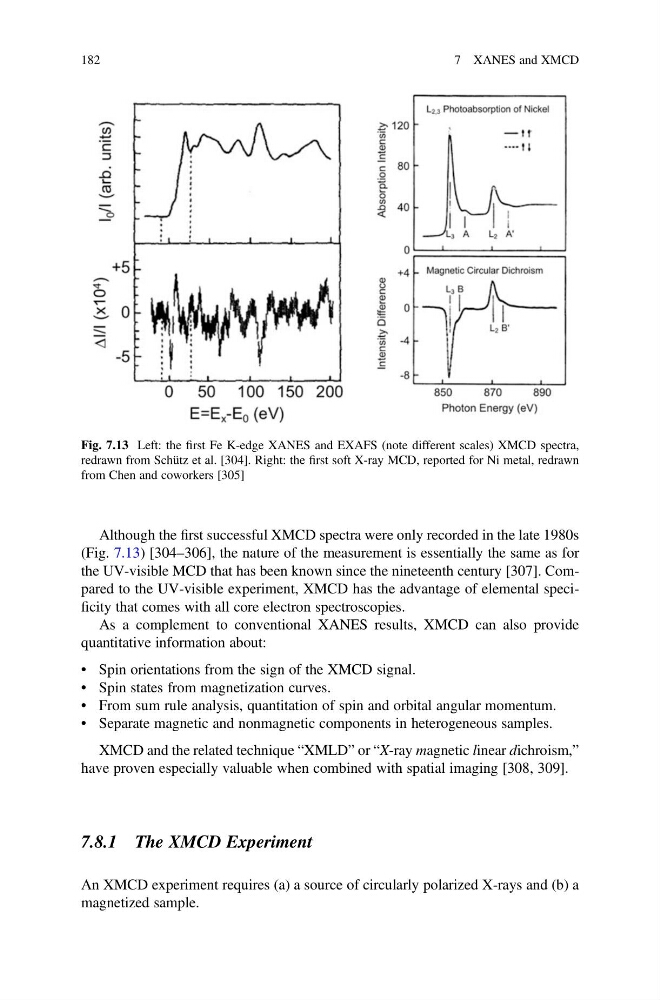
Although the first successful XMCD spectra were only recorded in the late 1980s
(Fig. 7.13) [304–306], the nature of the measurement is essentially the same as for
the UV-visible MCD that has been known since the nineteenth century [307]. Compared to the UV-visible experiment, XMCD has the advantage of elemental specificity that comes with all core electron spectroscopies.
As a complement to conventional XANES results, XMCD can also provide
quantitative information about:
• Spin orientations from the sign of the XMCD signal.
• Spin states from magnetization curves.
• From sum rule analysis, quantitation of spin and orbital angular momentum.
• Separate magnetic and nonmagnetic components in heterogeneous samples.
XMCD and the related technique “XMLD” or “X-ray magnetic linear dichroism,”
have proven especially valuable when combined with spatial imaging [308, 309].
7.8.1 The XMCD Experiment
An XMCD experiment requires (a) a source of circularly polarized X-rays and (b) a
magnetized sample.
Fig. 7.13 Left: the first Fe K-edge XANES and EXAFS (note different scales) XMCD spectra,
redrawn from Schütz et al. [304]. Right: the first soft X-ray MCD, reported for Ni metal, redrawn
from Chen and coworkers [305]
182
7 XANES and XMCD
(Fig. 7.13) [304–306], the nature of the measurement is essentially the same as for
the UV-visible MCD that has been known since the nineteenth century [307]. Compared to the UV-visible experiment, XMCD has the advantage of elemental specificity that comes with all core electron spectroscopies.
As a complement to conventional XANES results, XMCD can also provide
quantitative information about:
• Spin orientations from the sign of the XMCD signal.
• Spin states from magnetization curves.
• From sum rule analysis, quantitation of spin and orbital angular momentum.
• Separate magnetic and nonmagnetic components in heterogeneous samples.
XMCD and the related technique “XMLD” or “X-ray magnetic linear dichroism,”
have proven especially valuable when combined with spatial imaging [308, 309].
7.8.1 The XMCD Experiment
An XMCD experiment requires (a) a source of circularly polarized X-rays and (b) a
magnetized sample.
Fig. 7.13 Left: the first Fe K-edge XANES and EXAFS (note different scales) XMCD spectra,
redrawn from Schütz et al. [304]. Right: the first soft X-ray MCD, reported for Ni metal, redrawn
from Chen and coworkers [305]
182
7 XANES and XMCD