

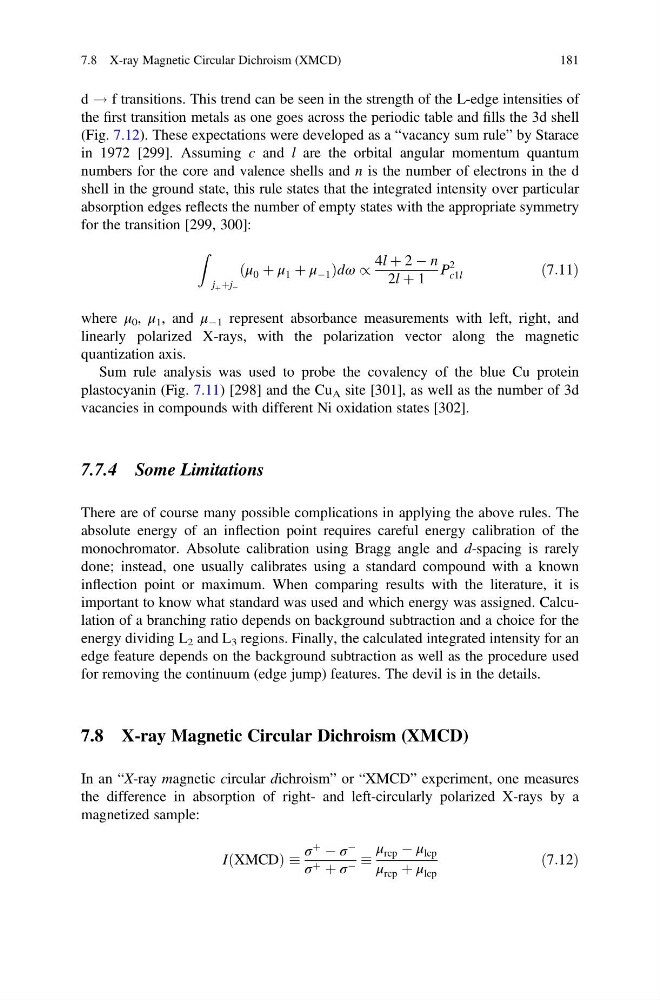
d ! f transitions. This trend can be seen in the strength of the L-edge intensities of
the first transition metals as one goes across the periodic table and fills the 3d shell
(Fig. 7.12). These expectations were developed as a “vacancy sum rule” by Starace
in 1972 [299]. Assuming c and l are the orbital angular momentum quantum
numbers for the core and valence shells and n is the number of electrons in the d
shell in the ground state, this rule states that the integrated intensity over particular
absorption edges reflects the number of empty states with the appropriate symmetry
for the transition [299, 300]:
Z
j þ þj À
μ 0 þ μ 1 þ μ À1
ð
Þ dω /
4l þ 2 À n
2l þ 1
P
2
c1l
ð7:11Þ
where μ 0 , μ 1 , and μ À1 represent absorbance measurements with left, right, and
linearly polarized X-rays, with the polarization vector along the magnetic
quantization axis.
Sum rule analysis was used to probe the covalency of the blue Cu protein
plastocyanin (Fig. 7.11) [298] and the Cu A site [301], as well as the number of 3d
vacancies in compounds with different Ni oxidation states [302].
7.7.4 Some Limitations
There are of course many possible complications in applying the above rules. The
absolute energy of an inflection point requires careful energy calibration of the
monochromator. Absolute calibration using Bragg angle and d-spacing is rarely
done; instead, one usually calibrates using a standard compound with a known
inflection point or maximum. When comparing results with the literature, it is
important to know what standard was used and which energy was assigned. Calculation of a branching ratio depends on background subtraction and a choice for the
energy dividing L 2 and L 3 regions. Finally, the calculated integrated intensity for an
edge feature depends on the background subtraction as well as the procedure used
for removing the continuum (edge jump) features. The devil is in the details.
7.8 X-ray Magnetic Circular Dichroism (XMCD)
In an “X-ray magnetic circular dichroism” or “XMCD” experiment, one measures
the difference in absorption of right- and left-circularly polarized X-rays by a
magnetized sample:
I XMCD
ð
Þ
σ
þ
À σ
À
σ þ þ σ À
μ rcp À μ lcp
μ rcp þ μ lcp
ð7:12Þ
7.8 X-ray Magnetic Circular Dichroism (XMCD)
181
the first transition metals as one goes across the periodic table and fills the 3d shell
(Fig. 7.12). These expectations were developed as a “vacancy sum rule” by Starace
in 1972 [299]. Assuming c and l are the orbital angular momentum quantum
numbers for the core and valence shells and n is the number of electrons in the d
shell in the ground state, this rule states that the integrated intensity over particular
absorption edges reflects the number of empty states with the appropriate symmetry
for the transition [299, 300]:
Z
j þ þj À
μ 0 þ μ 1 þ μ À1
ð
Þ dω /
4l þ 2 À n
2l þ 1
P
2
c1l
ð7:11Þ
where μ 0 , μ 1 , and μ À1 represent absorbance measurements with left, right, and
linearly polarized X-rays, with the polarization vector along the magnetic
quantization axis.
Sum rule analysis was used to probe the covalency of the blue Cu protein
plastocyanin (Fig. 7.11) [298] and the Cu A site [301], as well as the number of 3d
vacancies in compounds with different Ni oxidation states [302].
7.7.4 Some Limitations
There are of course many possible complications in applying the above rules. The
absolute energy of an inflection point requires careful energy calibration of the
monochromator. Absolute calibration using Bragg angle and d-spacing is rarely
done; instead, one usually calibrates using a standard compound with a known
inflection point or maximum. When comparing results with the literature, it is
important to know what standard was used and which energy was assigned. Calculation of a branching ratio depends on background subtraction and a choice for the
energy dividing L 2 and L 3 regions. Finally, the calculated integrated intensity for an
edge feature depends on the background subtraction as well as the procedure used
for removing the continuum (edge jump) features. The devil is in the details.
7.8 X-ray Magnetic Circular Dichroism (XMCD)
In an “X-ray magnetic circular dichroism” or “XMCD” experiment, one measures
the difference in absorption of right- and left-circularly polarized X-rays by a
magnetized sample:
I XMCD
ð
Þ
σ
þ
À σ
À
σ þ þ σ À
μ rcp À μ lcp
μ rcp þ μ lcp
ð7:12Þ
7.8 X-ray Magnetic Circular Dichroism (XMCD)
181