

procedures, but for the excited-state band structure, it is essential to include the
effects of the core hole. The calculations typically involve a “supercell” consisting of
multiple unit cells, including a cell with one excited atom with a core vacancy and an
extra valence electron.
The most popular “reciprocal space” package for calculating XANES from band
structure is WIEN2k [282]. This software uses a “full-potential (linearized) augmented plane wave and local-orbitals” [FP-(L)APW + lo] basis set to solve the
Kohn-Sham equations of density functional theory.
7.6 Charge-Transfer Multiplet Theory
A very different approach to XANES is appropriate for the soft X-ray spectroscopy
of transition metal and lanthanide complexes [283]. For these cases, there is a very
large interaction between the core vacancy and the final-state valence electrons—this
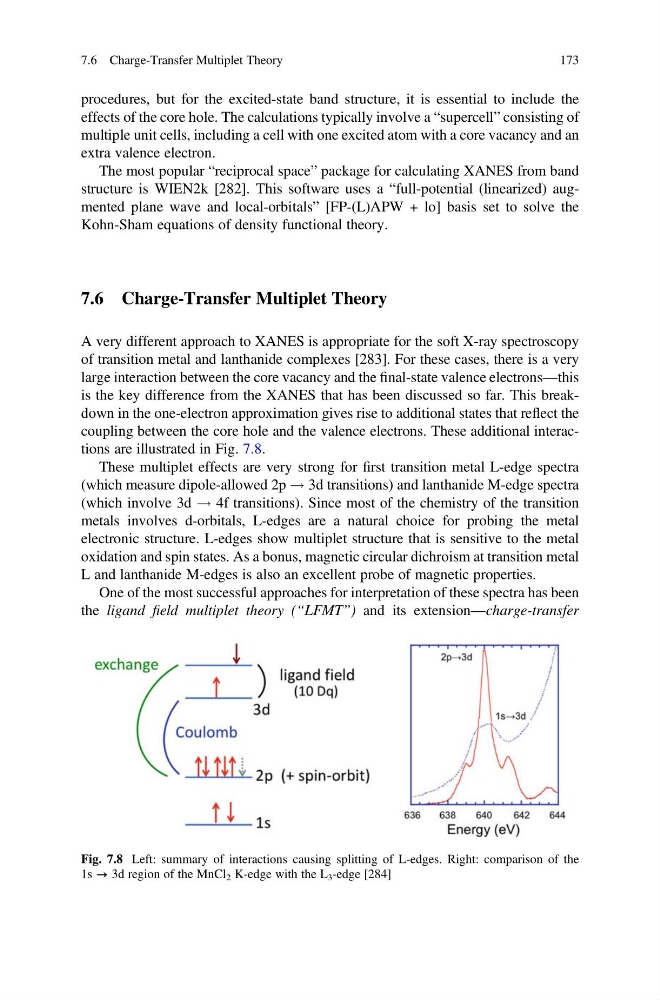
is the key difference from the XANES that has been discussed so far. This breakdown in the one-electron approximation gives rise to additional states that reflect the
coupling between the core hole and the valence electrons. These additional interactions are illustrated in Fig. 7.8.
These multiplet effects are very strong for first transition metal L-edge spectra
(which measure dipole-allowed 2p ! 3d transitions) and lanthanide M-edge spectra
(which involve 3d ! 4f transitions). Since most of the chemistry of the transition
metals involves d-orbitals, L-edges are a natural choice for probing the metal
electronic structure. L-edges show multiplet structure that is sensitive to the metal
oxidation and spin states. As a bonus, magnetic circular dichroism at transition metal
L and lanthanide M-edges is also an excellent probe of magnetic properties.
One of the most successful approaches for interpretation of these spectra has been
the ligand field multiplet theory (“LFMT”) and its extension—charge-transfer
Fig. 7.8 Left: summary of interactions causing splitting of L-edges. Right: comparison of the
1s → 3d region of the MnCl 2 K-edge with the L 3 -edge [284]
7.6 Charge-Transfer Multiplet Theory
173
effects of the core hole. The calculations typically involve a “supercell” consisting of
multiple unit cells, including a cell with one excited atom with a core vacancy and an
extra valence electron.
The most popular “reciprocal space” package for calculating XANES from band
structure is WIEN2k [282]. This software uses a “full-potential (linearized) augmented plane wave and local-orbitals” [FP-(L)APW + lo] basis set to solve the
Kohn-Sham equations of density functional theory.
7.6 Charge-Transfer Multiplet Theory
A very different approach to XANES is appropriate for the soft X-ray spectroscopy
of transition metal and lanthanide complexes [283]. For these cases, there is a very
large interaction between the core vacancy and the final-state valence electrons—this
is the key difference from the XANES that has been discussed so far. This breakdown in the one-electron approximation gives rise to additional states that reflect the
coupling between the core hole and the valence electrons. These additional interactions are illustrated in Fig. 7.8.
These multiplet effects are very strong for first transition metal L-edge spectra
(which measure dipole-allowed 2p ! 3d transitions) and lanthanide M-edge spectra
(which involve 3d ! 4f transitions). Since most of the chemistry of the transition
metals involves d-orbitals, L-edges are a natural choice for probing the metal
electronic structure. L-edges show multiplet structure that is sensitive to the metal
oxidation and spin states. As a bonus, magnetic circular dichroism at transition metal
L and lanthanide M-edges is also an excellent probe of magnetic properties.
One of the most successful approaches for interpretation of these spectra has been
the ligand field multiplet theory (“LFMT”) and its extension—charge-transfer
Fig. 7.8 Left: summary of interactions causing splitting of L-edges. Right: comparison of the
1s → 3d region of the MnCl 2 K-edge with the L 3 -edge [284]
7.6 Charge-Transfer Multiplet Theory
173