

debate in the literature about the validity of the “ruler” approach [268]. The general
trend seems reliable within a closely related set of molecules.
Nowadays, shape resonances can be nicely modeled by a full multiple-scattering
(FMS) approach using software such as FEFF [228, 269, 271]; they are in fact the
same as the DOS that is calculated by DFT. The key difference between XANES
analysis and EXAFS analysis is the extent to which high-order multiple-scattering
contributions are included. Through its use of Green’s function methods, the FEFF
approach can include multiple-scattering paths within a modest cluster summed to
infinite order! In contrast, we saw in Chap. 6 that EXAFS is usually described by
summation of a small number of direct and multiple-scattering paths.
Other commonly used “real-space” packages for simulating absorption edges in
terms of transitions to molecular orbitals and multiple-scattering resonances are
ORCA [272] and StoBe [273]. All of these packages rely on the DFT approximation,
so ideally they should yield the same results. In practice, this is not always the case.
A nice application of shape resonances involves monitoring the structural differences between ethylene molecules that have been physisorbed or chemisorbed on a
Cu(1 0 0) surface [269]. As seen in Fig. 7.5, the C–C σ
à position moves by ~17 eV as
the C–C distances change from 1.2 Å in C 2 H 2 to 1.5 Å in C 2 H 6 . Thus, in Fig. 7.5 a
downshift of 3 eV between physisorbed C 2 H 4 at 25 K and chemisorbed C 2 H 4 at 60 K
indicates a modest expansion of the C–C bond upon forming a stronger bond with
the surface Cu as electron density flows into the σ
à orbital. A more rigorous FEFF
treatment of these spectra does a reasonably good job at reproducing the C–C σ
Ã
features (Fig. 7.5).
7.5.1 The Water Story
One of the most controversial applications of XANES (and X-ray spectroscopy in
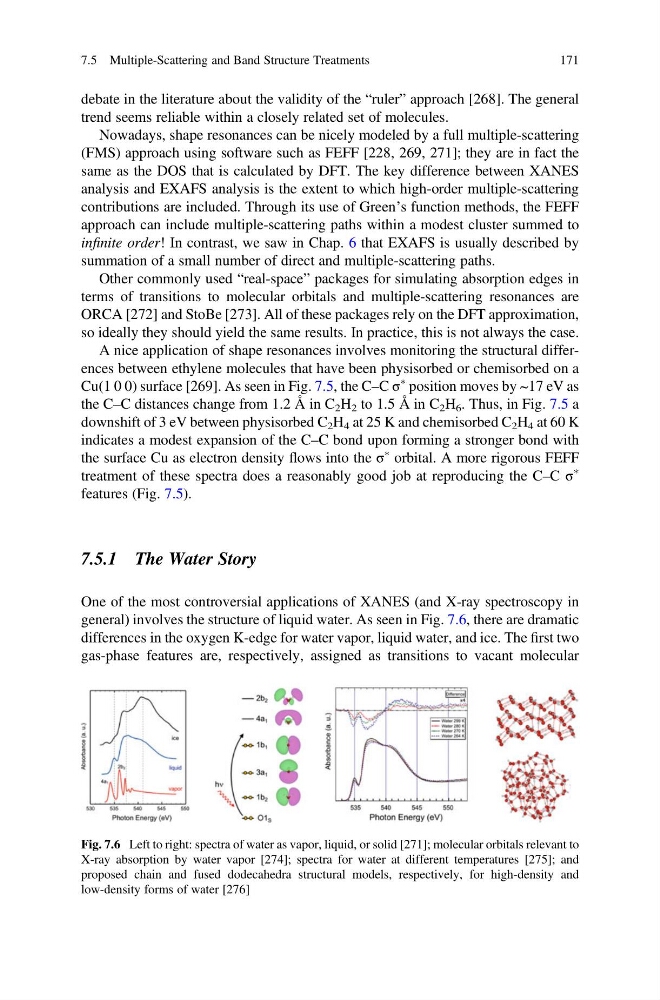
general) involves the structure of liquid water. As seen in Fig. 7.6, there are dramatic
differences in the oxygen K-edge for water vapor, liquid water, and ice. The first two
gas-phase features are, respectively, assigned as transitions to vacant molecular
Fig. 7.6 Left to right: spectra of water as vapor, liquid, or solid [271]; molecular orbitals relevant to
X-ray absorption by water vapor [274]; spectra for water at different temperatures [275]; and
proposed chain and fused dodecahedra structural models, respectively, for high-density and
low-density forms of water [276]
7.5 Multiple-Scattering and Band Structure Treatments
171
trend seems reliable within a closely related set of molecules.
Nowadays, shape resonances can be nicely modeled by a full multiple-scattering
(FMS) approach using software such as FEFF [228, 269, 271]; they are in fact the
same as the DOS that is calculated by DFT. The key difference between XANES
analysis and EXAFS analysis is the extent to which high-order multiple-scattering
contributions are included. Through its use of Green’s function methods, the FEFF
approach can include multiple-scattering paths within a modest cluster summed to
infinite order! In contrast, we saw in Chap. 6 that EXAFS is usually described by
summation of a small number of direct and multiple-scattering paths.
Other commonly used “real-space” packages for simulating absorption edges in
terms of transitions to molecular orbitals and multiple-scattering resonances are
ORCA [272] and StoBe [273]. All of these packages rely on the DFT approximation,
so ideally they should yield the same results. In practice, this is not always the case.
A nice application of shape resonances involves monitoring the structural differences between ethylene molecules that have been physisorbed or chemisorbed on a
Cu(1 0 0) surface [269]. As seen in Fig. 7.5, the C–C σ
à position moves by ~17 eV as
the C–C distances change from 1.2 Å in C 2 H 2 to 1.5 Å in C 2 H 6 . Thus, in Fig. 7.5 a
downshift of 3 eV between physisorbed C 2 H 4 at 25 K and chemisorbed C 2 H 4 at 60 K
indicates a modest expansion of the C–C bond upon forming a stronger bond with
the surface Cu as electron density flows into the σ
à orbital. A more rigorous FEFF
treatment of these spectra does a reasonably good job at reproducing the C–C σ
Ã
features (Fig. 7.5).
7.5.1 The Water Story
One of the most controversial applications of XANES (and X-ray spectroscopy in
general) involves the structure of liquid water. As seen in Fig. 7.6, there are dramatic
differences in the oxygen K-edge for water vapor, liquid water, and ice. The first two
gas-phase features are, respectively, assigned as transitions to vacant molecular
Fig. 7.6 Left to right: spectra of water as vapor, liquid, or solid [271]; molecular orbitals relevant to
X-ray absorption by water vapor [274]; spectra for water at different temperatures [275]; and
proposed chain and fused dodecahedra structural models, respectively, for high-density and
low-density forms of water [276]
7.5 Multiple-Scattering and Band Structure Treatments
171