

7.5 Multiple-Scattering and Band Structure Treatments
The 1s ! σ
à transition in N 2 lies above the ionization threshold, so it can also be
described as a multiple-scattering resonance, sometimes called a shape resonance
[264]. In a shape resonance, extensive back and forth scattering between nearest
neighbors causes the outgoing photoelectron to be temporarily trapped, resulting in
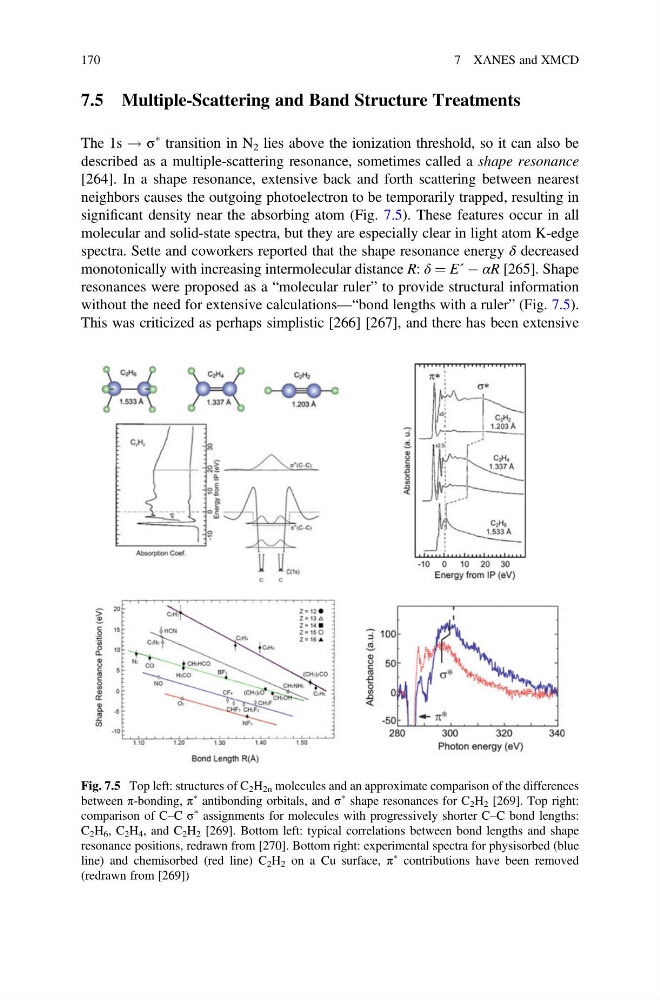
significant density near the absorbing atom (Fig. 7.5). These features occur in all
molecular and solid-state spectra, but they are especially clear in light atom K-edge
spectra. Sette and coworkers reported that the shape resonance energy δ decreased
monotonically with increasing intermolecular distance R: δ ¼ E´ À αR [265]. Shape
resonances were proposed as a “molecular ruler” to provide structural information
without the need for extensive calculations—“bond lengths with a ruler” (Fig. 7.5).
This was criticized as perhaps simplistic [266] [267], and there has been extensive
Fig. 7.5 Top left: structures of C 2 H 2n molecules and an approximate comparison of the differences
between π-bonding, π
à antibonding orbitals, and σ
à shape resonances for C 2 H 2 [269]. Top right:
comparison of C–C σ
à assignments for molecules with progressively shorter C–C bond lengths:
C 2 H 6 , C 2 H 4 , and C 2 H 2 [269]. Bottom left: typical correlations between bond lengths and shape
resonance positions, redrawn from [270]. Bottom right: experimental spectra for physisorbed (blue
line) and chemisorbed (red line) C 2 H 2 on a Cu surface, π
à contributions have been removed
(redrawn from [269])
170
7 XANES and XMCD
The 1s ! σ
à transition in N 2 lies above the ionization threshold, so it can also be
described as a multiple-scattering resonance, sometimes called a shape resonance
[264]. In a shape resonance, extensive back and forth scattering between nearest
neighbors causes the outgoing photoelectron to be temporarily trapped, resulting in
significant density near the absorbing atom (Fig. 7.5). These features occur in all
molecular and solid-state spectra, but they are especially clear in light atom K-edge
spectra. Sette and coworkers reported that the shape resonance energy δ decreased
monotonically with increasing intermolecular distance R: δ ¼ E´ À αR [265]. Shape
resonances were proposed as a “molecular ruler” to provide structural information
without the need for extensive calculations—“bond lengths with a ruler” (Fig. 7.5).
This was criticized as perhaps simplistic [266] [267], and there has been extensive
Fig. 7.5 Top left: structures of C 2 H 2n molecules and an approximate comparison of the differences
between π-bonding, π
à antibonding orbitals, and σ
à shape resonances for C 2 H 2 [269]. Top right:
comparison of C–C σ
à assignments for molecules with progressively shorter C–C bond lengths:
C 2 H 6 , C 2 H 4 , and C 2 H 2 [269]. Bottom left: typical correlations between bond lengths and shape
resonance positions, redrawn from [270]. Bottom right: experimental spectra for physisorbed (blue
line) and chemisorbed (red line) C 2 H 2 on a Cu surface, π
à contributions have been removed
(redrawn from [269])
170
7 XANES and XMCD