

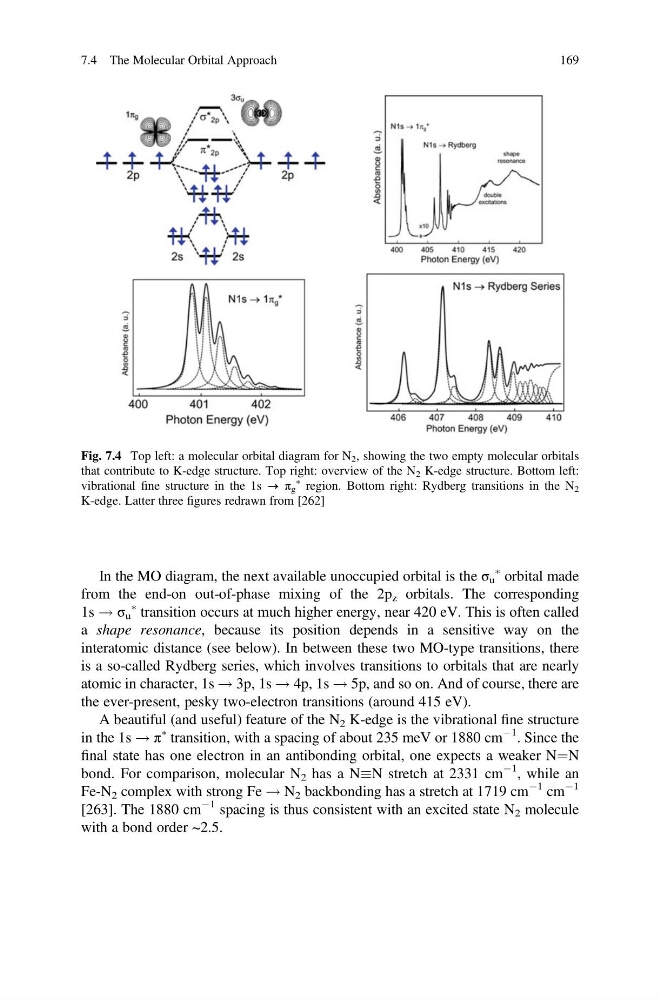
In the MO diagram, the next available unoccupied orbital is the σ u
à orbital made
from the end-on out-of-phase mixing of the 2p z orbitals. The corresponding
1s ! σ u
à transition occurs at much higher energy, near 420 eV. This is often called
a shape resonance, because its position depends in a sensitive way on the
interatomic distance (see below). In between these two MO-type transitions, there
is a so-called Rydberg series, which involves transitions to orbitals that are nearly
atomic in character, 1s ! 3p, 1s ! 4p, 1s ! 5p, and so on. And of course, there are
the ever-present, pesky two-electron transitions (around 415 eV).
A beautiful (and useful) feature of the N 2 K-edge is the vibrational fine structure
in the 1s ! π
à transition, with a spacing of about 235 meV or 1880 cm
À1 . Since the
final state has one electron in an antibonding orbital, one expects a weaker N¼N
bond. For comparison, molecular N 2 has a NN stretch at 2331 cm
À1 , while an
Fe-N 2 complex with strong Fe ! N 2 backbonding has a stretch at 1719 cm
À1 cm
À1
[263]. The 1880 cm
À1 spacing is thus consistent with an excited state N 2 molecule
with a bond order ~2.5.
Fig. 7.4 Top left: a molecular orbital diagram for N 2 , showing the two empty molecular orbitals
that contribute to K-edge structure. Top right: overview of the N 2 K-edge structure. Bottom left:
vibrational fine structure in the 1s → π g
à region. Bottom right: Rydberg transitions in the N 2
K-edge. Latter three figures redrawn from [262]
7.4 The Molecular Orbital Approach
169
à orbital made
from the end-on out-of-phase mixing of the 2p z orbitals. The corresponding
1s ! σ u
à transition occurs at much higher energy, near 420 eV. This is often called
a shape resonance, because its position depends in a sensitive way on the
interatomic distance (see below). In between these two MO-type transitions, there
is a so-called Rydberg series, which involves transitions to orbitals that are nearly
atomic in character, 1s ! 3p, 1s ! 4p, 1s ! 5p, and so on. And of course, there are
the ever-present, pesky two-electron transitions (around 415 eV).
A beautiful (and useful) feature of the N 2 K-edge is the vibrational fine structure
in the 1s ! π
à transition, with a spacing of about 235 meV or 1880 cm
À1 . Since the
final state has one electron in an antibonding orbital, one expects a weaker N¼N
bond. For comparison, molecular N 2 has a NN stretch at 2331 cm
À1 , while an
Fe-N 2 complex with strong Fe ! N 2 backbonding has a stretch at 1719 cm
À1 cm
À1
[263]. The 1880 cm
À1 spacing is thus consistent with an excited state N 2 molecule
with a bond order ~2.5.
Fig. 7.4 Top left: a molecular orbital diagram for N 2 , showing the two empty molecular orbitals
that contribute to K-edge structure. Top right: overview of the N 2 K-edge structure. Bottom left:
vibrational fine structure in the 1s → π g
à region. Bottom right: Rydberg transitions in the N 2
K-edge. Latter three figures redrawn from [262]
7.4 The Molecular Orbital Approach
169