

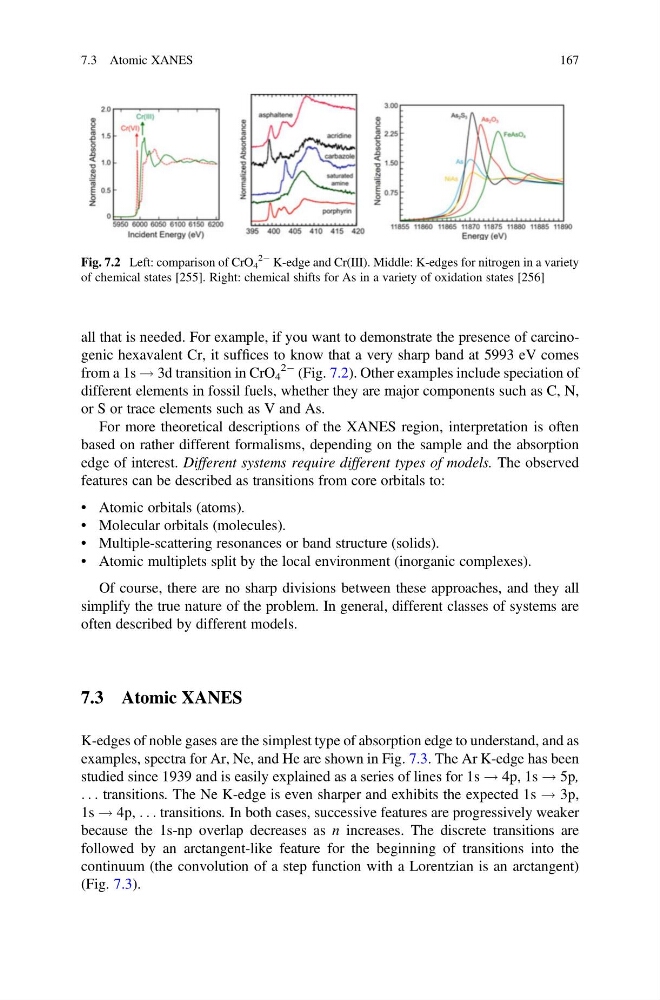
all that is needed. For example, if you want to demonstrate the presence of carcinogenic hexavalent Cr, it suffices to know that a very sharp band at 5993 eV comes
from a 1s ! 3d transition in CrO 4
2À (Fig. 7.2). Other examples include speciation of
different elements in fossil fuels, whether they are major components such as C, N,
or S or trace elements such as V and As.
For more theoretical descriptions of the XANES region, interpretation is often
based on rather different formalisms, depending on the sample and the absorption
edge of interest. Different systems require different types of models. The observed
features can be described as transitions from core orbitals to:
• Atomic orbitals (atoms).
• Molecular orbitals (molecules).
• Multiple-scattering resonances or band structure (solids).
• Atomic multiplets split by the local environment (inorganic complexes).
Of course, there are no sharp divisions between these approaches, and they all
simplify the true nature of the problem. In general, different classes of systems are
often described by different models.
7.3 Atomic XANES
K-edges of noble gases are the simplest type of absorption edge to understand, and as
examples, spectra for Ar, Ne, and He are shown in Fig. 7.3. The Ar K-edge has been
studied since 1939 and is easily explained as a series of lines for 1s ! 4p, 1s ! 5p,
. . . transitions. The Ne K-edge is even sharper and exhibits the expected 1s ! 3p,
1s ! 4p, . . . transitions. In both cases, successive features are progressively weaker
because the 1s-np overlap decreases as n increases. The discrete transitions are
followed by an arctangent-like feature for the beginning of transitions into the
continuum (the convolution of a step function with a Lorentzian is an arctangent)
(Fig. 7.3).
Fig. 7.2 Left: comparison of CrO 4
2À K-edge and Cr(III). Middle: K-edges for nitrogen in a variety
of chemical states [255]. Right: chemical shifts for As in a variety of oxidation states [256]
7.3 Atomic XANES
167
from a 1s ! 3d transition in CrO 4
2À (Fig. 7.2). Other examples include speciation of
different elements in fossil fuels, whether they are major components such as C, N,
or S or trace elements such as V and As.
For more theoretical descriptions of the XANES region, interpretation is often
based on rather different formalisms, depending on the sample and the absorption
edge of interest. Different systems require different types of models. The observed
features can be described as transitions from core orbitals to:
• Atomic orbitals (atoms).
• Molecular orbitals (molecules).
• Multiple-scattering resonances or band structure (solids).
• Atomic multiplets split by the local environment (inorganic complexes).
Of course, there are no sharp divisions between these approaches, and they all
simplify the true nature of the problem. In general, different classes of systems are
often described by different models.
7.3 Atomic XANES
K-edges of noble gases are the simplest type of absorption edge to understand, and as
examples, spectra for Ar, Ne, and He are shown in Fig. 7.3. The Ar K-edge has been
studied since 1939 and is easily explained as a series of lines for 1s ! 4p, 1s ! 5p,
. . . transitions. The Ne K-edge is even sharper and exhibits the expected 1s ! 3p,
1s ! 4p, . . . transitions. In both cases, successive features are progressively weaker
because the 1s-np overlap decreases as n increases. The discrete transitions are
followed by an arctangent-like feature for the beginning of transitions into the
continuum (the convolution of a step function with a Lorentzian is an arctangent)
(Fig. 7.3).
Fig. 7.2 Left: comparison of CrO 4
2À K-edge and Cr(III). Middle: K-edges for nitrogen in a variety
of chemical states [255]. Right: chemical shifts for As in a variety of oxidation states [256]
7.3 Atomic XANES
167