

6.6.1 Baseline and Pre-edge Subtraction
The first processing step is to remove the contributions from absorption by other
elements and by other edges of the element under study. This can be done by
extrapolation of a curve fit to the trend below the absorption edge. The functional
form of this parameterized curve can be as simple as a straight line, but a more
rational form is the so-called Victoreen function [243]:
μ
ρ
Z
¼ Cλ
3
À Dλ
4
þ σ 0 N 0
Z
A
ð6:34Þ
Since extrapolations are notoriously unstable, another approach is to use a
pre-edge subtraction to estimate the size of the absorption jump and then to use
the Victoreen to estimate the post-edge falloff in intensity of the atomic contribution
(see below).
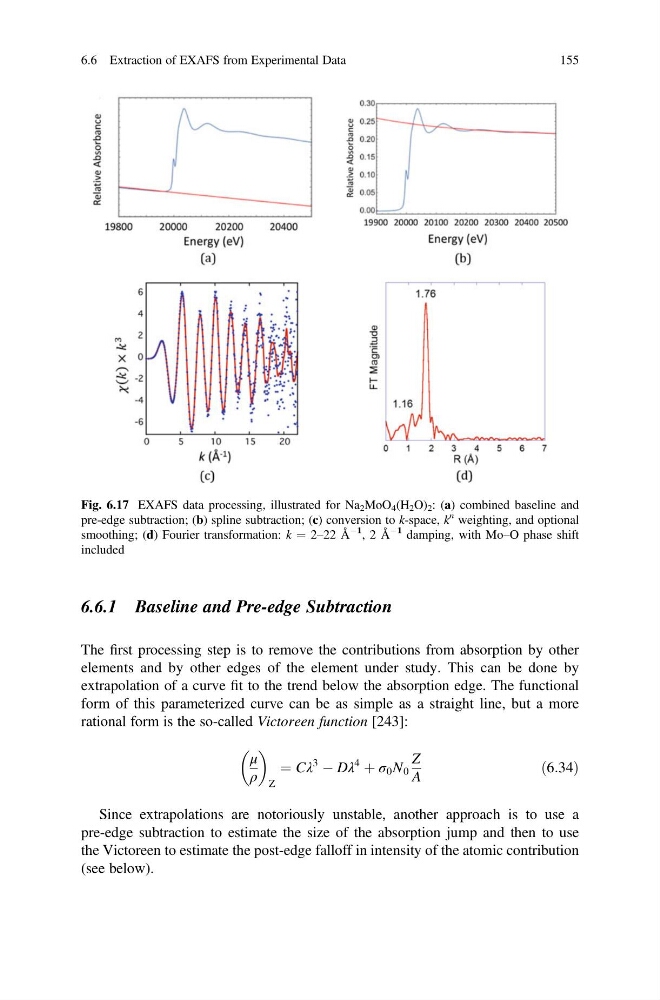
Fig. 6.17 EXAFS data processing, illustrated for Na 2 MoO 4 (H 2 O) 2 : (a) combined baseline and
pre-edge subtraction; (b) spline subtraction; (c) conversion to k-space, k
n weighting, and optional
smoothing; (d) Fourier transformation: k ¼ 2–22 Å
À1
, 2 Å
À1 damping, with Mo–O phase shift
included
6.6 Extraction of EXAFS from Experimental Data
155
The first processing step is to remove the contributions from absorption by other
elements and by other edges of the element under study. This can be done by
extrapolation of a curve fit to the trend below the absorption edge. The functional
form of this parameterized curve can be as simple as a straight line, but a more
rational form is the so-called Victoreen function [243]:
μ
ρ
Z
¼ Cλ
3
À Dλ
4
þ σ 0 N 0
Z
A
ð6:34Þ
Since extrapolations are notoriously unstable, another approach is to use a
pre-edge subtraction to estimate the size of the absorption jump and then to use
the Victoreen to estimate the post-edge falloff in intensity of the atomic contribution
(see below).
Fig. 6.17 EXAFS data processing, illustrated for Na 2 MoO 4 (H 2 O) 2 : (a) combined baseline and
pre-edge subtraction; (b) spline subtraction; (c) conversion to k-space, k
n weighting, and optional
smoothing; (d) Fourier transformation: k ¼ 2–22 Å
À1
, 2 Å
À1 damping, with Mo–O phase shift
included
6.6 Extraction of EXAFS from Experimental Data
155