

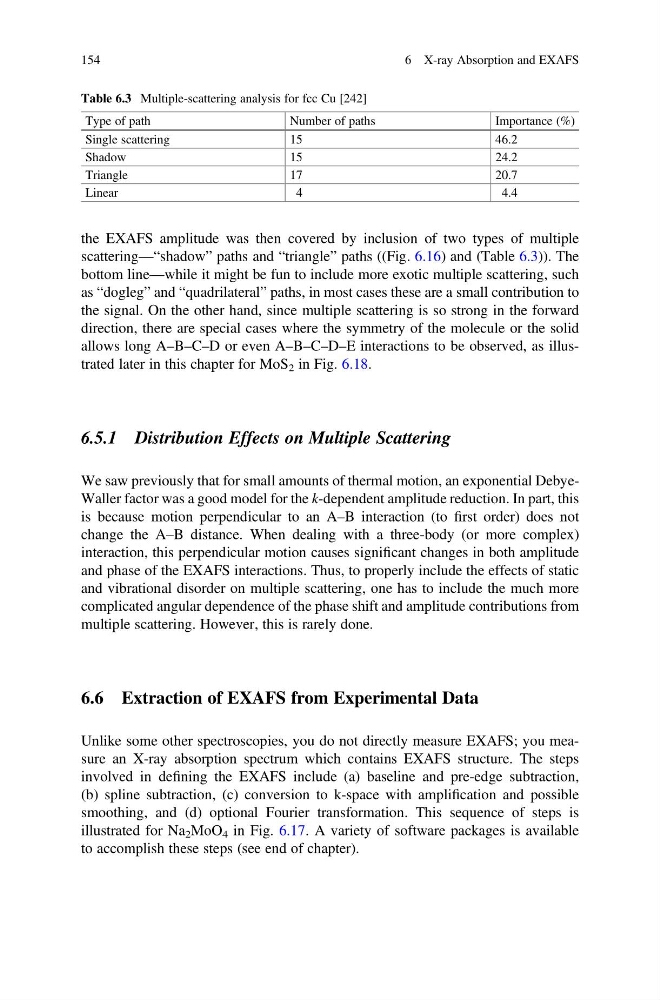
the EXAFS amplitude was then covered by inclusion of two types of multiple
scattering—“shadow” paths and “triangle” paths ((Fig. 6.16) and (Table 6.3)). The
bottom line—while it might be fun to include more exotic multiple scattering, such
as “dogleg” and “quadrilateral” paths, in most cases these are a small contribution to
the signal. On the other hand, since multiple scattering is so strong in the forward
direction, there are special cases where the symmetry of the molecule or the solid
allows long A–B–C–D or even A–B–C–D–E interactions to be observed, as illustrated later in this chapter for MoS 2 in Fig. 6.18.
6.5.1 Distribution Effects on Multiple Scattering
We saw previously that for small amounts of thermal motion, an exponential DebyeWaller factor was a good model for the k-dependent amplitude reduction. In part, this
is because motion perpendicular to an A–B interaction (to first order) does not
change the A–B distance. When dealing with a three-body (or more complex)
interaction, this perpendicular motion causes significant changes in both amplitude
and phase of the EXAFS interactions. Thus, to properly include the effects of static
and vibrational disorder on multiple scattering, one has to include the much more
complicated angular dependence of the phase shift and amplitude contributions from
multiple scattering. However, this is rarely done.
6.6 Extraction of EXAFS from Experimental Data
Unlike some other spectroscopies, you do not directly measure EXAFS; you measure an X-ray absorption spectrum which contains EXAFS structure. The steps
involved in defining the EXAFS include (a) baseline and pre-edge subtraction,
(b) spline subtraction, (c) conversion to k-space with amplification and possible
smoothing, and (d) optional Fourier transformation. This sequence of steps is
illustrated for Na 2 MoO 4 in Fig. 6.17. A variety of software packages is available
to accomplish these steps (see end of chapter).
Table 6.3 Multiple-scattering analysis for fcc Cu [242]
Type of path
Number of paths
Importance (%)
Single scattering
15
46.2
Shadow
15
24.2
Triangle
17
20.7
Linear
4
4.4
154
6 X-ray Absorption and EXAFS
scattering—“shadow” paths and “triangle” paths ((Fig. 6.16) and (Table 6.3)). The
bottom line—while it might be fun to include more exotic multiple scattering, such
as “dogleg” and “quadrilateral” paths, in most cases these are a small contribution to
the signal. On the other hand, since multiple scattering is so strong in the forward
direction, there are special cases where the symmetry of the molecule or the solid
allows long A–B–C–D or even A–B–C–D–E interactions to be observed, as illustrated later in this chapter for MoS 2 in Fig. 6.18.
6.5.1 Distribution Effects on Multiple Scattering
We saw previously that for small amounts of thermal motion, an exponential DebyeWaller factor was a good model for the k-dependent amplitude reduction. In part, this
is because motion perpendicular to an A–B interaction (to first order) does not
change the A–B distance. When dealing with a three-body (or more complex)
interaction, this perpendicular motion causes significant changes in both amplitude
and phase of the EXAFS interactions. Thus, to properly include the effects of static
and vibrational disorder on multiple scattering, one has to include the much more
complicated angular dependence of the phase shift and amplitude contributions from
multiple scattering. However, this is rarely done.
6.6 Extraction of EXAFS from Experimental Data
Unlike some other spectroscopies, you do not directly measure EXAFS; you measure an X-ray absorption spectrum which contains EXAFS structure. The steps
involved in defining the EXAFS include (a) baseline and pre-edge subtraction,
(b) spline subtraction, (c) conversion to k-space with amplification and possible
smoothing, and (d) optional Fourier transformation. This sequence of steps is
illustrated for Na 2 MoO 4 in Fig. 6.17. A variety of software packages is available
to accomplish these steps (see end of chapter).
Table 6.3 Multiple-scattering analysis for fcc Cu [242]
Type of path
Number of paths
Importance (%)
Single scattering
15
46.2
Shadow
15
24.2
Triangle
17
20.7
Linear
4
4.4
154
6 X-ray Absorption and EXAFS