

Path 2 : χ
AC
2
k
ð Þ /
2F B β, k
ð ÞF C π, k
ð Þ
R AB R BC R AC
ð6:32Þ
Path 3 : χ
AC
3
k
ð Þ /
F
2
B β, k
ð ÞF C π, k
ð Þ
R
2
AB R
2
BC
ð6:33Þ
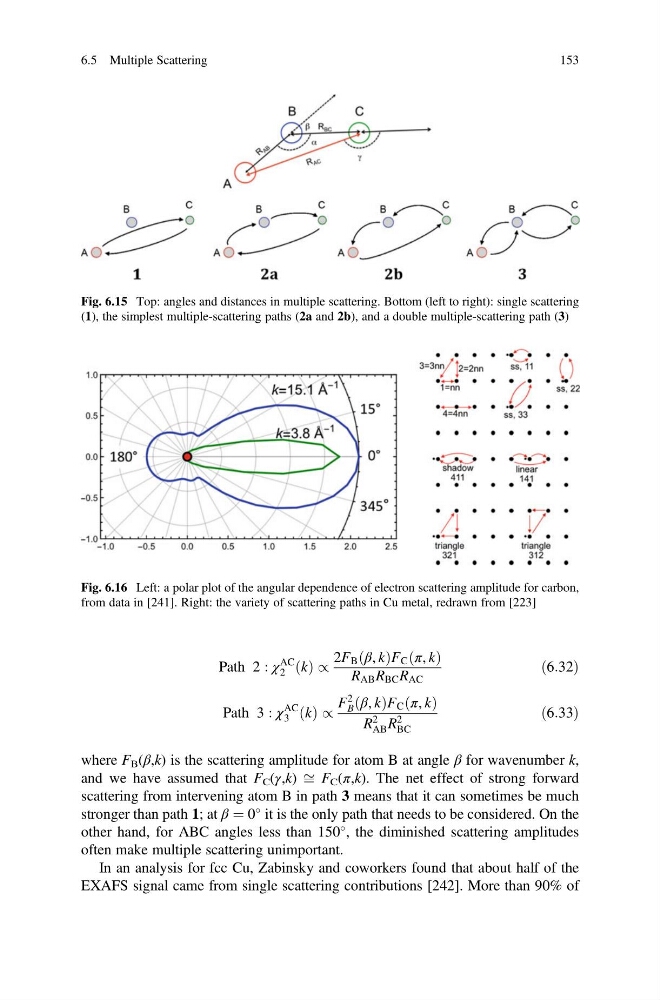
where F B (β,k) is the scattering amplitude for atom B at angle β for wavenumber k,
and we have assumed that F C (γ,k) ffi F C (π,k). The net effect of strong forward
scattering from intervening atom B in path 3 means that it can sometimes be much
stronger than path 1; at β ¼ 0
it is the only path that needs to be considered. On the
other hand, for ABC angles less than 150
, the diminished scattering amplitudes
often make multiple scattering unimportant.
In an analysis for fcc Cu, Zabinsky and coworkers found that about half of the
EXAFS signal came from single scattering contributions [242]. More than 90% of
Fig. 6.15 Top: angles and distances in multiple scattering. Bottom (left to right): single scattering
(1), the simplest multiple-scattering paths (2a and 2b), and a double multiple-scattering path (3)
Fig. 6.16 Left: a polar plot of the angular dependence of electron scattering amplitude for carbon,
from data in [241]. Right: the variety of scattering paths in Cu metal, redrawn from [223]
6.5 Multiple Scattering
153
AC
2
k
ð Þ /
2F B β, k
ð ÞF C π, k
ð Þ
R AB R BC R AC
ð6:32Þ
Path 3 : χ
AC
3
k
ð Þ /
F
2
B β, k
ð ÞF C π, k
ð Þ
R
2
AB R
2
BC
ð6:33Þ
where F B (β,k) is the scattering amplitude for atom B at angle β for wavenumber k,
and we have assumed that F C (γ,k) ffi F C (π,k). The net effect of strong forward
scattering from intervening atom B in path 3 means that it can sometimes be much
stronger than path 1; at β ¼ 0
it is the only path that needs to be considered. On the
other hand, for ABC angles less than 150
, the diminished scattering amplitudes
often make multiple scattering unimportant.
In an analysis for fcc Cu, Zabinsky and coworkers found that about half of the
EXAFS signal came from single scattering contributions [242]. More than 90% of
Fig. 6.15 Top: angles and distances in multiple scattering. Bottom (left to right): single scattering
(1), the simplest multiple-scattering paths (2a and 2b), and a double multiple-scattering path (3)
Fig. 6.16 Left: a polar plot of the angular dependence of electron scattering amplitude for carbon,
from data in [241]. Right: the variety of scattering paths in Cu metal, redrawn from [223]
6.5 Multiple Scattering
153