

6.5 Multiple Scattering
So far, we have assumed that EXAFS comes only from single scattering processes,
where the photoelectron scatters at 180
from neighboring atoms (Path 1 in
Fig. 6.15). Of course, the photoelectron can scatter at other angles and subsequently
off additional atoms. Among the plethora of possible multiple-scattering events, the
simplest additional process involves scattering off one additional atom, thus yielding
triangular paths such as 2a and 2b in Fig. 6.15, with scattering from B ! C ! A as
well as scattering from C ! B ! A. Thus, this triangular path needs to be counted
twice. Finally, there can be contributions from path 3, with scattering B ! C ! B ! A.
We call these cases three-body paths to include the limiting case where the first
scattering angle β ¼ 0
and hence the second scattering angle γ ¼ 180
.
The angular dependence of scattering for a carbon atom is illustrated in Fig. 6.16.
The scattering amplitude falls off rapidly beyond 20–30
and then rises slightly near
180
. From this we can see that not all three-body paths are equally important.
Because scattering is strongest in the forward direction, paths that involve scattering
at angles close to 0
or 180
are far more important than those involving 90
scattering. For bound A–B–C systems, multiple scattering is relatively unimportant
unless the ABC angle is greater than 150
.
To reiterate, the relative importance of multiple-scattering paths is exquisitely
sensitive to the scattering angle β (as defined in Fig. 6.15). Ignoring mean free path
and disorder effects for the moment, expressions from Teo for the relative intensities
for paths 1, 2, and 3 are given by [241]:
Path 1 : χ
AC
1
k
ð Þ /
F C π, k
ð Þ
R
2
AC
ð6:31Þ
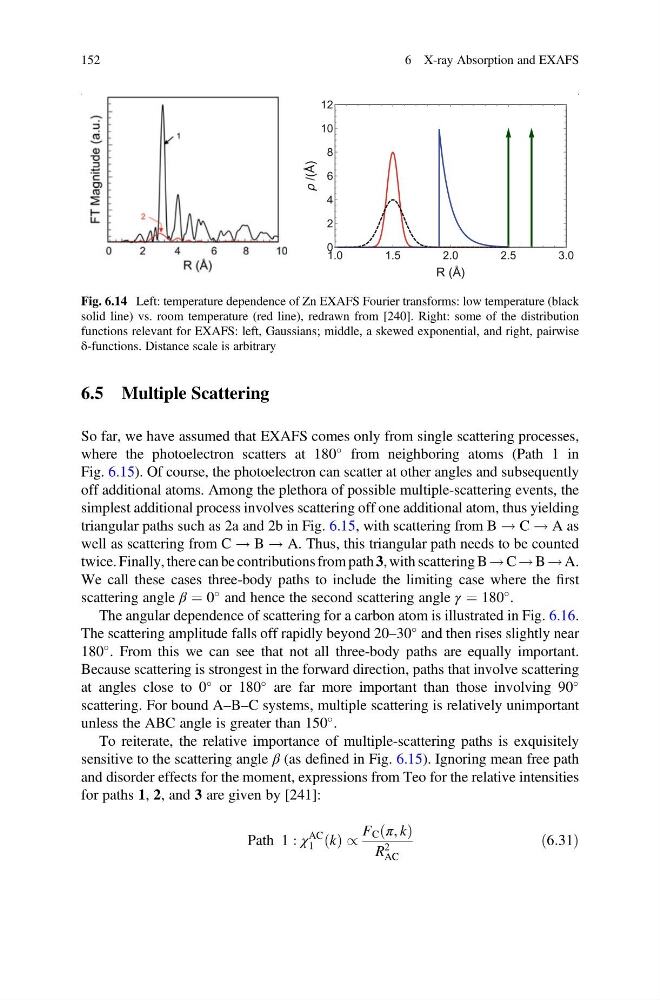
Fig. 6.14 Left: temperature dependence of Zn EXAFS Fourier transforms: low temperature (black
solid line) vs. room temperature (red line), redrawn from [240]. Right: some of the distribution
functions relevant for EXAFS: left, Gaussians; middle, a skewed exponential, and right, pairwise
δ-functions. Distance scale is arbitrary
152
6 X-ray Absorption and EXAFS
So far, we have assumed that EXAFS comes only from single scattering processes,
where the photoelectron scatters at 180
from neighboring atoms (Path 1 in
Fig. 6.15). Of course, the photoelectron can scatter at other angles and subsequently
off additional atoms. Among the plethora of possible multiple-scattering events, the
simplest additional process involves scattering off one additional atom, thus yielding
triangular paths such as 2a and 2b in Fig. 6.15, with scattering from B ! C ! A as
well as scattering from C ! B ! A. Thus, this triangular path needs to be counted
twice. Finally, there can be contributions from path 3, with scattering B ! C ! B ! A.
We call these cases three-body paths to include the limiting case where the first
scattering angle β ¼ 0
and hence the second scattering angle γ ¼ 180
.
The angular dependence of scattering for a carbon atom is illustrated in Fig. 6.16.
The scattering amplitude falls off rapidly beyond 20–30
and then rises slightly near
180
. From this we can see that not all three-body paths are equally important.
Because scattering is strongest in the forward direction, paths that involve scattering
at angles close to 0
or 180
are far more important than those involving 90
scattering. For bound A–B–C systems, multiple scattering is relatively unimportant
unless the ABC angle is greater than 150
.
To reiterate, the relative importance of multiple-scattering paths is exquisitely
sensitive to the scattering angle β (as defined in Fig. 6.15). Ignoring mean free path
and disorder effects for the moment, expressions from Teo for the relative intensities
for paths 1, 2, and 3 are given by [241]:
Path 1 : χ
AC
1
k
ð Þ /
F C π, k
ð Þ
R
2
AC
ð6:31Þ
Fig. 6.14 Left: temperature dependence of Zn EXAFS Fourier transforms: low temperature (black
solid line) vs. room temperature (red line), redrawn from [240]. Right: some of the distribution
functions relevant for EXAFS: left, Gaussians; middle, a skewed exponential, and right, pairwise
δ-functions. Distance scale is arbitrary
152
6 X-ray Absorption and EXAFS