

mean free path λ(k) is commonly used, resulting in a distance-dependent amplitude
reduction term:
χ k
ð Þ / exp
À2R
λ k
ð Þ
!
ð6:26Þ
6.4.5 Polarization and Orientation Dependence
In our presentation of the original EXAFS equation (Eq. 6.15), we assumed a fluid or
powder sample with no favored molecular orientation, and we thus ignored the
angular dependence of the outgoing photoelectron. In the case of an oriented sample,
this angular dependence can no longer be ignored. For a K-edge or L 1 -edge
transition, one starts from a spherical s-orbital, and the dipole selection rule constrains the outgoing electron to p-wave symmetry. In such cases, one can use the
result derived by Stern [222]. This says that for a particular absorber-backscatterer
A–B pair, the intensity of the oriented EXAFS will be proportional to 3 cos
2
θ, where
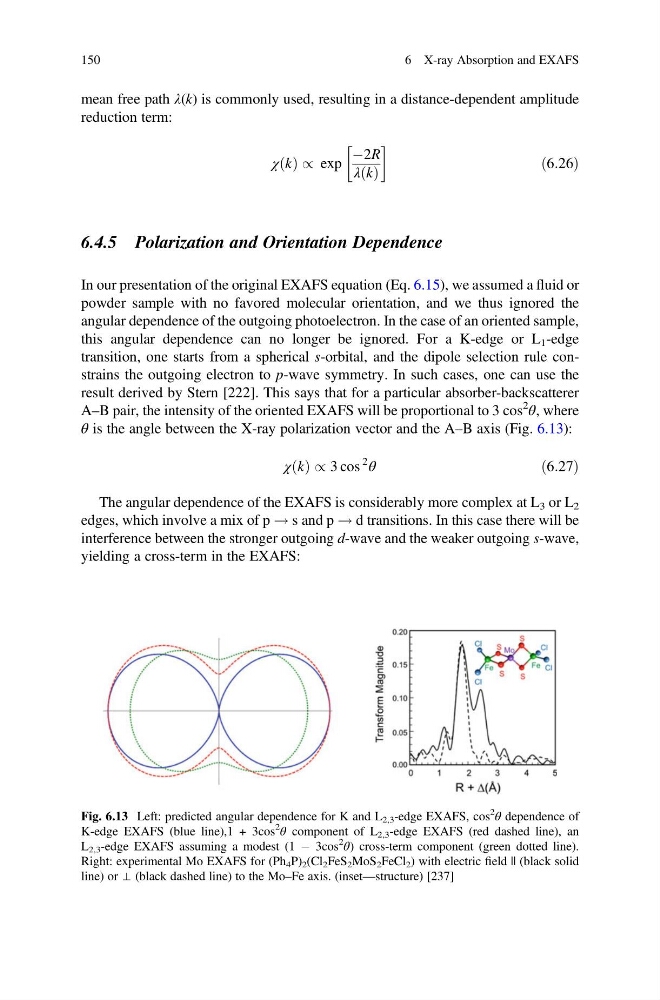
θ is the angle between the X-ray polarization vector and the A–B axis (Fig. 6.13):
χ k
ð Þ / 3 cos
2
θ
ð6:27Þ
The angular dependence of the EXAFS is considerably more complex at L 3 or L 2
edges, which involve a mix of p ! s and p ! d transitions. In this case there will be
interference between the stronger outgoing d-wave and the weaker outgoing s-wave,
yielding a cross-term in the EXAFS:
Fig. 6.13 Left: predicted angular dependence for K and L 2,3 -edge EXAFS, cos
2
θ dependence of
K-edge EXAFS (blue line),1 + 3cos
2
θ component of L 2,3 -edge EXAFS (red dashed line), an
L 2,3 -edge EXAFS assuming a modest (1 À 3cos
2
θ) cross-term component (green dotted line).
Right: experimental Mo EXAFS for (Ph 4 P) 2 (Cl 2 FeS 2 MoS 2 FeCl 2 ) with electric field || (black solid
line) or ⊥ (black dashed line) to the Mo–Fe axis. (inset—structure) [237]
150
6 X-ray Absorption and EXAFS
reduction term:
χ k
ð Þ / exp
À2R
λ k
ð Þ
!
ð6:26Þ
6.4.5 Polarization and Orientation Dependence
In our presentation of the original EXAFS equation (Eq. 6.15), we assumed a fluid or
powder sample with no favored molecular orientation, and we thus ignored the
angular dependence of the outgoing photoelectron. In the case of an oriented sample,
this angular dependence can no longer be ignored. For a K-edge or L 1 -edge
transition, one starts from a spherical s-orbital, and the dipole selection rule constrains the outgoing electron to p-wave symmetry. In such cases, one can use the
result derived by Stern [222]. This says that for a particular absorber-backscatterer
A–B pair, the intensity of the oriented EXAFS will be proportional to 3 cos
2
θ, where
θ is the angle between the X-ray polarization vector and the A–B axis (Fig. 6.13):
χ k
ð Þ / 3 cos
2
θ
ð6:27Þ
The angular dependence of the EXAFS is considerably more complex at L 3 or L 2
edges, which involve a mix of p ! s and p ! d transitions. In this case there will be
interference between the stronger outgoing d-wave and the weaker outgoing s-wave,
yielding a cross-term in the EXAFS:
Fig. 6.13 Left: predicted angular dependence for K and L 2,3 -edge EXAFS, cos
2
θ dependence of
K-edge EXAFS (blue line),1 + 3cos
2
θ component of L 2,3 -edge EXAFS (red dashed line), an
L 2,3 -edge EXAFS assuming a modest (1 À 3cos
2
θ) cross-term component (green dotted line).
Right: experimental Mo EXAFS for (Ph 4 P) 2 (Cl 2 FeS 2 MoS 2 FeCl 2 ) with electric field || (black solid
line) or ⊥ (black dashed line) to the Mo–Fe axis. (inset—structure) [237]
150
6 X-ray Absorption and EXAFS