

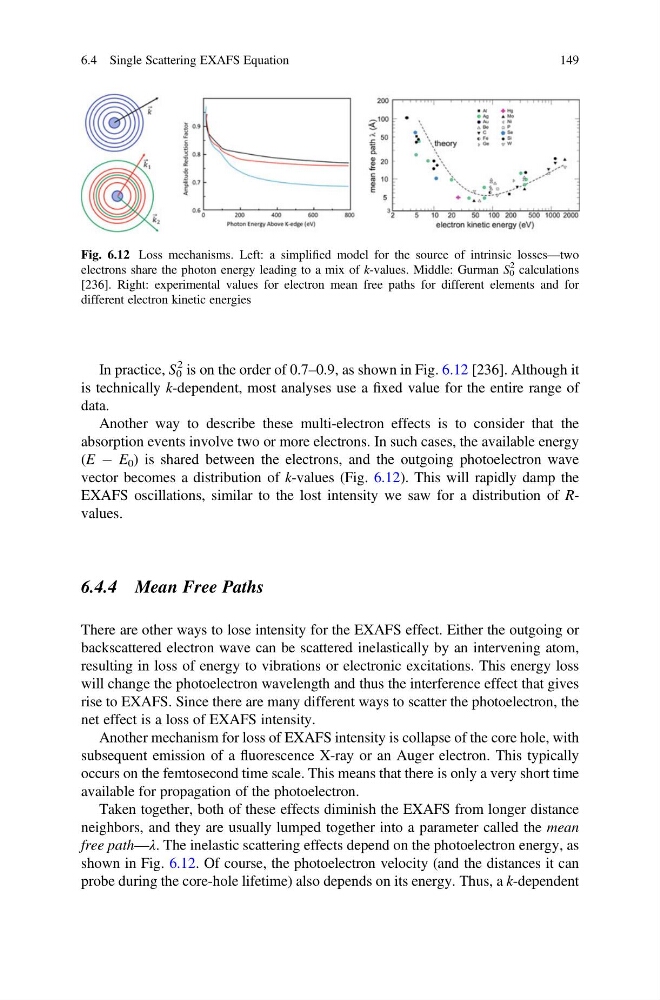
In practice, S 0
2 is on the order of 0.7–0.9, as shown in Fig. 6.12 [236]. Although it
is technically k-dependent, most analyses use a fixed value for the entire range of
data.
Another way to describe these multi-electron effects is to consider that the
absorption events involve two or more electrons. In such cases, the available energy
(E À E 0 ) is shared between the electrons, and the outgoing photoelectron wave
vector becomes a distribution of k-values (Fig. 6.12). This will rapidly damp the
EXAFS oscillations, similar to the lost intensity we saw for a distribution of Rvalues.
6.4.4 Mean Free Paths
There are other ways to lose intensity for the EXAFS effect. Either the outgoing or
backscattered electron wave can be scattered inelastically by an intervening atom,
resulting in loss of energy to vibrations or electronic excitations. This energy loss
will change the photoelectron wavelength and thus the interference effect that gives
rise to EXAFS. Since there are many different ways to scatter the photoelectron, the
net effect is a loss of EXAFS intensity.
Another mechanism for loss of EXAFS intensity is collapse of the core hole, with
subsequent emission of a fluorescence X-ray or an Auger electron. This typically
occurs on the femtosecond time scale. This means that there is only a very short time
available for propagation of the photoelectron.
Taken together, both of these effects diminish the EXAFS from longer distance
neighbors, and they are usually lumped together into a parameter called the mean
free path—λ. The inelastic scattering effects depend on the photoelectron energy, as
shown in Fig. 6.12. Of course, the photoelectron velocity (and the distances it can
probe during the core-hole lifetime) also depends on its energy. Thus, a k-dependent
Fig. 6.12 Loss mechanisms. Left: a simplified model for the source of intrinsic losses—two
electrons share the photon energy leading to a mix of k-values. Middle: Gurman S 0
2 calculations
[236]. Right: experimental values for electron mean free paths for different elements and for
different electron kinetic energies
6.4 Single Scattering EXAFS Equation
149
2 is on the order of 0.7–0.9, as shown in Fig. 6.12 [236]. Although it
is technically k-dependent, most analyses use a fixed value for the entire range of
data.
Another way to describe these multi-electron effects is to consider that the
absorption events involve two or more electrons. In such cases, the available energy
(E À E 0 ) is shared between the electrons, and the outgoing photoelectron wave
vector becomes a distribution of k-values (Fig. 6.12). This will rapidly damp the
EXAFS oscillations, similar to the lost intensity we saw for a distribution of Rvalues.
6.4.4 Mean Free Paths
There are other ways to lose intensity for the EXAFS effect. Either the outgoing or
backscattered electron wave can be scattered inelastically by an intervening atom,
resulting in loss of energy to vibrations or electronic excitations. This energy loss
will change the photoelectron wavelength and thus the interference effect that gives
rise to EXAFS. Since there are many different ways to scatter the photoelectron, the
net effect is a loss of EXAFS intensity.
Another mechanism for loss of EXAFS intensity is collapse of the core hole, with
subsequent emission of a fluorescence X-ray or an Auger electron. This typically
occurs on the femtosecond time scale. This means that there is only a very short time
available for propagation of the photoelectron.
Taken together, both of these effects diminish the EXAFS from longer distance
neighbors, and they are usually lumped together into a parameter called the mean
free path—λ. The inelastic scattering effects depend on the photoelectron energy, as
shown in Fig. 6.12. Of course, the photoelectron velocity (and the distances it can
probe during the core-hole lifetime) also depends on its energy. Thus, a k-dependent
Fig. 6.12 Loss mechanisms. Left: a simplified model for the source of intrinsic losses—two
electrons share the photon energy leading to a mix of k-values. Middle: Gurman S 0
2 calculations
[236]. Right: experimental values for electron mean free paths for different elements and for
different electron kinetic energies
6.4 Single Scattering EXAFS Equation
149