

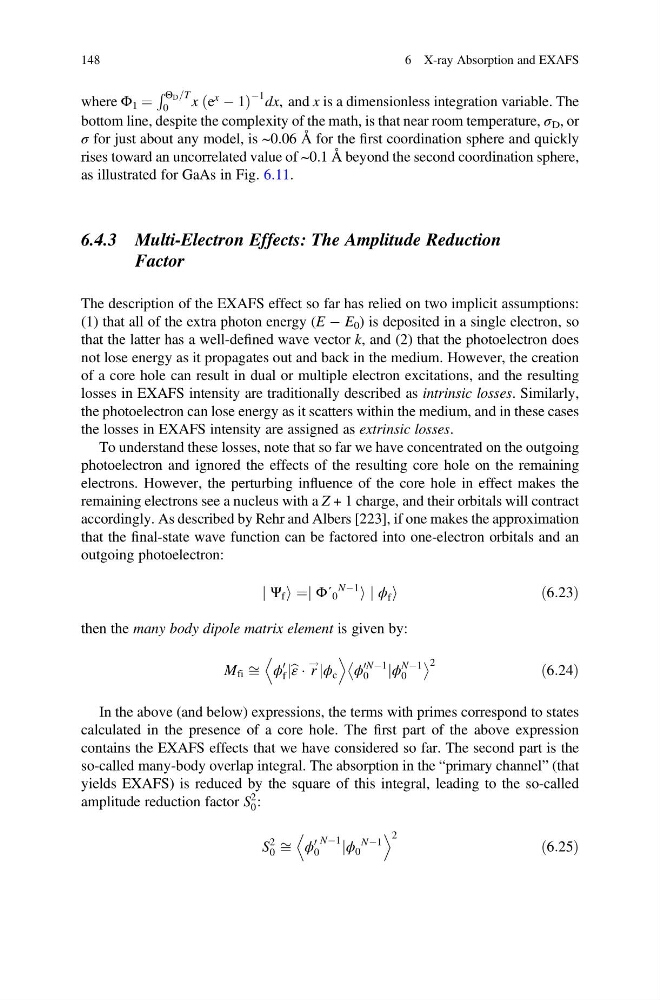
where Φ 1 ¼
R Θ D =T
0
x e
x
À 1
ð
Þ
À1 dx, and x is a dimensionless integration variable. The
bottom line, despite the complexity of the math, is that near room temperature, σ D , or
σ for just about any model, is ~0.06 Å for the first coordination sphere and quickly
rises toward an uncorrelated value of ~0.1 Å beyond the second coordination sphere,
as illustrated for GaAs in Fig. 6.11.
6.4.3 Multi-Electron Effects: The Amplitude Reduction
Factor
The description of the EXAFS effect so far has relied on two implicit assumptions:
(1) that all of the extra photon energy (E À E 0 ) is deposited in a single electron, so
that the latter has a well-defined wave vector k, and (2) that the photoelectron does
not lose energy as it propagates out and back in the medium. However, the creation
of a core hole can result in dual or multiple electron excitations, and the resulting
losses in EXAFS intensity are traditionally described as intrinsic losses. Similarly,
the photoelectron can lose energy as it scatters within the medium, and in these cases
the losses in EXAFS intensity are assigned as extrinsic losses.
To understand these losses, note that so far we have concentrated on the outgoing
photoelectron and ignored the effects of the resulting core hole on the remaining
electrons. However, the perturbing influence of the core hole in effect makes the
remaining electrons see a nucleus with a Z + 1 charge, and their orbitals will contract
accordingly. As described by Rehr and Albers [223], if one makes the approximation
that the final-state wave function can be factored into one-electron orbitals and an
outgoing photoelectron:
j Ψ f i ¼j Φ´ 0
NÀ1
i j ϕ f i
ð 6:23Þ
then the many body dipole matrix element is given by:
M fi ffi ϕ
0
f jb ε Á r
!
jϕ c
D
E
ϕ
0NÀ1
0
jϕ
NÀ1
0
2
ð6:24Þ
In the above (and below) expressions, the terms with primes correspond to states
calculated in the presence of a core hole. The first part of the above expression
contains the EXAFS effects that we have considered so far. The second part is the
so-called many-body overlap integral. The absorption in the “primary channel” (that
yields EXAFS) is reduced by the square of this integral, leading to the so-called
amplitude reduction factor S
2
0 :
S
2
0 ffi ϕ
0
0
NÀ1 jϕ 0
NÀ1
D
E 2
ð6:25Þ
148
6 X-ray Absorption and EXAFS
R Θ D =T
0
x e
x
À 1
ð
Þ
À1 dx, and x is a dimensionless integration variable. The
bottom line, despite the complexity of the math, is that near room temperature, σ D , or
σ for just about any model, is ~0.06 Å for the first coordination sphere and quickly
rises toward an uncorrelated value of ~0.1 Å beyond the second coordination sphere,
as illustrated for GaAs in Fig. 6.11.
6.4.3 Multi-Electron Effects: The Amplitude Reduction
Factor
The description of the EXAFS effect so far has relied on two implicit assumptions:
(1) that all of the extra photon energy (E À E 0 ) is deposited in a single electron, so
that the latter has a well-defined wave vector k, and (2) that the photoelectron does
not lose energy as it propagates out and back in the medium. However, the creation
of a core hole can result in dual or multiple electron excitations, and the resulting
losses in EXAFS intensity are traditionally described as intrinsic losses. Similarly,
the photoelectron can lose energy as it scatters within the medium, and in these cases
the losses in EXAFS intensity are assigned as extrinsic losses.
To understand these losses, note that so far we have concentrated on the outgoing
photoelectron and ignored the effects of the resulting core hole on the remaining
electrons. However, the perturbing influence of the core hole in effect makes the
remaining electrons see a nucleus with a Z + 1 charge, and their orbitals will contract
accordingly. As described by Rehr and Albers [223], if one makes the approximation
that the final-state wave function can be factored into one-electron orbitals and an
outgoing photoelectron:
j Ψ f i ¼j Φ´ 0
NÀ1
i j ϕ f i
ð 6:23Þ
then the many body dipole matrix element is given by:
M fi ffi ϕ
0
f jb ε Á r
!
jϕ c
D
E
ϕ
0NÀ1
0
jϕ
NÀ1
0
2
ð6:24Þ
In the above (and below) expressions, the terms with primes correspond to states
calculated in the presence of a core hole. The first part of the above expression
contains the EXAFS effects that we have considered so far. The second part is the
so-called many-body overlap integral. The absorption in the “primary channel” (that
yields EXAFS) is reduced by the square of this integral, leading to the so-called
amplitude reduction factor S
2
0 :
S
2
0 ffi ϕ
0
0
NÀ1 jϕ 0
NÀ1
D
E 2
ð6:25Þ
148
6 X-ray Absorption and EXAFS