

EXAFS analysis, one also needs to define a projected density of states, which
weights each particular mode at frequency ω by the mean square deviation of the
relevant interatomic distance in that mode—p j (ω).
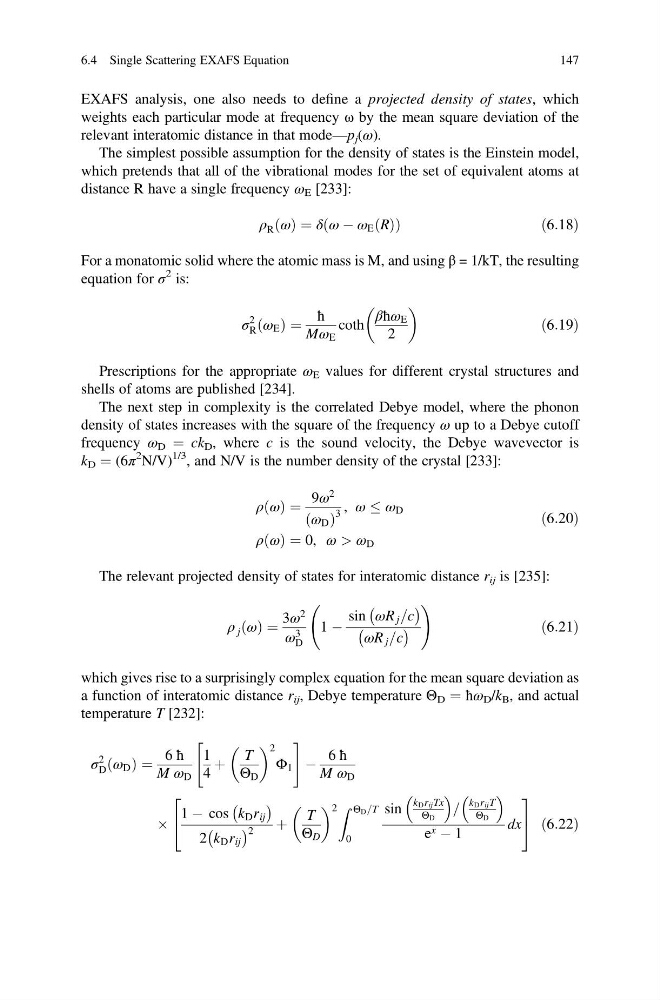
The simplest possible assumption for the density of states is the Einstein model,
which pretends that all of the vibrational modes for the set of equivalent atoms at
distance R have a single frequency ω E [233]:
ρ R ω
ð Þ ¼ δ ω À ω E R
ð Þ
ð
Þ
ð 6:18Þ
For a monatomic solid where the atomic mass is M, and using β = 1/kT, the resulting
equation for σ
2 is:
σ
2
R ω E
ð Þ ¼
ħ
Mω E
coth
βħω E
2
ð6:19Þ
Prescriptions for the appropriate ω E values for different crystal structures and
shells of atoms are published [234].
The next step in complexity is the correlated Debye model, where the phonon
density of states increases with the square of the frequency ω up to a Debye cutoff
frequency ω D ¼ ck D , where c is the sound velocity, the Debye wavevector is
k D ¼ (6π
2 N/V)
1/3
, and N/V is the number density of the crystal [233]:
ρ ω
ð Þ ¼
9ω
2
ω D
ð Þ
3
, ω ω D
ρ ω
ð Þ ¼ 0, ω > ω D
ð6:20Þ
The relevant projected density of states for interatomic distance r ij is [235]:
ρ j ω
ð Þ ¼
3ω
2
ω
3
D
1 À
sin ωR j =c
À
Á
ωR j =c
À
Á
!
ð6:21Þ
which gives rise to a surprisingly complex equation for the mean square deviation as
a function of interatomic distance r ij , Debye temperature Θ D ¼ ħω D /k B , and actual
temperature T [232]:
σ
2
D ω D
ð Þ ¼
6 ħ
M ω D
1
4
þ
T
Θ D
2
Φ 1
"
#
À
6 ħ
M ω D
Â
1 À cos k D r ij
À
Á
2 k D r ij
À
Á 2
þ
T
Θ D
2 Z Θ D =T
0
sin
k D r ij Tx
Θ D
=
k D r ij T
Θ D
e x À 1
dx
2
4
3
5 ð6:22Þ
6.4 Single Scattering EXAFS Equation
147
weights each particular mode at frequency ω by the mean square deviation of the
relevant interatomic distance in that mode—p j (ω).
The simplest possible assumption for the density of states is the Einstein model,
which pretends that all of the vibrational modes for the set of equivalent atoms at
distance R have a single frequency ω E [233]:
ρ R ω
ð Þ ¼ δ ω À ω E R
ð Þ
ð
Þ
ð 6:18Þ
For a monatomic solid where the atomic mass is M, and using β = 1/kT, the resulting
equation for σ
2 is:
σ
2
R ω E
ð Þ ¼
ħ
Mω E
coth
βħω E
2
ð6:19Þ
Prescriptions for the appropriate ω E values for different crystal structures and
shells of atoms are published [234].
The next step in complexity is the correlated Debye model, where the phonon
density of states increases with the square of the frequency ω up to a Debye cutoff
frequency ω D ¼ ck D , where c is the sound velocity, the Debye wavevector is
k D ¼ (6π
2 N/V)
1/3
, and N/V is the number density of the crystal [233]:
ρ ω
ð Þ ¼
9ω
2
ω D
ð Þ
3
, ω ω D
ρ ω
ð Þ ¼ 0, ω > ω D
ð6:20Þ
The relevant projected density of states for interatomic distance r ij is [235]:
ρ j ω
ð Þ ¼
3ω
2
ω
3
D
1 À
sin ωR j =c
À
Á
ωR j =c
À
Á
!
ð6:21Þ
which gives rise to a surprisingly complex equation for the mean square deviation as
a function of interatomic distance r ij , Debye temperature Θ D ¼ ħω D /k B , and actual
temperature T [232]:
σ
2
D ω D
ð Þ ¼
6 ħ
M ω D
1
4
þ
T
Θ D
2
Φ 1
"
#
À
6 ħ
M ω D
Â
1 À cos k D r ij
À
Á
2 k D r ij
À
Á 2
þ
T
Θ D
2 Z Θ D =T
0
sin
k D r ij Tx
Θ D
=
k D r ij T
Θ D
e x À 1
dx
2
4
3
5 ð6:22Þ
6.4 Single Scattering EXAFS Equation
147