

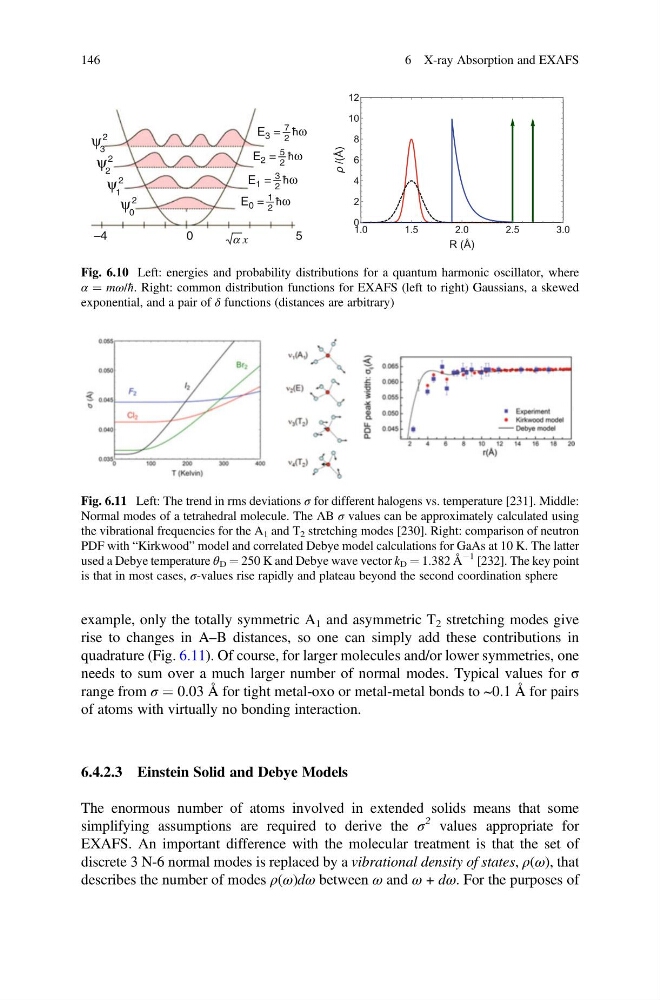
example, only the totally symmetric A 1 and asymmetric T 2 stretching modes give
rise to changes in A–B distances, so one can simply add these contributions in
quadrature (Fig. 6.11). Of course, for larger molecules and/or lower symmetries, one
needs to sum over a much larger number of normal modes. Typical values for σ
range from σ ¼ 0.03 Å for tight metal-oxo or metal-metal bonds to ~0.1 Å for pairs
of atoms with virtually no bonding interaction.
6.4.2.3 Einstein Solid and Debye Models
The enormous number of atoms involved in extended solids means that some
simplifying assumptions are required to derive the σ
2 values appropriate for
EXAFS. An important difference with the molecular treatment is that the set of
discrete 3 N-6 normal modes is replaced by a vibrational density of states, ρ(ω), that
describes the number of modes ρ(ω)dω between ω and ω + dω. For the purposes of
–4
0
5
x
a
E 3 =
7
2
ħω
E 2 =
5
2
ħω
E 1 =
3
2
ħω
E 0 =
1
2
ħω
2
3
ψ
2
2
ψ
2
1
ψ
2
0
ψ
Fig. 6.10 Left: energies and probability distributions for a quantum harmonic oscillator, where
α ¼ mω/ħ. Right: common distribution functions for EXAFS (left to right) Gaussians, a skewed
exponential, and a pair of δ functions (distances are arbitrary)
Fig. 6.11 Left: The trend in rms deviations σ for different halogens vs. temperature [231]. Middle:
Normal modes of a tetrahedral molecule. The AB σ values can be approximately calculated using
the vibrational frequencies for the A 1 and T 2 stretching modes [230]. Right: comparison of neutron
PDF with “Kirkwood” model and correlated Debye model calculations for GaAs at 10 K. The latter
used a Debye temperature θ D ¼ 250 K and Debye wave vector k D ¼ 1.382 Å
À1 [232]. The key point
is that in most cases, σ-values rise rapidly and plateau beyond the second coordination sphere
146
6 X-ray Absorption and EXAFS
rise to changes in A–B distances, so one can simply add these contributions in
quadrature (Fig. 6.11). Of course, for larger molecules and/or lower symmetries, one
needs to sum over a much larger number of normal modes. Typical values for σ
range from σ ¼ 0.03 Å for tight metal-oxo or metal-metal bonds to ~0.1 Å for pairs
of atoms with virtually no bonding interaction.
6.4.2.3 Einstein Solid and Debye Models
The enormous number of atoms involved in extended solids means that some
simplifying assumptions are required to derive the σ
2 values appropriate for
EXAFS. An important difference with the molecular treatment is that the set of
discrete 3 N-6 normal modes is replaced by a vibrational density of states, ρ(ω), that
describes the number of modes ρ(ω)dω between ω and ω + dω. For the purposes of
–4
0
5
x
a
E 3 =
7
2
ħω
E 2 =
5
2
ħω
E 1 =
3
2
ħω
E 0 =
1
2
ħω
2
3
ψ
2
2
ψ
2
1
ψ
2
0
ψ
Fig. 6.10 Left: energies and probability distributions for a quantum harmonic oscillator, where
α ¼ mω/ħ. Right: common distribution functions for EXAFS (left to right) Gaussians, a skewed
exponential, and a pair of δ functions (distances are arbitrary)
Fig. 6.11 Left: The trend in rms deviations σ for different halogens vs. temperature [231]. Middle:
Normal modes of a tetrahedral molecule. The AB σ values can be approximately calculated using
the vibrational frequencies for the A 1 and T 2 stretching modes [230]. Right: comparison of neutron
PDF with “Kirkwood” model and correlated Debye model calculations for GaAs at 10 K. The latter
used a Debye temperature θ D ¼ 250 K and Debye wave vector k D ¼ 1.382 Å
À1 [232]. The key point
is that in most cases, σ-values rise rapidly and plateau beyond the second coordination sphere
146
6 X-ray Absorption and EXAFS