

6.2.3 Artefacts
X-ray absorption is a deceptively simple experiment—one will always get “data”—
meaning that the beamline computer will always generate an output file. However,
the quality of that data and its relationship to the desired quantity, the absorption
coefficient μ s (E) for a particular ‘sample’ element, depends on avoiding a host of
experimental artefacts. Included among the numerous possible artefacts are:
• Leakage effects.
• Fluorescence saturation effects.
• Detector nonlinearity.
• Crystal Glitches.
6.2.4 Leakage Effects
In transmission experiments, a range of artefacts can be summarized under the
heading of “leakage effects” [214, 216]. Suppose that the measurements that purportedly correspond to the incident and transmitted intensities I 0 and I are both
contaminated by the addition of a second signal proportional to I 0 : αI 0 . This
additional intensity could come from, among other things, (a) pinholes in the sample
that allow beam to pass without attenuation, (b) harmonic wavelengths in the
incident beam that have a much lower absorption cross section, (c) electronic
noise in the detector itself, and even (d) fluorescence from the sample that is
reemitted into the I 0 or I detectors. Regardless of source, leakage results in reduced
apparent absorbance and a loss of EXAFS amplitude (Fig. 6.5). The math behind
leakage effects has been summarized elsewhere [214, 216].
6.2.5 Fluorescence Saturation Effects
The derivation of Eq. 6.2 from Eq. 6.1 requires that the absorbance contribution from
the sample μ s is small compared to the total absorbance μ T . On the other hand, if the
contribution from the sample μ s is significant, the fluorescence proportionality to
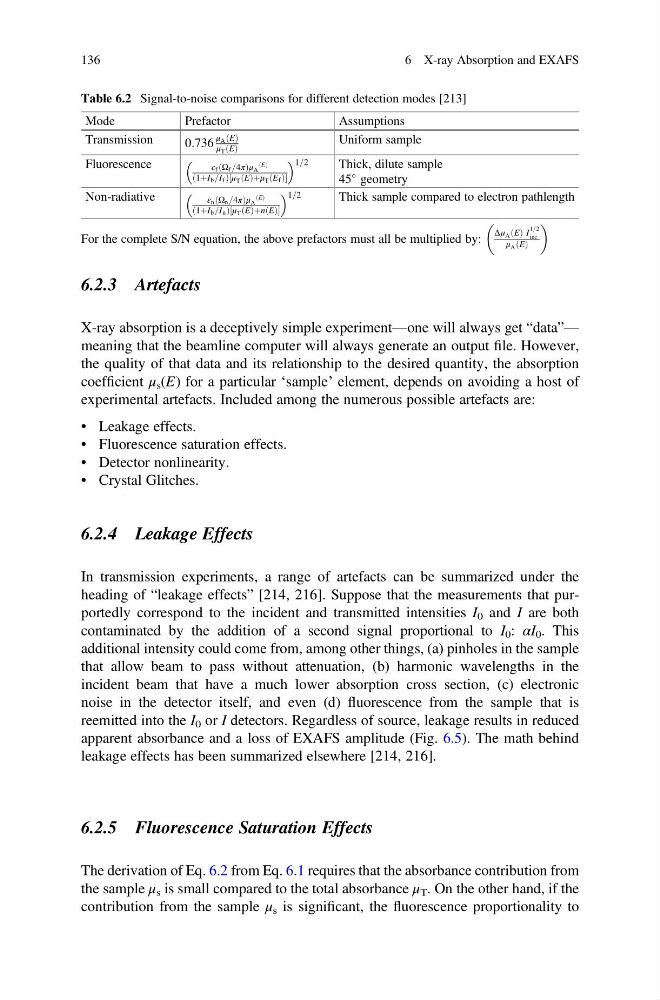
Table 6.2 Signal-to-noise comparisons for different detection modes [213]
Mode
Prefactor
Assumptions
Transmission
0:736
μ A E
ð Þ
μ T E
ð Þ
Uniform sample
Fluorescence
εf Ωf =4π
ð
Þ μ A
E
ð Þ
1þIb=If
ð
Þμ T E
ð Þþμ T Ef
ð Þ
½
1=2
Thick, dilute sample
45
geometry
Non-radiative
εn Ωn=4π
ð
Þ μ A
E
ð Þ
1þIb=In
ð
Þ μ T E
ð Þþn E
ð Þ
½
1=2
Thick sample compared to electron pathlength
For the complete S/N equation, the above prefactors must all be multiplied by:
Δμ A E
ð Þ I
1=2
inc
μ A E
ð Þ
136
6 X-ray Absorption and EXAFS
X-ray absorption is a deceptively simple experiment—one will always get “data”—
meaning that the beamline computer will always generate an output file. However,
the quality of that data and its relationship to the desired quantity, the absorption
coefficient μ s (E) for a particular ‘sample’ element, depends on avoiding a host of
experimental artefacts. Included among the numerous possible artefacts are:
• Leakage effects.
• Fluorescence saturation effects.
• Detector nonlinearity.
• Crystal Glitches.
6.2.4 Leakage Effects
In transmission experiments, a range of artefacts can be summarized under the
heading of “leakage effects” [214, 216]. Suppose that the measurements that purportedly correspond to the incident and transmitted intensities I 0 and I are both
contaminated by the addition of a second signal proportional to I 0 : αI 0 . This
additional intensity could come from, among other things, (a) pinholes in the sample
that allow beam to pass without attenuation, (b) harmonic wavelengths in the
incident beam that have a much lower absorption cross section, (c) electronic
noise in the detector itself, and even (d) fluorescence from the sample that is
reemitted into the I 0 or I detectors. Regardless of source, leakage results in reduced
apparent absorbance and a loss of EXAFS amplitude (Fig. 6.5). The math behind
leakage effects has been summarized elsewhere [214, 216].
6.2.5 Fluorescence Saturation Effects
The derivation of Eq. 6.2 from Eq. 6.1 requires that the absorbance contribution from
the sample μ s is small compared to the total absorbance μ T . On the other hand, if the
contribution from the sample μ s is significant, the fluorescence proportionality to
Table 6.2 Signal-to-noise comparisons for different detection modes [213]
Mode
Prefactor
Assumptions
Transmission
0:736
μ A E
ð Þ
μ T E
ð Þ
Uniform sample
Fluorescence
εf Ωf =4π
ð
Þ μ A
E
ð Þ
1þIb=If
ð
Þμ T E
ð Þþμ T Ef
ð Þ
½
1=2
Thick, dilute sample
45
geometry
Non-radiative
εn Ωn=4π
ð
Þ μ A
E
ð Þ
1þIb=In
ð
Þ μ T E
ð Þþn E
ð Þ
½
1=2
Thick sample compared to electron pathlength
For the complete S/N equation, the above prefactors must all be multiplied by:
Δμ A E
ð Þ I
1=2
inc
μ A E
ð Þ
136
6 X-ray Absorption and EXAFS