

A “transition edge sensor” (“TES”) is an improved variation on the microcalorimeter concept [203, 205]. In this device, a thin metal film is held just on the rising
edge of the transition temperature between a superconducting state and normal
conductance. An X-ray photon that strikes the detector raises the temperature
enough to alter current through the superconductor, and the current is proportional
to the energy of the photon.
The individual X-ray absorbers need to be small (for low heat capacity) and the
response is still relatively slow (microseconds). Thus, TES detectors are ideal
candidates for array detectors. Devices with 240 detectors have been built and
deployed for synchrotron experiments as well as other measurements [202]. Plans
for TES arrays with millions of elements are being considered—for astronomers, of
course [204].
5.15 Detector Electronics
The electronics that is paired with X-ray detectors has certainly come a long way
over the past few decades. In the early days of EXAFS experiments at SSRL, a task
as simple as changing the amplifier gain required taking out a soldering iron and
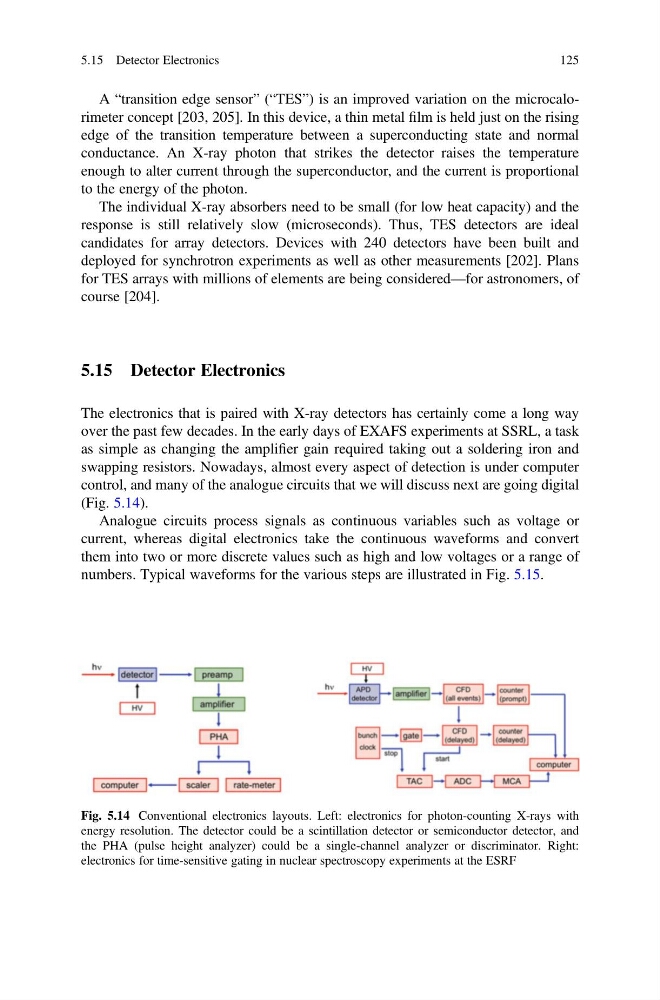
swapping resistors. Nowadays, almost every aspect of detection is under computer
control, and many of the analogue circuits that we will discuss next are going digital
(Fig. 5.14).
Analogue circuits process signals as continuous variables such as voltage or
current, whereas digital electronics take the continuous waveforms and convert
them into two or more discrete values such as high and low voltages or a range of
numbers. Typical waveforms for the various steps are illustrated in Fig. 5.15.
Fig. 5.14 Conventional electronics layouts. Left: electronics for photon-counting X-rays with
energy resolution. The detector could be a scintillation detector or semiconductor detector, and
the PHA (pulse height analyzer) could be a single-channel analyzer or discriminator. Right:
electronics for time-sensitive gating in nuclear spectroscopy experiments at the ESRF
5.15 Detector Electronics
125
edge of the transition temperature between a superconducting state and normal
conductance. An X-ray photon that strikes the detector raises the temperature
enough to alter current through the superconductor, and the current is proportional
to the energy of the photon.
The individual X-ray absorbers need to be small (for low heat capacity) and the
response is still relatively slow (microseconds). Thus, TES detectors are ideal
candidates for array detectors. Devices with 240 detectors have been built and
deployed for synchrotron experiments as well as other measurements [202]. Plans
for TES arrays with millions of elements are being considered—for astronomers, of
course [204].
5.15 Detector Electronics
The electronics that is paired with X-ray detectors has certainly come a long way
over the past few decades. In the early days of EXAFS experiments at SSRL, a task
as simple as changing the amplifier gain required taking out a soldering iron and
swapping resistors. Nowadays, almost every aspect of detection is under computer
control, and many of the analogue circuits that we will discuss next are going digital
(Fig. 5.14).
Analogue circuits process signals as continuous variables such as voltage or
current, whereas digital electronics take the continuous waveforms and convert
them into two or more discrete values such as high and low voltages or a range of
numbers. Typical waveforms for the various steps are illustrated in Fig. 5.15.
Fig. 5.14 Conventional electronics layouts. Left: electronics for photon-counting X-rays with
energy resolution. The detector could be a scintillation detector or semiconductor detector, and
the PHA (pulse height analyzer) could be a single-channel analyzer or discriminator. Right:
electronics for time-sensitive gating in nuclear spectroscopy experiments at the ESRF
5.15 Detector Electronics
125