

5.14 Microcalorimeters and Transition Edge Sensor (TES)
Detectors
The ultimate in energy resolution is achieved by measuring the amount of heat
produced when an X-ray dissipates all of its energy in a sensor. In this case the
energy resolution is determined by thermodynamic fluctuations at the phonon level,
as opposed to electron-hole pairs in semiconductor detectors or quasiparticles in
STJs. In a conventional microcalorimeter, the temperature change in the X-ray
absorber is measured by a thermistor in contact with the absorber. (The term
bolometer is usually reserved for a thermal detector that measures the power of the
incident radiation, as opposed to individual particle energies.) The absorptive element is connected to a thermal reservoir (a body of constant temperature) through a
thermal link so that it eventually returns to its original temperature. The speed of the
device depends on the heat capacity of the absorptive element and the thermal
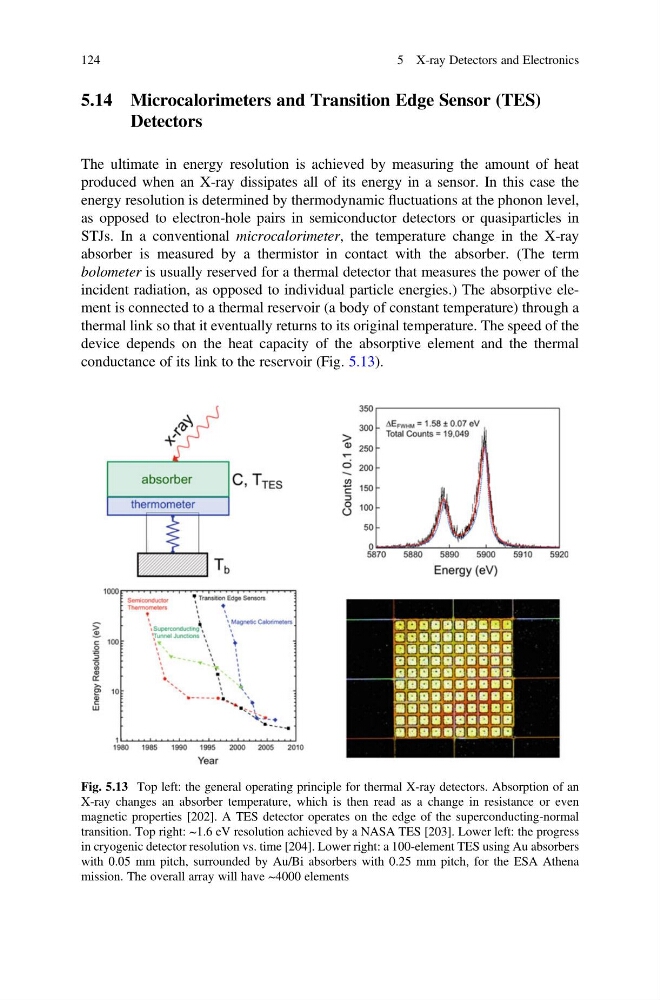
conductance of its link to the reservoir (Fig. 5.13).
Fig. 5.13 Top left: the general operating principle for thermal X-ray detectors. Absorption of an
X-ray changes an absorber temperature, which is then read as a change in resistance or even
magnetic properties [202]. A TES detector operates on the edge of the superconducting-normal
transition. Top right: ~1.6 eV resolution achieved by a NASA TES [203]. Lower left: the progress
in cryogenic detector resolution vs. time [204]. Lower right: a 100-element TES using Au absorbers
with 0.05 mm pitch, surrounded by Au/Bi absorbers with 0.25 mm pitch, for the ESA Athena
mission. The overall array will have ~4000 elements
124
5 X-ray Detectors and Electronics
Detectors
The ultimate in energy resolution is achieved by measuring the amount of heat
produced when an X-ray dissipates all of its energy in a sensor. In this case the
energy resolution is determined by thermodynamic fluctuations at the phonon level,
as opposed to electron-hole pairs in semiconductor detectors or quasiparticles in
STJs. In a conventional microcalorimeter, the temperature change in the X-ray
absorber is measured by a thermistor in contact with the absorber. (The term
bolometer is usually reserved for a thermal detector that measures the power of the
incident radiation, as opposed to individual particle energies.) The absorptive element is connected to a thermal reservoir (a body of constant temperature) through a
thermal link so that it eventually returns to its original temperature. The speed of the
device depends on the heat capacity of the absorptive element and the thermal
conductance of its link to the reservoir (Fig. 5.13).
Fig. 5.13 Top left: the general operating principle for thermal X-ray detectors. Absorption of an
X-ray changes an absorber temperature, which is then read as a change in resistance or even
magnetic properties [202]. A TES detector operates on the edge of the superconducting-normal
transition. Top right: ~1.6 eV resolution achieved by a NASA TES [203]. Lower left: the progress
in cryogenic detector resolution vs. time [204]. Lower right: a 100-element TES using Au absorbers
with 0.05 mm pitch, surrounded by Au/Bi absorbers with 0.25 mm pitch, for the ESA Athena
mission. The overall array will have ~4000 elements
124
5 X-ray Detectors and Electronics