

5.15.1 Preamplifiers
The initial signals from most detectors are small currents that require amplification.
For example, the currents in an ion chamber might be on the order of nA to μA, and
they are usually followed by a current-to-voltage preamplifier with gains on the order
of 10
9
–10
6 V/A. For semiconductor detectors, two basic types of charge-sensitive
preamplifiers are used. One type uses dynamic charge restoration (RC feedback),
while the other employs pulsed charge restoration via pulsed optical or transistor
reset methods to discharge the integrator [206]. More details on these and other
electronics are in the text by Knoll [206] and also on the commercial websites for
various detector companies.
5.15.2 Amplifiers
For semiconductor detectors, the next stage in analogue processing involves shaping
amplifiers. These devices take the step-like output from a preamplifer and convert it
into a shaped output pulse. A common output shape is a Gaussian waveform, and the
“shaping time” is the standard deviation of that pulse width. The shaping time is
usually a compromise—it needs to be long enough to collect most of the charge from
the preamplifier, but short enough to avoid significant “pileup” between successive
pulses (see Appendix F).
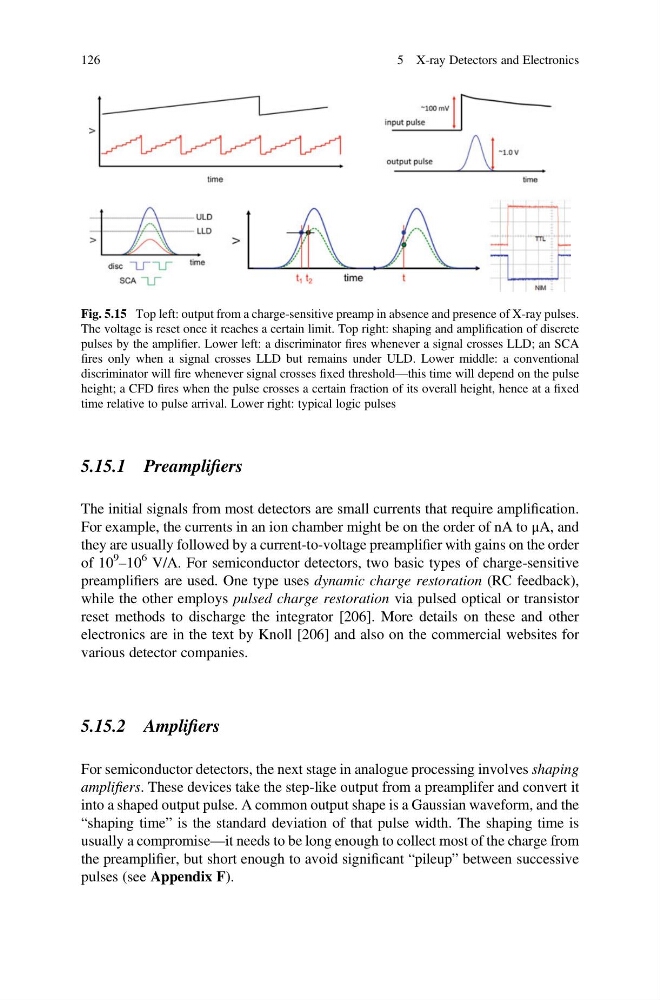
Fig. 5.15 Top left: output from a charge-sensitive preamp in absence and presence of X-ray pulses.
The voltage is reset once it reaches a certain limit. Top right: shaping and amplification of discrete
pulses by the amplifier. Lower left: a discriminator fires whenever a signal crosses LLD; an SCA
fires only when a signal crosses LLD but remains under ULD. Lower middle: a conventional
discriminator will fire whenever signal crosses fixed threshold—this time will depend on the pulse
height; a CFD fires when the pulse crosses a certain fraction of its overall height, hence at a fixed
time relative to pulse arrival. Lower right: typical logic pulses
126
5 X-ray Detectors and Electronics
The initial signals from most detectors are small currents that require amplification.
For example, the currents in an ion chamber might be on the order of nA to μA, and
they are usually followed by a current-to-voltage preamplifier with gains on the order
of 10
9
–10
6 V/A. For semiconductor detectors, two basic types of charge-sensitive
preamplifiers are used. One type uses dynamic charge restoration (RC feedback),
while the other employs pulsed charge restoration via pulsed optical or transistor
reset methods to discharge the integrator [206]. More details on these and other
electronics are in the text by Knoll [206] and also on the commercial websites for
various detector companies.
5.15.2 Amplifiers
For semiconductor detectors, the next stage in analogue processing involves shaping
amplifiers. These devices take the step-like output from a preamplifer and convert it
into a shaped output pulse. A common output shape is a Gaussian waveform, and the
“shaping time” is the standard deviation of that pulse width. The shaping time is
usually a compromise—it needs to be long enough to collect most of the charge from
the preamplifier, but short enough to avoid significant “pileup” between successive
pulses (see Appendix F).
Fig. 5.15 Top left: output from a charge-sensitive preamp in absence and presence of X-ray pulses.
The voltage is reset once it reaches a certain limit. Top right: shaping and amplification of discrete
pulses by the amplifier. Lower left: a discriminator fires whenever a signal crosses LLD; an SCA
fires only when a signal crosses LLD but remains under ULD. Lower middle: a conventional
discriminator will fire whenever signal crosses fixed threshold—this time will depend on the pulse
height; a CFD fires when the pulse crosses a certain fraction of its overall height, hence at a fixed
time relative to pulse arrival. Lower right: typical logic pulses
126
5 X-ray Detectors and Electronics