

~200 kcps, but with relatively poor energy resolution. For fluorescence-detected
X-ray absorption experiments on an element with atomic number Z, filters of
element Z À 1 can be used to absorb most of the scattered radiation while transmitting the lower energy Kα fluorescence. Arrays of up to 36 NaI(Tl) detectors were
employed at one time (Fig. 5.8) [180], but they have generally been replaced by
arrays of semiconductor detectors with better energy resolution [181].
5.10 Energy-Dispersive Semiconductor Detectors
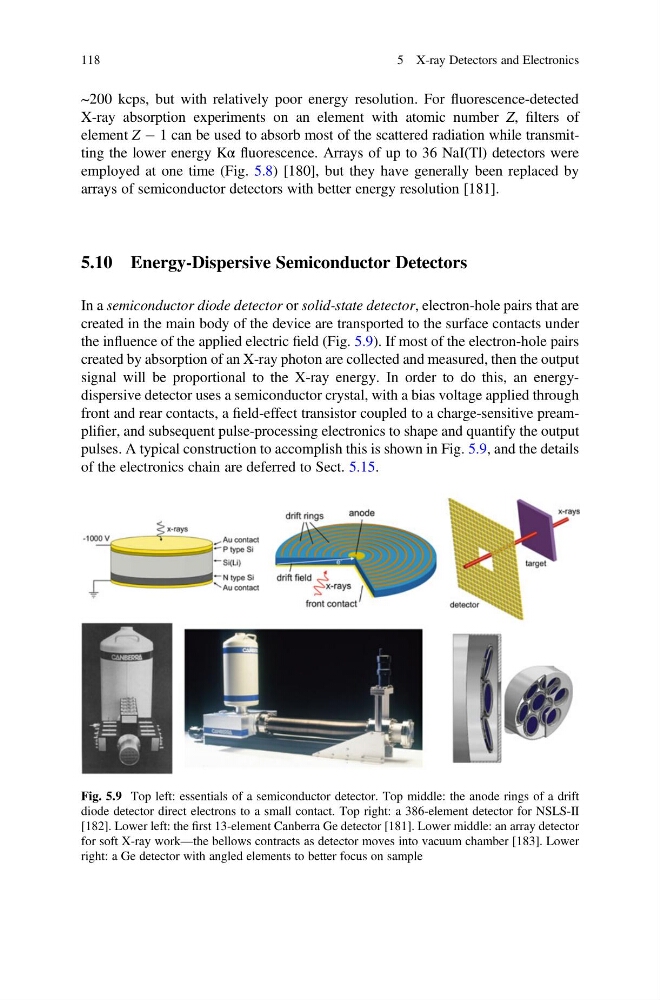
In a semiconductor diode detector or solid-state detector, electron-hole pairs that are
created in the main body of the device are transported to the surface contacts under
the influence of the applied electric field (Fig. 5.9). If most of the electron-hole pairs
created by absorption of an X-ray photon are collected and measured, then the output
signal will be proportional to the X-ray energy. In order to do this, an energydispersive detector uses a semiconductor crystal, with a bias voltage applied through
front and rear contacts, a field-effect transistor coupled to a charge-sensitive preamplifier, and subsequent pulse-processing electronics to shape and quantify the output
pulses. A typical construction to accomplish this is shown in Fig. 5.9, and the details
of the electronics chain are deferred to Sect. 5.15.
Fig. 5.9 Top left: essentials of a semiconductor detector. Top middle: the anode rings of a drift
diode detector direct electrons to a small contact. Top right: a 386-element detector for NSLS-II
[182]. Lower left: the first 13-element Canberra Ge detector [181]. Lower middle: an array detector
for soft X-ray work—the bellows contracts as detector moves into vacuum chamber [183]. Lower
right: a Ge detector with angled elements to better focus on sample
118
5 X-ray Detectors and Electronics
X-ray absorption experiments on an element with atomic number Z, filters of
element Z À 1 can be used to absorb most of the scattered radiation while transmitting the lower energy Kα fluorescence. Arrays of up to 36 NaI(Tl) detectors were
employed at one time (Fig. 5.8) [180], but they have generally been replaced by
arrays of semiconductor detectors with better energy resolution [181].
5.10 Energy-Dispersive Semiconductor Detectors
In a semiconductor diode detector or solid-state detector, electron-hole pairs that are
created in the main body of the device are transported to the surface contacts under
the influence of the applied electric field (Fig. 5.9). If most of the electron-hole pairs
created by absorption of an X-ray photon are collected and measured, then the output
signal will be proportional to the X-ray energy. In order to do this, an energydispersive detector uses a semiconductor crystal, with a bias voltage applied through
front and rear contacts, a field-effect transistor coupled to a charge-sensitive preamplifier, and subsequent pulse-processing electronics to shape and quantify the output
pulses. A typical construction to accomplish this is shown in Fig. 5.9, and the details
of the electronics chain are deferred to Sect. 5.15.
Fig. 5.9 Top left: essentials of a semiconductor detector. Top middle: the anode rings of a drift
diode detector direct electrons to a small contact. Top right: a 386-element detector for NSLS-II
[182]. Lower left: the first 13-element Canberra Ge detector [181]. Lower middle: an array detector
for soft X-ray work—the bellows contracts as detector moves into vacuum chamber [183]. Lower
right: a Ge detector with angled elements to better focus on sample
118
5 X-ray Detectors and Electronics