

5.10.1 Energy Resolution
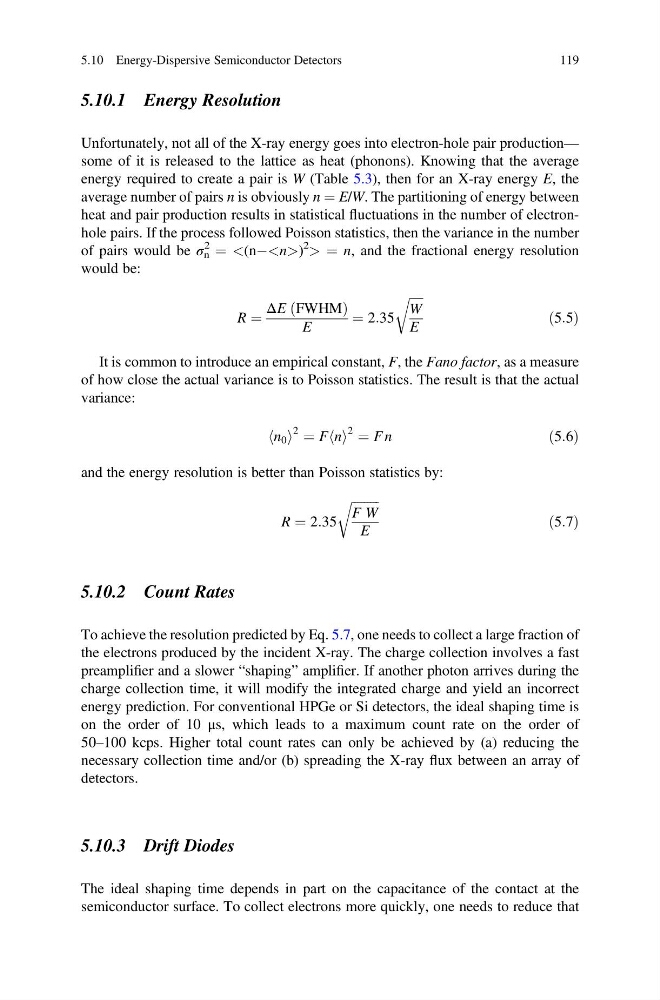
Unfortunately, not all of the X-ray energy goes into electron-hole pair production—
some of it is released to the lattice as heat (phonons). Knowing that the average
energy required to create a pair is W (Table 5.3), then for an X-ray energy E, the
average number of pairs n is obviously n ¼ E/W. The partitioning of energy between
heat and pair production results in statistical fluctuations in the number of electronhole pairs. If the process followed Poisson statistics, then the variance in the number
of pairs would be σ
2
n ¼ <(nÀ)
2 > ¼ n, and the fractional energy resolution
would be:
R ¼
ΔE FWHM
ð
Þ
E
¼ 2:35
ffiffiffiffi ffi
W
E
r
ð5:5Þ
It is common to introduce an empirical constant, F, the Fano factor, as a measure
of how close the actual variance is to Poisson statistics. The result is that the actual
variance:
n 0
h i
2 ¼ F n
h i
2 ¼ F n
ð5:6Þ
and the energy resolution is better than Poisson statistics by:
R ¼ 2:35
ffiffiffiffiffiffiffiffiffi
F W
E
r
ð5:7Þ
5.10.2 Count Rates
To achieve the resolution predicted by Eq. 5.7, one needs to collect a large fraction of
the electrons produced by the incident X-ray. The charge collection involves a fast
preamplifier and a slower “shaping” amplifier. If another photon arrives during the
charge collection time, it will modify the integrated charge and yield an incorrect
energy prediction. For conventional HPGe or Si detectors, the ideal shaping time is
on the order of 10 μs, which leads to a maximum count rate on the order of
50–100 kcps. Higher total count rates can only be achieved by (a) reducing the
necessary collection time and/or (b) spreading the X-ray flux between an array of
detectors.
5.10.3 Drift Diodes
The ideal shaping time depends in part on the capacitance of the contact at the
semiconductor surface. To collect electrons more quickly, one needs to reduce that
5.10 Energy-Dispersive Semiconductor Detectors
119
Unfortunately, not all of the X-ray energy goes into electron-hole pair production—
some of it is released to the lattice as heat (phonons). Knowing that the average
energy required to create a pair is W (Table 5.3), then for an X-ray energy E, the
average number of pairs n is obviously n ¼ E/W. The partitioning of energy between
heat and pair production results in statistical fluctuations in the number of electronhole pairs. If the process followed Poisson statistics, then the variance in the number
of pairs would be σ
2
n ¼ <(nÀ
2 > ¼ n, and the fractional energy resolution
would be:
R ¼
ΔE FWHM
ð
Þ
E
¼ 2:35
ffiffiffiffi ffi
W
E
r
ð5:5Þ
It is common to introduce an empirical constant, F, the Fano factor, as a measure
of how close the actual variance is to Poisson statistics. The result is that the actual
variance:
n 0
h i
2 ¼ F n
h i
2 ¼ F n
ð5:6Þ
and the energy resolution is better than Poisson statistics by:
R ¼ 2:35
ffiffiffiffiffiffiffiffiffi
F W
E
r
ð5:7Þ
5.10.2 Count Rates
To achieve the resolution predicted by Eq. 5.7, one needs to collect a large fraction of
the electrons produced by the incident X-ray. The charge collection involves a fast
preamplifier and a slower “shaping” amplifier. If another photon arrives during the
charge collection time, it will modify the integrated charge and yield an incorrect
energy prediction. For conventional HPGe or Si detectors, the ideal shaping time is
on the order of 10 μs, which leads to a maximum count rate on the order of
50–100 kcps. Higher total count rates can only be achieved by (a) reducing the
necessary collection time and/or (b) spreading the X-ray flux between an array of
detectors.
5.10.3 Drift Diodes
The ideal shaping time depends in part on the capacitance of the contact at the
semiconductor surface. To collect electrons more quickly, one needs to reduce that
5.10 Energy-Dispersive Semiconductor Detectors
119