

5.8 Multi-Wire Proportional Counters and Silicon
Microstrip Detectors
A multi-wire proportional counter (“MWPC”) consists of sets of thin parallel anode
wires placed equidistant between two cathode planes (Fig. 5.7). By giving the wires
a significant resistance per unit length, the position of an X-ray absorption event
along a given wire can be derived from the ratio of charges collected at each end of
the wire. Position information can also be gained by constructing the cathode in
perpendicular strips and employing electronic center-of-gravity techniques
(Fig. 5.7). Arrays of MWPCs played an important role in tracking particles in
high-energy physics experiments, and Charpak received the 1992 Nobel Prize for
his development of this device—“for his invention and development of particle
detectors, in particular the multi-wire proportional chamber”. MWPC detectors
were used early on for high-resolution X-ray fluorescence experiments [174], but
have since been replaced by Si “microstrip detectors” [175–177]. These devices
behave like solid-state analogues of MWPCs, and they have parallel narrow electrodes fabricated on the surface of the silicon (Fig. 5.7).
5.9 Scintillation Detectors
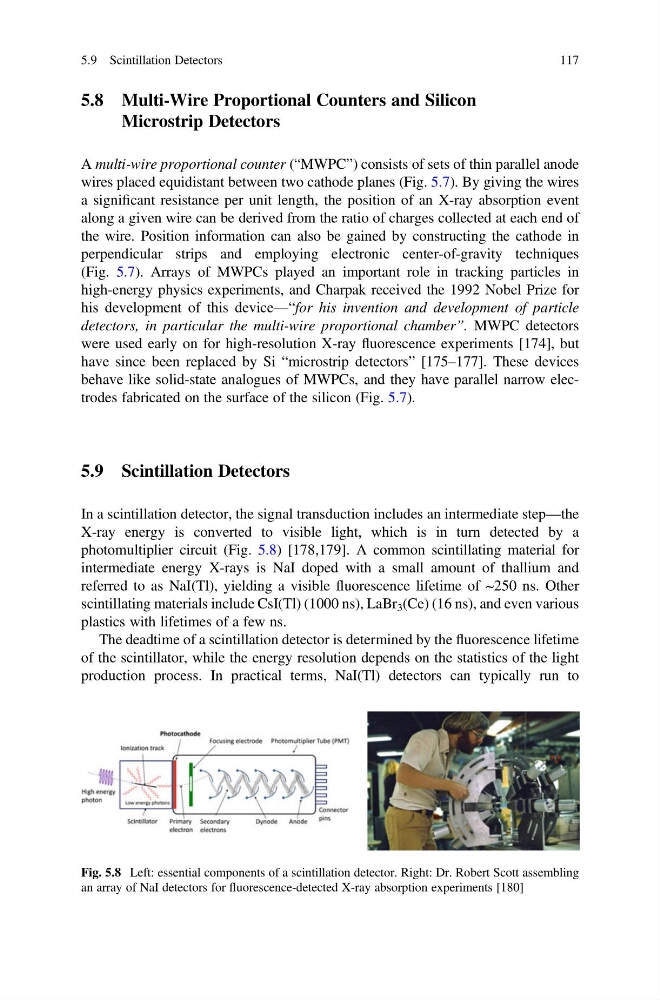
In a scintillation detector, the signal transduction includes an intermediate step—the
X-ray energy is converted to visible light, which is in turn detected by a
photomultiplier circuit (Fig. 5.8) [178,179]. A common scintillating material for
intermediate energy X-rays is NaI doped with a small amount of thallium and
referred to as NaI(Tl), yielding a visible fluorescence lifetime of ~250 ns. Other
scintillating materials include CsI(Tl) (1000 ns), LaBr 3 (Ce) (16 ns), and even various
plastics with lifetimes of a few ns.
The deadtime of a scintillation detector is determined by the fluorescence lifetime
of the scintillator, while the energy resolution depends on the statistics of the light
production process. In practical terms, NaI(Tl) detectors can typically run to
Fig. 5.8 Left: essential components of a scintillation detector. Right: Dr. Robert Scott assembling
an array of NaI detectors for fluorescence-detected X-ray absorption experiments [180]
5.9 Scintillation Detectors
117
Microstrip Detectors
A multi-wire proportional counter (“MWPC”) consists of sets of thin parallel anode
wires placed equidistant between two cathode planes (Fig. 5.7). By giving the wires
a significant resistance per unit length, the position of an X-ray absorption event
along a given wire can be derived from the ratio of charges collected at each end of
the wire. Position information can also be gained by constructing the cathode in
perpendicular strips and employing electronic center-of-gravity techniques
(Fig. 5.7). Arrays of MWPCs played an important role in tracking particles in
high-energy physics experiments, and Charpak received the 1992 Nobel Prize for
his development of this device—“for his invention and development of particle
detectors, in particular the multi-wire proportional chamber”. MWPC detectors
were used early on for high-resolution X-ray fluorescence experiments [174], but
have since been replaced by Si “microstrip detectors” [175–177]. These devices
behave like solid-state analogues of MWPCs, and they have parallel narrow electrodes fabricated on the surface of the silicon (Fig. 5.7).
5.9 Scintillation Detectors
In a scintillation detector, the signal transduction includes an intermediate step—the
X-ray energy is converted to visible light, which is in turn detected by a
photomultiplier circuit (Fig. 5.8) [178,179]. A common scintillating material for
intermediate energy X-rays is NaI doped with a small amount of thallium and
referred to as NaI(Tl), yielding a visible fluorescence lifetime of ~250 ns. Other
scintillating materials include CsI(Tl) (1000 ns), LaBr 3 (Ce) (16 ns), and even various
plastics with lifetimes of a few ns.
The deadtime of a scintillation detector is determined by the fluorescence lifetime
of the scintillator, while the energy resolution depends on the statistics of the light
production process. In practical terms, NaI(Tl) detectors can typically run to
Fig. 5.8 Left: essential components of a scintillation detector. Right: Dr. Robert Scott assembling
an array of NaI detectors for fluorescence-detected X-ray absorption experiments [180]
5.9 Scintillation Detectors
117