

the cathode. The resulting dead time limits the maximum linear count rate to
~10 kcps. Since the same signal is produced regardless of the initial photon or
particle energy, there is no energy discrimination to this device.
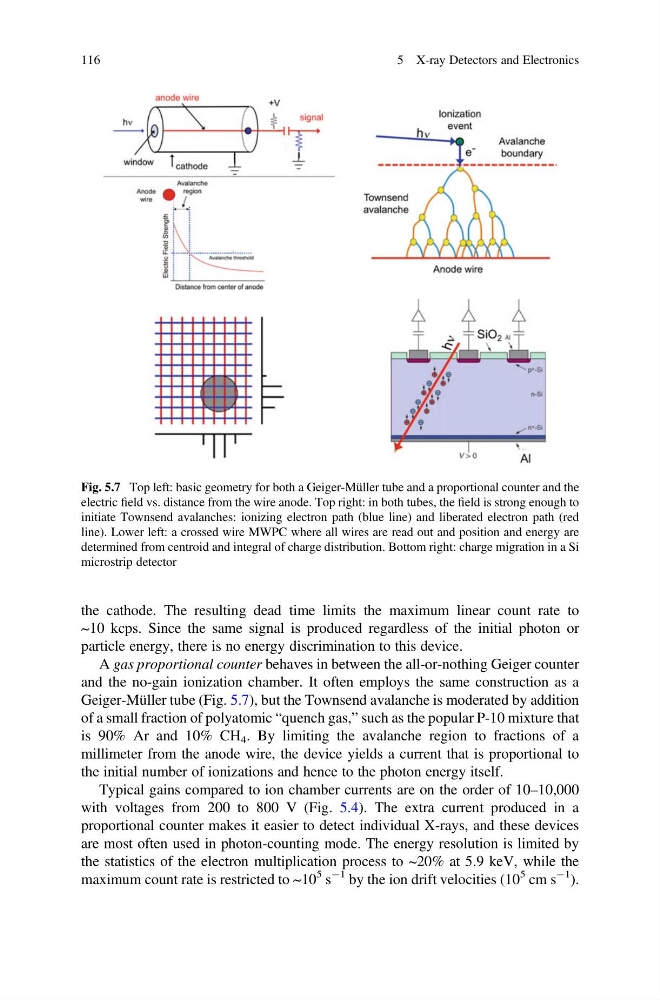
A gas proportional counter behaves in between the all-or-nothing Geiger counter
and the no-gain ionization chamber. It often employs the same construction as a
Geiger-Müller tube (Fig. 5.7), but the Townsend avalanche is moderated by addition
of a small fraction of polyatomic “quench gas,” such as the popular P-10 mixture that
is 90% Ar and 10% CH 4 . By limiting the avalanche region to fractions of a
millimeter from the anode wire, the device yields a current that is proportional to
the initial number of ionizations and hence to the photon energy itself.
Typical gains compared to ion chamber currents are on the order of 10–10,000
with voltages from 200 to 800 V (Fig. 5.4). The extra current produced in a
proportional counter makes it easier to detect individual X-rays, and these devices
are most often used in photon-counting mode. The energy resolution is limited by
the statistics of the electron multiplication process to ~20% at 5.9 keV, while the
maximum count rate is restricted to ~10
5 s
À1 by the ion drift velocities (10
5 cm s
À1 ).
Fig. 5.7 Top left: basic geometry for both a Geiger-Müller tube and a proportional counter and the
electric field vs. distance from the wire anode. Top right: in both tubes, the field is strong enough to
initiate Townsend avalanches: ionizing electron path (blue line) and liberated electron path (red
line). Lower left: a crossed wire MWPC where all wires are read out and position and energy are
determined from centroid and integral of charge distribution. Bottom right: charge migration in a Si
microstrip detector
116
5 X-ray Detectors and Electronics
~10 kcps. Since the same signal is produced regardless of the initial photon or
particle energy, there is no energy discrimination to this device.
A gas proportional counter behaves in between the all-or-nothing Geiger counter
and the no-gain ionization chamber. It often employs the same construction as a
Geiger-Müller tube (Fig. 5.7), but the Townsend avalanche is moderated by addition
of a small fraction of polyatomic “quench gas,” such as the popular P-10 mixture that
is 90% Ar and 10% CH 4 . By limiting the avalanche region to fractions of a
millimeter from the anode wire, the device yields a current that is proportional to
the initial number of ionizations and hence to the photon energy itself.
Typical gains compared to ion chamber currents are on the order of 10–10,000
with voltages from 200 to 800 V (Fig. 5.4). The extra current produced in a
proportional counter makes it easier to detect individual X-rays, and these devices
are most often used in photon-counting mode. The energy resolution is limited by
the statistics of the electron multiplication process to ~20% at 5.9 keV, while the
maximum count rate is restricted to ~10
5 s
À1 by the ion drift velocities (10
5 cm s
À1 ).
Fig. 5.7 Top left: basic geometry for both a Geiger-Müller tube and a proportional counter and the
electric field vs. distance from the wire anode. Top right: in both tubes, the field is strong enough to
initiate Townsend avalanches: ionizing electron path (blue line) and liberated electron path (red
line). Lower left: a crossed wire MWPC where all wires are read out and position and energy are
determined from centroid and integral of charge distribution. Bottom right: charge migration in a Si
microstrip detector
116
5 X-ray Detectors and Electronics