

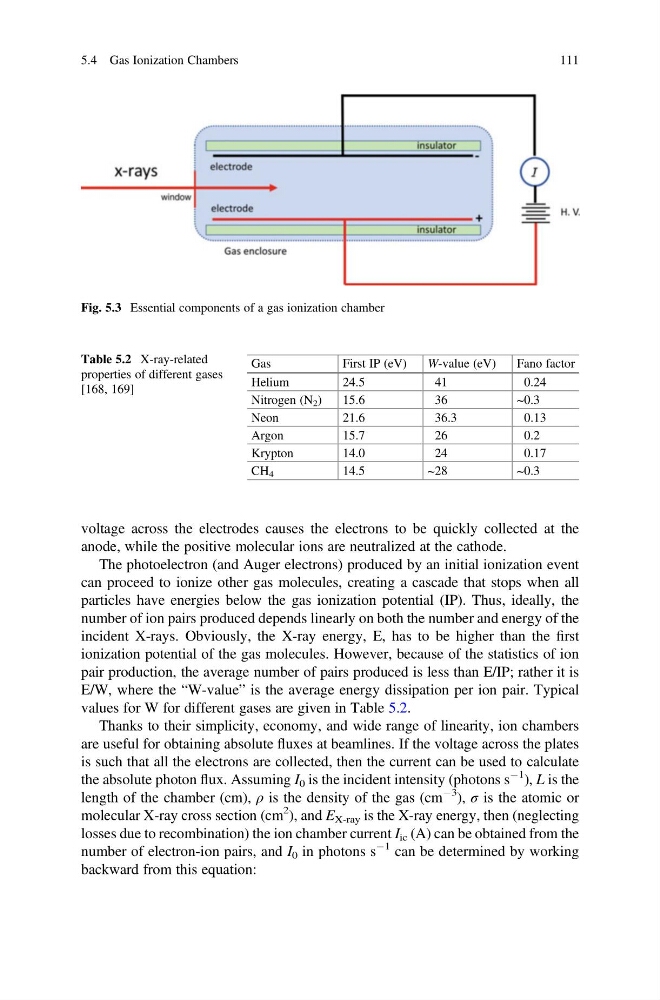
voltage across the electrodes causes the electrons to be quickly collected at the
anode, while the positive molecular ions are neutralized at the cathode.
The photoelectron (and Auger electrons) produced by an initial ionization event
can proceed to ionize other gas molecules, creating a cascade that stops when all
particles have energies below the gas ionization potential (IP). Thus, ideally, the
number of ion pairs produced depends linearly on both the number and energy of the
incident X-rays. Obviously, the X-ray energy, E, has to be higher than the first
ionization potential of the gas molecules. However, because of the statistics of ion
pair production, the average number of pairs produced is less than E/IP; rather it is
E/W, where the “W-value” is the average energy dissipation per ion pair. Typical
values for W for different gases are given in Table 5.2.
Thanks to their simplicity, economy, and wide range of linearity, ion chambers
are useful for obtaining absolute fluxes at beamlines. If the voltage across the plates
is such that all the electrons are collected, then the current can be used to calculate
the absolute photon flux. Assuming I 0 is the incident intensity (photons s
À1 ), L is the
length of the chamber (cm), ρ is the density of the gas (cm
À3 ), σ is the atomic or
molecular X-ray cross section (cm
2 ), and E X-ray is the X-ray energy, then (neglecting
losses due to recombination) the ion chamber current I ic (A) can be obtained from the
number of electron-ion pairs, and I 0 in photons s
À1 can be determined by working
backward from this equation:
Fig. 5.3 Essential components of a gas ionization chamber
Table 5.2 X-ray-related
properties of different gases
[168, 169]
Gas
First IP (eV)
W-value (eV)
Fano factor
Helium
24.5
41
0.24
Nitrogen (N 2 )
15.6
36
~0.3
Neon
21.6
36.3
0.13
Argon
15.7
26
0.2
Krypton
14.0
24
0.17
CH 4
14.5
~28
~0.3
5.4 Gas Ionization Chambers
111
anode, while the positive molecular ions are neutralized at the cathode.
The photoelectron (and Auger electrons) produced by an initial ionization event
can proceed to ionize other gas molecules, creating a cascade that stops when all
particles have energies below the gas ionization potential (IP). Thus, ideally, the
number of ion pairs produced depends linearly on both the number and energy of the
incident X-rays. Obviously, the X-ray energy, E, has to be higher than the first
ionization potential of the gas molecules. However, because of the statistics of ion
pair production, the average number of pairs produced is less than E/IP; rather it is
E/W, where the “W-value” is the average energy dissipation per ion pair. Typical
values for W for different gases are given in Table 5.2.
Thanks to their simplicity, economy, and wide range of linearity, ion chambers
are useful for obtaining absolute fluxes at beamlines. If the voltage across the plates
is such that all the electrons are collected, then the current can be used to calculate
the absolute photon flux. Assuming I 0 is the incident intensity (photons s
À1 ), L is the
length of the chamber (cm), ρ is the density of the gas (cm
À3 ), σ is the atomic or
molecular X-ray cross section (cm
2 ), and E X-ray is the X-ray energy, then (neglecting
losses due to recombination) the ion chamber current I ic (A) can be obtained from the
number of electron-ion pairs, and I 0 in photons s
À1 can be determined by working
backward from this equation:
Fig. 5.3 Essential components of a gas ionization chamber
Table 5.2 X-ray-related
properties of different gases
[168, 169]
Gas
First IP (eV)
W-value (eV)
Fano factor
Helium
24.5
41
0.24
Nitrogen (N 2 )
15.6
36
~0.3
Neon
21.6
36.3
0.13
Argon
15.7
26
0.2
Krypton
14.0
24
0.17
CH 4
14.5
~28
~0.3
5.4 Gas Ionization Chambers
111