

they can improve the reflectivity of hard X-ray mirrors from 2000 to >50 keV. How
can multilayer X-ray mirrors achieve such performance?
Multilayers are treated theoretically as stacks of partially reflecting mirrors,
arranged so that weak individual reflections add in phase to produce good overall
reflectivity. We saw earlier in this chapter that at large glancing angles, the intensity
reflectivity R
2 might be ~10
À4 . However, this also means that the amplitude reflectivity R might be 10
À2 . Thus, if one can add the reflections from 100 layers in phase,
the total reflectivity could approach 100%.
Apart from a small correction for refraction, if d is the overall period length, and
δ is the bilayer weighted real part of the refractive index, then the multilayer equation
looks just like the Bragg equation:
mλ ¼ 2d sin θ
ffiffiffiffiffiffiffiffiffiffiffiffiffiffiffiffiffiffiffiffi
1 À
2δ
sin
2
θ
s
¼ 2d sin θ
ffiffiffiffiffiffiffiffiffiffiffiffiffiffiffiffiffiffi
1 À
4δd
2
m 2 λ
2
s
ð4:42Þ
To produce a high efficiency multilayer reflector, one needs to stack materials
having alternately high and low refractive indices, with thicknesses such that the
path length difference for reflections from successive layer pairs is equal to one
wavelength. These multilayers are thus quite similar to the “quarter-wave stacks”
used for visible light coating technology. In the X-ray/EUV region, they can be used
to improve the reflectivity of mirrors and/or to improve the performance of diffraction gratings (Fig. 4.25).
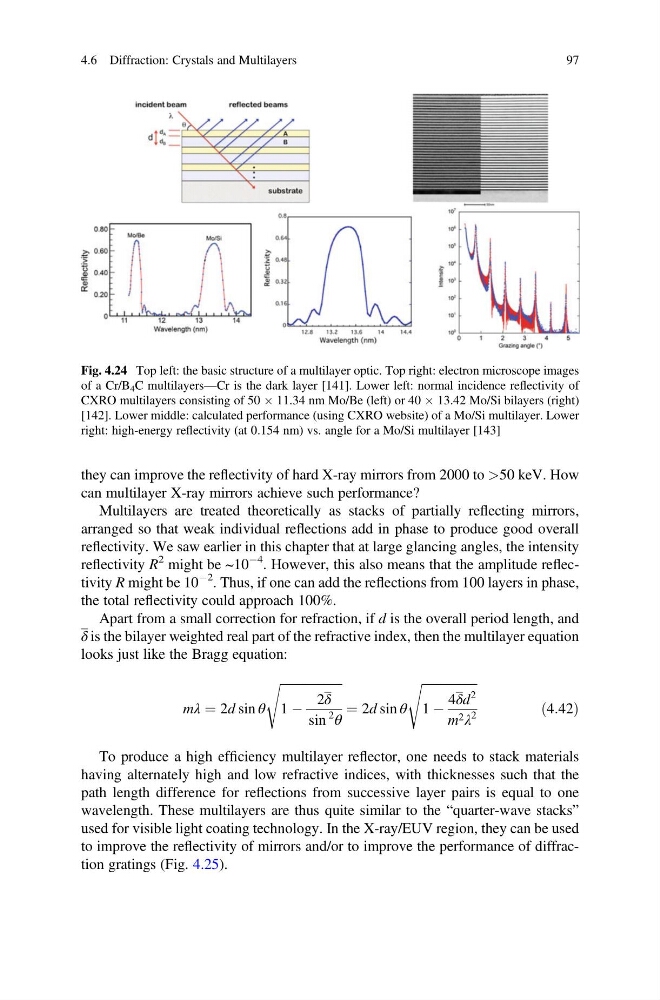
Fig. 4.24 Top left: the basic structure of a multilayer optic. Top right: electron microscope images
of a Cr/B 4 C multilayers—Cr is the dark layer [141]. Lower left: normal incidence reflectivity of
CXRO multilayers consisting of 50 Â 11.34 nm Mo/Be (left) or 40 Â 13.42 Mo/Si bilayers (right)
[142]. Lower middle: calculated performance (using CXRO website) of a Mo/Si multilayer. Lower
right: high-energy reflectivity (at 0.154 nm) vs. angle for a Mo/Si multilayer [143]
4.6 Diffraction: Crystals and Multilayers
97
can multilayer X-ray mirrors achieve such performance?
Multilayers are treated theoretically as stacks of partially reflecting mirrors,
arranged so that weak individual reflections add in phase to produce good overall
reflectivity. We saw earlier in this chapter that at large glancing angles, the intensity
reflectivity R
2 might be ~10
À4 . However, this also means that the amplitude reflectivity R might be 10
À2 . Thus, if one can add the reflections from 100 layers in phase,
the total reflectivity could approach 100%.
Apart from a small correction for refraction, if d is the overall period length, and
δ is the bilayer weighted real part of the refractive index, then the multilayer equation
looks just like the Bragg equation:
mλ ¼ 2d sin θ
ffiffiffiffiffiffiffiffiffiffiffiffiffiffiffiffiffiffiffiffi
1 À
2δ
sin
2
θ
s
¼ 2d sin θ
ffiffiffiffiffiffiffiffiffiffiffiffiffiffiffiffiffiffi
1 À
4δd
2
m 2 λ
2
s
ð4:42Þ
To produce a high efficiency multilayer reflector, one needs to stack materials
having alternately high and low refractive indices, with thicknesses such that the
path length difference for reflections from successive layer pairs is equal to one
wavelength. These multilayers are thus quite similar to the “quarter-wave stacks”
used for visible light coating technology. In the X-ray/EUV region, they can be used
to improve the reflectivity of mirrors and/or to improve the performance of diffraction gratings (Fig. 4.25).
Fig. 4.24 Top left: the basic structure of a multilayer optic. Top right: electron microscope images
of a Cr/B 4 C multilayers—Cr is the dark layer [141]. Lower left: normal incidence reflectivity of
CXRO multilayers consisting of 50 Â 11.34 nm Mo/Be (left) or 40 Â 13.42 Mo/Si bilayers (right)
[142]. Lower middle: calculated performance (using CXRO website) of a Mo/Si multilayer. Lower
right: high-energy reflectivity (at 0.154 nm) vs. angle for a Mo/Si multilayer [143]
4.6 Diffraction: Crystals and Multilayers
97