

diffraction plane of the phase plate and E σ is the component perpendicular to the
plane. If the diffraction planes of a crystal are rotated by an angle Ψ from with
respect to the electric field of the incoming X-rays, and if the phase shift difference
for the two components E σ and E π is Φ, then the degree of circular polarization is
given by [133,135]:
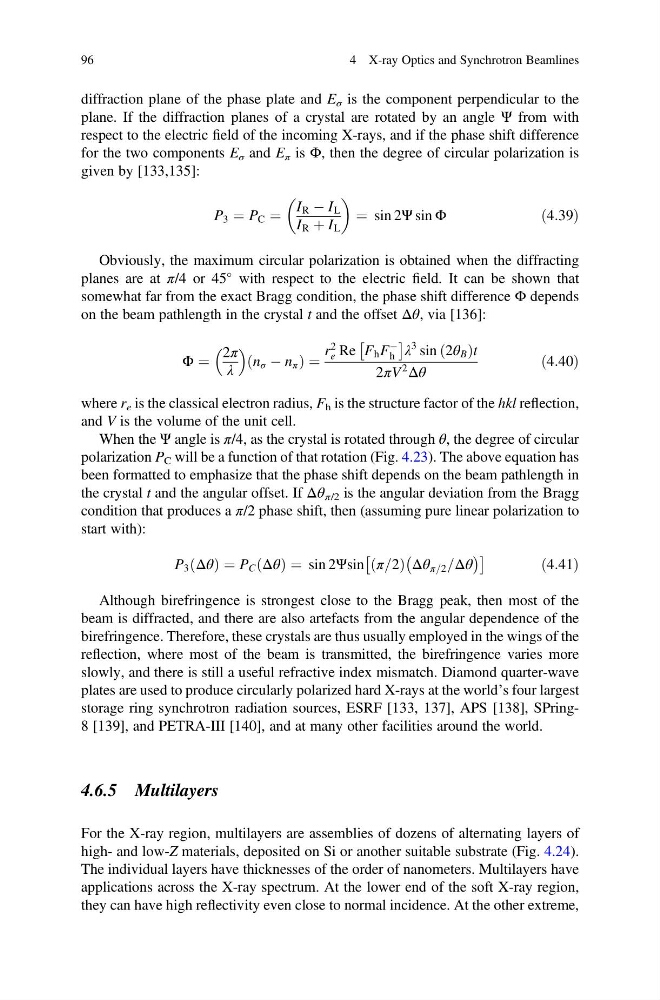
P 3 ¼ P C ¼
I R À I L
I R þ I L
¼ sin 2Ψ sin Φ
ð4:39Þ
Obviously, the maximum circular polarization is obtained when the diffracting
planes are at π/4 or 45
with respect to the electric field. It can be shown that
somewhat far from the exact Bragg condition, the phase shift difference Φ depends
on the beam pathlength in the crystal t and the offset Δθ, via [136]:
Φ ¼
2π
λ
n σ À n π
ð
Þ¼
r
2
e Re F h F
À
h
Â
à λ
3 sin 2θ B
ð Þt
2πV
2
Δθ
ð4:40Þ
where r e is the classical electron radius, F h is the structure factor of the hkl reflection,
and V is the volume of the unit cell.
When the Ψ angle is π/4, as the crystal is rotated through θ, the degree of circular
polarization P C will be a function of that rotation (Fig. 4.23). The above equation has
been formatted to emphasize that the phase shift depends on the beam pathlength in
the crystal t and the angular offset. If Δθ π/2 is the angular deviation from the Bragg
condition that produces a π/2 phase shift, then (assuming pure linear polarization to
start with):
P 3 Δθ
ð Þ ¼ P C Δθ
ð Þ ¼ sin 2Ψsin π=2
ð
Þ Δθ π=2 =Δθ
À
Á
Â
Ã
ð4:41Þ
Although birefringence is strongest close to the Bragg peak, then most of the
beam is diffracted, and there are also artefacts from the angular dependence of the
birefringence. Therefore, these crystals are thus usually employed in the wings of the
reflection, where most of the beam is transmitted, the birefringence varies more
slowly, and there is still a useful refractive index mismatch. Diamond quarter-wave
plates are used to produce circularly polarized hard X-rays at the world’s four largest
storage ring synchrotron radiation sources, ESRF [133, 137], APS [138], SPring8 [139], and PETRA-III [140], and at many other facilities around the world.
4.6.5 Multilayers
For the X-ray region, multilayers are assemblies of dozens of alternating layers of
high- and low-Z materials, deposited on Si or another suitable substrate (Fig. 4.24).
The individual layers have thicknesses of the order of nanometers. Multilayers have
applications across the X-ray spectrum. At the lower end of the soft X-ray region,
they can have high reflectivity even close to normal incidence. At the other extreme,
96
4 X-ray Optics and Synchrotron Beamlines
plane. If the diffraction planes of a crystal are rotated by an angle Ψ from with
respect to the electric field of the incoming X-rays, and if the phase shift difference
for the two components E σ and E π is Φ, then the degree of circular polarization is
given by [133,135]:
P 3 ¼ P C ¼
I R À I L
I R þ I L
¼ sin 2Ψ sin Φ
ð4:39Þ
Obviously, the maximum circular polarization is obtained when the diffracting
planes are at π/4 or 45
with respect to the electric field. It can be shown that
somewhat far from the exact Bragg condition, the phase shift difference Φ depends
on the beam pathlength in the crystal t and the offset Δθ, via [136]:
Φ ¼
2π
λ
n σ À n π
ð
Þ¼
r
2
e Re F h F
À
h
Â
à λ
3 sin 2θ B
ð Þt
2πV
2
Δθ
ð4:40Þ
where r e is the classical electron radius, F h is the structure factor of the hkl reflection,
and V is the volume of the unit cell.
When the Ψ angle is π/4, as the crystal is rotated through θ, the degree of circular
polarization P C will be a function of that rotation (Fig. 4.23). The above equation has
been formatted to emphasize that the phase shift depends on the beam pathlength in
the crystal t and the angular offset. If Δθ π/2 is the angular deviation from the Bragg
condition that produces a π/2 phase shift, then (assuming pure linear polarization to
start with):
P 3 Δθ
ð Þ ¼ P C Δθ
ð Þ ¼ sin 2Ψsin π=2
ð
Þ Δθ π=2 =Δθ
À
Á
Â
Ã
ð4:41Þ
Although birefringence is strongest close to the Bragg peak, then most of the
beam is diffracted, and there are also artefacts from the angular dependence of the
birefringence. Therefore, these crystals are thus usually employed in the wings of the
reflection, where most of the beam is transmitted, the birefringence varies more
slowly, and there is still a useful refractive index mismatch. Diamond quarter-wave
plates are used to produce circularly polarized hard X-rays at the world’s four largest
storage ring synchrotron radiation sources, ESRF [133, 137], APS [138], SPring8 [139], and PETRA-III [140], and at many other facilities around the world.
4.6.5 Multilayers
For the X-ray region, multilayers are assemblies of dozens of alternating layers of
high- and low-Z materials, deposited on Si or another suitable substrate (Fig. 4.24).
The individual layers have thicknesses of the order of nanometers. Multilayers have
applications across the X-ray spectrum. At the lower end of the soft X-ray region,
they can have high reflectivity even close to normal incidence. At the other extreme,
96
4 X-ray Optics and Synchrotron Beamlines