

4.6.2.2 Asymmetric Diffraction
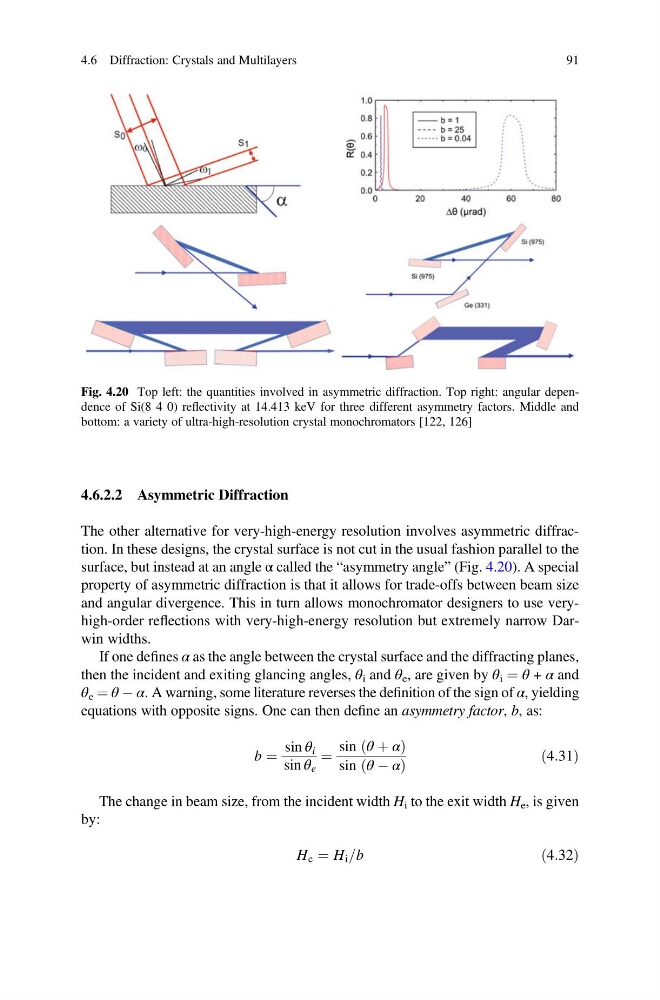
The other alternative for very-high-energy resolution involves asymmetric diffraction. In these designs, the crystal surface is not cut in the usual fashion parallel to the
surface, but instead at an angle α called the “asymmetry angle” (Fig. 4.20). A special
property of asymmetric diffraction is that it allows for trade-offs between beam size
and angular divergence. This in turn allows monochromator designers to use veryhigh-order reflections with very-high-energy resolution but extremely narrow Darwin widths.
If one defines α as the angle between the crystal surface and the diffracting planes,
then the incident and exiting glancing angles, θ i and θ e , are given by θ i ¼ θ + α and
θ e ¼ θ À α. A warning, some literature reverses the definition of the sign of α, yielding
equations with opposite signs. One can then define an asymmetry factor, b, as:
b ¼
sin θ i
sin θ e
¼
sin θ þ α
ð
Þ
sin θ À α
ð
Þ
ð4:31Þ
The change in beam size, from the incident width H i to the exit width H e , is given
by:
H e ¼ H i =b
ð4:32Þ
Fig. 4.20 Top left: the quantities involved in asymmetric diffraction. Top right: angular dependence of Si(8 4 0) reflectivity at 14.413 keV for three different asymmetry factors. Middle and
bottom: a variety of ultra-high-resolution crystal monochromators [122, 126]
4.6 Diffraction: Crystals and Multilayers
91
The other alternative for very-high-energy resolution involves asymmetric diffraction. In these designs, the crystal surface is not cut in the usual fashion parallel to the
surface, but instead at an angle α called the “asymmetry angle” (Fig. 4.20). A special
property of asymmetric diffraction is that it allows for trade-offs between beam size
and angular divergence. This in turn allows monochromator designers to use veryhigh-order reflections with very-high-energy resolution but extremely narrow Darwin widths.
If one defines α as the angle between the crystal surface and the diffracting planes,
then the incident and exiting glancing angles, θ i and θ e , are given by θ i ¼ θ + α and
θ e ¼ θ À α. A warning, some literature reverses the definition of the sign of α, yielding
equations with opposite signs. One can then define an asymmetry factor, b, as:
b ¼
sin θ i
sin θ e
¼
sin θ þ α
ð
Þ
sin θ À α
ð
Þ
ð4:31Þ
The change in beam size, from the incident width H i to the exit width H e , is given
by:
H e ¼ H i =b
ð4:32Þ
Fig. 4.20 Top left: the quantities involved in asymmetric diffraction. Top right: angular dependence of Si(8 4 0) reflectivity at 14.413 keV for three different asymmetry factors. Middle and
bottom: a variety of ultra-high-resolution crystal monochromators [122, 126]
4.6 Diffraction: Crystals and Multilayers
91