

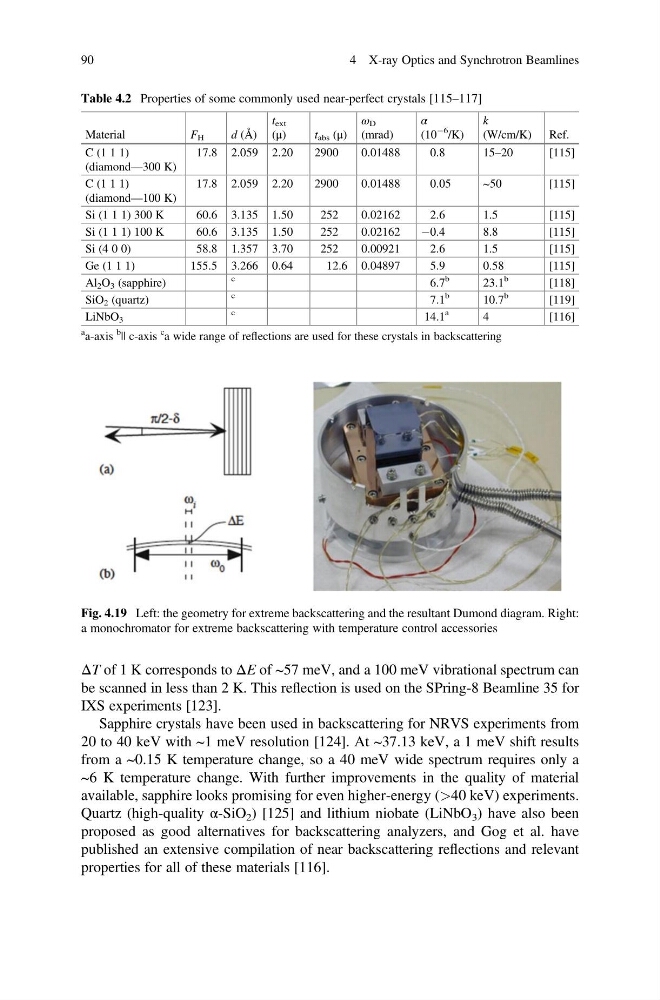
ΔT of 1 K corresponds to ΔE of ~57 meV, and a 100 meV vibrational spectrum can
be scanned in less than 2 K. This reflection is used on the SPring-8 Beamline 35 for
IXS experiments [123].
Sapphire crystals have been used in backscattering for NRVS experiments from
20 to 40 keV with ~1 meV resolution [124]. At ~37.13 keV, a 1 meV shift results
from a ~0.15 K temperature change, so a 40 meV wide spectrum requires only a
~6 K temperature change. With further improvements in the quality of material
available, sapphire looks promising for even higher-energy (>40 keV) experiments.
Quartz (high-quality α-SiO 2 ) [125] and lithium niobate (LiNbO 3 ) have also been
proposed as good alternatives for backscattering analyzers, and Gog et al. have
published an extensive compilation of near backscattering reflections and relevant
properties for all of these materials [116].
Table 4.2 Properties of some commonly used near-perfect crystals [115–117]
Material
F H
d (Å)
t ext
(μ)
t abs (μ)
ω D
(mrad)
α
(10
À6 /K)
k
(W/cm/K) Ref.
C (1 1 1)
(diamond—300 K)
17.8 2.059 2.20
2900
0.01488
0.8
15–20
[115]
C (1 1 1)
(diamond—100 K)
17.8 2.059 2.20
2900
0.01488
0.05
~50
[115]
Si (1 1 1) 300 K
60.6 3.135 1.50
252
0.02162
2.6
1.5
[115]
Si (1 1 1) 100 K
60.6 3.135 1.50
252
0.02162
À0.4
8.8
[115]
Si (4 0 0)
58.8 1.357 3.70
252
0.00921
2.6
1.5
[115]
Ge (1 1 1)
155.5 3.266 0.64
12.6 0.04897
5.9
0.58
[115]
Al 2 O 3 (sapphire)
c
6.7
b
23.1
b
[118]
SiO 2 (quartz)
c
7.1
b
10.7
b
[119]
LiNbO 3
c
14.1
a
4
[116]
a
a-axis
b || c-axis
c
a wide range of reflections are used for these crystals in backscattering
Fig. 4.19 Left: the geometry for extreme backscattering and the resultant Dumond diagram. Right:
a monochromator for extreme backscattering with temperature control accessories
90
4 X-ray Optics and Synchrotron Beamlines
be scanned in less than 2 K. This reflection is used on the SPring-8 Beamline 35 for
IXS experiments [123].
Sapphire crystals have been used in backscattering for NRVS experiments from
20 to 40 keV with ~1 meV resolution [124]. At ~37.13 keV, a 1 meV shift results
from a ~0.15 K temperature change, so a 40 meV wide spectrum requires only a
~6 K temperature change. With further improvements in the quality of material
available, sapphire looks promising for even higher-energy (>40 keV) experiments.
Quartz (high-quality α-SiO 2 ) [125] and lithium niobate (LiNbO 3 ) have also been
proposed as good alternatives for backscattering analyzers, and Gog et al. have
published an extensive compilation of near backscattering reflections and relevant
properties for all of these materials [116].
Table 4.2 Properties of some commonly used near-perfect crystals [115–117]
Material
F H
d (Å)
t ext
(μ)
t abs (μ)
ω D
(mrad)
α
(10
À6 /K)
k
(W/cm/K) Ref.
C (1 1 1)
(diamond—300 K)
17.8 2.059 2.20
2900
0.01488
0.8
15–20
[115]
C (1 1 1)
(diamond—100 K)
17.8 2.059 2.20
2900
0.01488
0.05
~50
[115]
Si (1 1 1) 300 K
60.6 3.135 1.50
252
0.02162
2.6
1.5
[115]
Si (1 1 1) 100 K
60.6 3.135 1.50
252
0.02162
À0.4
8.8
[115]
Si (4 0 0)
58.8 1.357 3.70
252
0.00921
2.6
1.5
[115]
Ge (1 1 1)
155.5 3.266 0.64
12.6 0.04897
5.9
0.58
[115]
Al 2 O 3 (sapphire)
c
6.7
b
23.1
b
[118]
SiO 2 (quartz)
c
7.1
b
10.7
b
[119]
LiNbO 3
c
14.1
a
4
[116]
a
a-axis
b || c-axis
c
a wide range of reflections are used for these crystals in backscattering
Fig. 4.19 Left: the geometry for extreme backscattering and the resultant Dumond diagram. Right:
a monochromator for extreme backscattering with temperature control accessories
90
4 X-ray Optics and Synchrotron Beamlines