

38
3
gill withdrawal behaviour in the mollusc model organism Aplysia that the involvement
of cAMP and PKA in CREB- dependent gene regulation for the establishment of a longterm memory was originally discovered (reviewed in Kandel et al. (Kandel et al. 2014).
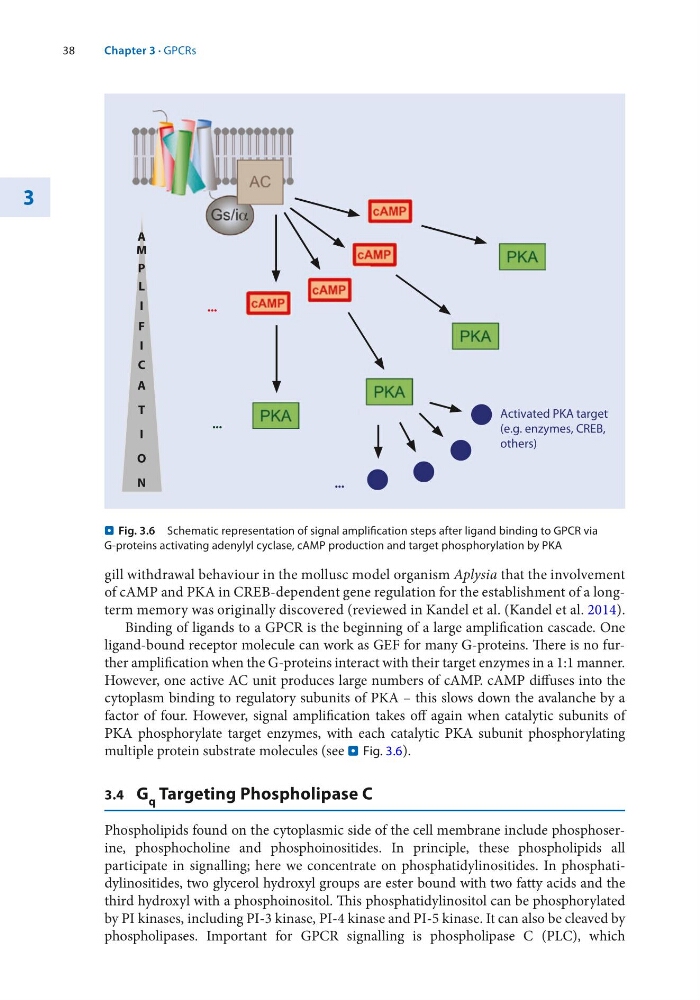
Binding of ligands to a GPCR is the beginning of a large amplification cascade. One
ligand-bound receptor molecule can work as GEF for many G-proteins. There is no further amplification when the G-proteins interact with their target enzymes in a 1:1 manner.
However, one active AC unit produces large numbers of cAMP. cAMP diffuses into the
cytoplasm binding to regulatory subunits of PKA – this slows down the avalanche by a
factor of four. However, signal amplification takes off again when catalytic subunits of
PKA phosphorylate target enzymes, with each catalytic PKA subunit phosphorylating
multiple protein substrate molecules (see . Fig. 3.6).
3.4 G q Targeting Phospholipase C
Phospholipids found on the cytoplasmic side of the cell membrane include phosphoserine, phosphocholine and phosphoinositides. In principle, these phospholipids all
participate in signalling; here we concentrate on phosphatidylinositides. In phosphatidylinositides, two glycerol hydroxyl groups are ester bound with two fatty acids and the
third hydroxyl with a phosphoinositol. This phosphatidylinositol can be phosphorylated
by PI kinases, including PI-3 kinase, PI-4 kinase and PI-5 kinase. It can also be cleaved by
phospholipases. Important for GPCR signalling is phospholipase C (PLC), which
Activated PKA target
(e.g. enzymes, CREB,
others)
...
...
...
A
M
P
L
I
F
I
C
A
T
I
O
N
. Fig. 3.6 Schematic representation of signal amplification steps after ligand binding to GPCR via
G-proteins activating adenylyl cyclase, cAMP production and target phosphorylation by PKA
Chapter 3 · GPCRs
3
gill withdrawal behaviour in the mollusc model organism Aplysia that the involvement
of cAMP and PKA in CREB- dependent gene regulation for the establishment of a longterm memory was originally discovered (reviewed in Kandel et al. (Kandel et al. 2014).
Binding of ligands to a GPCR is the beginning of a large amplification cascade. One
ligand-bound receptor molecule can work as GEF for many G-proteins. There is no further amplification when the G-proteins interact with their target enzymes in a 1:1 manner.
However, one active AC unit produces large numbers of cAMP. cAMP diffuses into the
cytoplasm binding to regulatory subunits of PKA – this slows down the avalanche by a
factor of four. However, signal amplification takes off again when catalytic subunits of
PKA phosphorylate target enzymes, with each catalytic PKA subunit phosphorylating
multiple protein substrate molecules (see . Fig. 3.6).
3.4 G q Targeting Phospholipase C
Phospholipids found on the cytoplasmic side of the cell membrane include phosphoserine, phosphocholine and phosphoinositides. In principle, these phospholipids all
participate in signalling; here we concentrate on phosphatidylinositides. In phosphatidylinositides, two glycerol hydroxyl groups are ester bound with two fatty acids and the
third hydroxyl with a phosphoinositol. This phosphatidylinositol can be phosphorylated
by PI kinases, including PI-3 kinase, PI-4 kinase and PI-5 kinase. It can also be cleaved by
phospholipases. Important for GPCR signalling is phospholipase C (PLC), which
Activated PKA target
(e.g. enzymes, CREB,
others)
...
...
...
A
M
P
L
I
F
I
C
A
T
I
O
N
. Fig. 3.6 Schematic representation of signal amplification steps after ligand binding to GPCR via
G-proteins activating adenylyl cyclase, cAMP production and target phosphorylation by PKA
Chapter 3 · GPCRs