

37
3
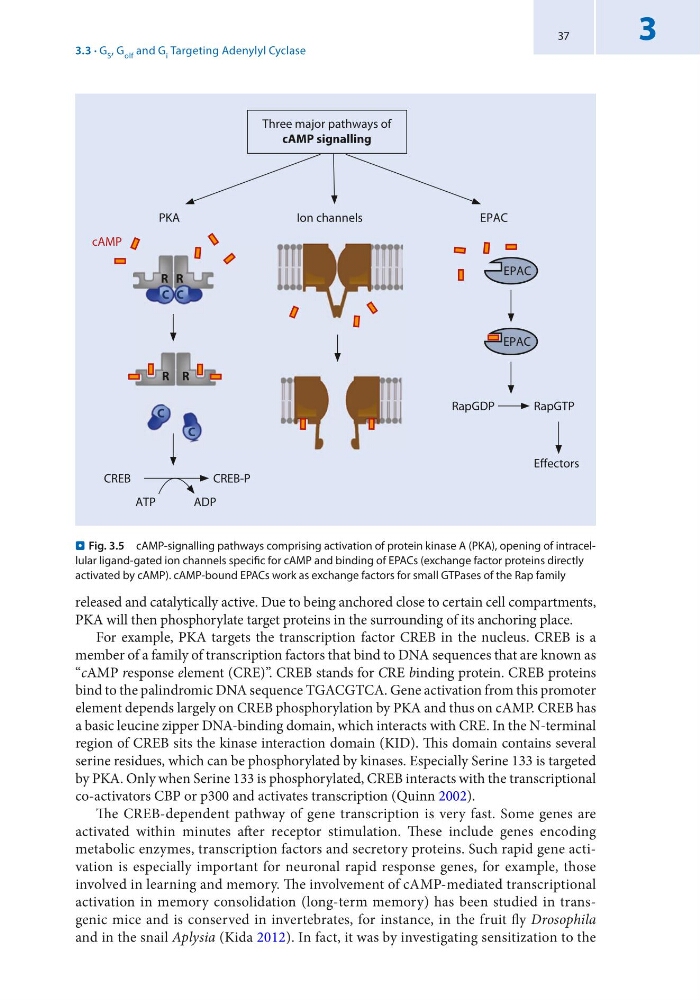
released and catalytically active. Due to being anchored close to certain cell compartments,
PKA will then phosphorylate target proteins in the surrounding of its anchoring place.
For example, PKA targets the transcription factor CREB in the nucleus. CREB is a
member of a family of transcription factors that bind to DNA sequences that are known as
“cAMP response element (CRE)”. CREB stands for CRE binding protein. CREB proteins
bind to the palindromic DNA sequence TGACGTCA. Gene activation from this promoter
element depends largely on CREB phosphorylation by PKA and thus on cAMP. CREB has
a basic leucine zipper DNA-binding domain, which interacts with CRE. In the N- terminal
region of CREB sits the kinase interaction domain (KID). This domain contains several
serine residues, which can be phosphorylated by kinases. Especially Serine 133 is targeted
by PKA. Only when Serine 133 is phosphorylated, CREB interacts with the transcriptional
co-activators CBP or p300 and activates transcription (Quinn 2002).
The CREB-dependent pathway of gene transcription is very fast. Some genes are
activated within minutes after receptor stimulation. These include genes encoding
metabolic enzymes, transcription factors and secretory proteins. Such rapid gene activation is especially important for neuronal rapid response genes, for example, those
involved in learning and memory. The involvement of cAMP-mediated transcriptional
activation in memory consolidation (long-term memory) has been studied in transgenic mice and is conserved in invertebrates, for instance, in the fruit fly Drosophila
and in the snail Aplysia (Kida 2012). In fact, it was by investigating sensitization to the
R
C
R
C
Ion channels
Three major pathways of
cAMP signalling
cAMP
EPAC
PKA
C
C
R R
CREB
CREB-P
ATP
ADP
EPAC
RapGDP
RapGTP
Effectors
EPAC
. Fig. 3.5 cAMP-signalling pathways comprising activation of protein kinase A (PKA), opening of intracellular ligand-gated ion channels specific for cAMP and binding of EPACs (exchange factor proteins directly
activated by cAMP). cAMP-bound EPACs work as exchange factors for small GTPases of the Rap family
3.3 · G S , G olf and G i Targeting Adenylyl Cyclase
3
released and catalytically active. Due to being anchored close to certain cell compartments,
PKA will then phosphorylate target proteins in the surrounding of its anchoring place.
For example, PKA targets the transcription factor CREB in the nucleus. CREB is a
member of a family of transcription factors that bind to DNA sequences that are known as
“cAMP response element (CRE)”. CREB stands for CRE binding protein. CREB proteins
bind to the palindromic DNA sequence TGACGTCA. Gene activation from this promoter
element depends largely on CREB phosphorylation by PKA and thus on cAMP. CREB has
a basic leucine zipper DNA-binding domain, which interacts with CRE. In the N- terminal
region of CREB sits the kinase interaction domain (KID). This domain contains several
serine residues, which can be phosphorylated by kinases. Especially Serine 133 is targeted
by PKA. Only when Serine 133 is phosphorylated, CREB interacts with the transcriptional
co-activators CBP or p300 and activates transcription (Quinn 2002).
The CREB-dependent pathway of gene transcription is very fast. Some genes are
activated within minutes after receptor stimulation. These include genes encoding
metabolic enzymes, transcription factors and secretory proteins. Such rapid gene activation is especially important for neuronal rapid response genes, for example, those
involved in learning and memory. The involvement of cAMP-mediated transcriptional
activation in memory consolidation (long-term memory) has been studied in transgenic mice and is conserved in invertebrates, for instance, in the fruit fly Drosophila
and in the snail Aplysia (Kida 2012). In fact, it was by investigating sensitization to the
R
C
R
C
Ion channels
Three major pathways of
cAMP signalling
cAMP
EPAC
PKA
C
C
R R
CREB
CREB-P
ATP
ADP
EPAC
RapGDP
RapGTP
Effectors
EPAC
. Fig. 3.5 cAMP-signalling pathways comprising activation of protein kinase A (PKA), opening of intracellular ligand-gated ion channels specific for cAMP and binding of EPACs (exchange factor proteins directly
activated by cAMP). cAMP-bound EPACs work as exchange factors for small GTPases of the Rap family
3.3 · G S , G olf and G i Targeting Adenylyl Cyclase