

36
3
families, which hydrolyse cyclic nucleotides, and have diverse subcellular localizations
and varying affinities for their cyclic nucleotide substrates. Therefore, cAMP that is produced in a cell in response to receptor activation will not be evenly distributed in the
cytoplasm. It will rather be restricted to certain subcellular structures. This adds specificity to the cAMP responses (Conti et al. 2014).
cAMP regulates further pathways, including the activity of protein kinase A (PKA)
(see . Fig. 3.5). It is involved in many PKA-dependent processes, such as metabolic pathways, gene regulation and cellular pathways regulating proliferation and apoptosis. cAMP
also regulates the conductivity of second messenger-gated ion channels and therefore
plays an important role in neurotransmission. Finally, cAMP regulates EPAC-proteins
(exchange factor proteins directly activated by cAMP). These are GEFs for small G-proteins
including Rap1 and Rap2. Rap proteins partially antagonize mitogenic signalling by
growth factors via Ras proteins by inhibiting the MAP kinase kinase kinase (MAPKKK)
c-Raf (rapidly accelerated fibrosarcoma). They also have functions in regulating phospholipids (by activating phosphatidylinositol-4, 5-biphosphate 3-kinase (PI-3 kinase), cell
adhesion (via cadherin and integrins) and the cytoskeleton (via activation of Rho-proteins)
(Zhang et al. 2017).
PKA is ubiquitously expressed in all cells, and numerous molecules, including hormones and neurotransmitters, activate this kinase via GPCR-mediated cAMP production.
To obtain specificity in PKA-regulated pathways, its activity has to be controlled on additional levels. This is achieved by its two regulatory subunits. Together with two catalytic
subunits, PKA forms a tetramer. The regulatory subunits interact with A-kinase- anchoring
proteins (AKAPs), a very large protein family with tightly regulated cellular localization.
AKAPs define the localization of PKA holoenzymes in different cellular compartments or
structures. Moreover, they function as scaffolds for other signalling molecules. Thus,
AKAPs form, within their respective cellular microenvironment, multiprotein complexes
with many proteins, including kinases and phosphatases that are responsive to different
cellular signalling pathways. In this way PKA activity on its substrates can be precisely
related to the respective upstream receptor activation event (Torres-Quesada et al. 2017).
When cAMP binds to the regulatory PKA subunits, the catalytic subunits of the enzyme are
Adenylyl cyclase (AC)
Cytosol
Catalytic
domains
COO –
NH3 +
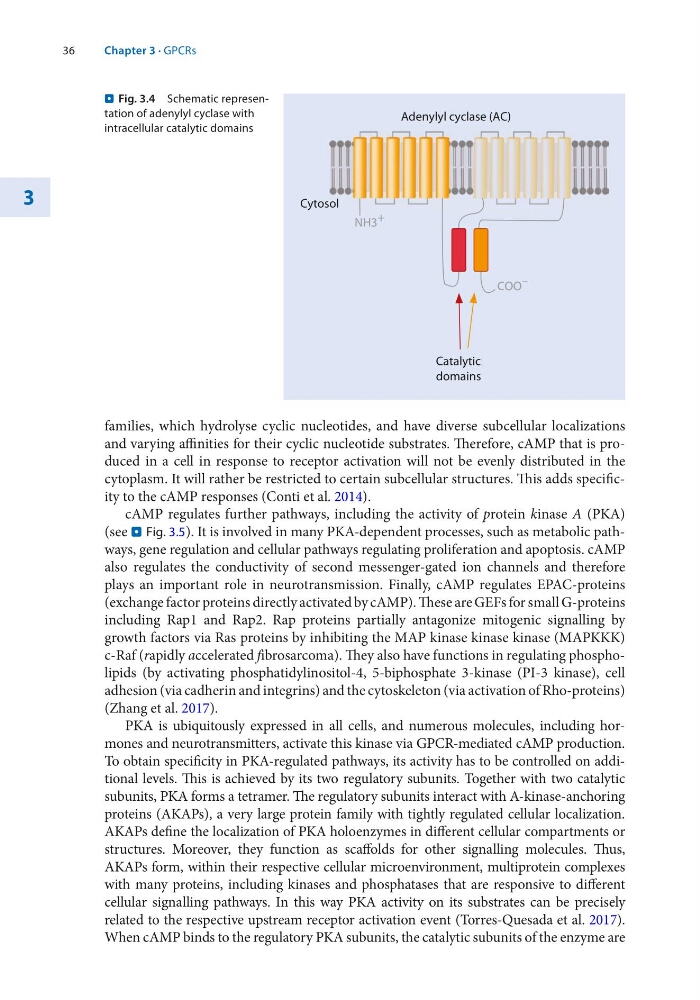
. Fig. 3.4 Schematic representation of adenylyl cyclase with
intracellular catalytic domains
Chapter 3 · GPCRs
3
families, which hydrolyse cyclic nucleotides, and have diverse subcellular localizations
and varying affinities for their cyclic nucleotide substrates. Therefore, cAMP that is produced in a cell in response to receptor activation will not be evenly distributed in the
cytoplasm. It will rather be restricted to certain subcellular structures. This adds specificity to the cAMP responses (Conti et al. 2014).
cAMP regulates further pathways, including the activity of protein kinase A (PKA)
(see . Fig. 3.5). It is involved in many PKA-dependent processes, such as metabolic pathways, gene regulation and cellular pathways regulating proliferation and apoptosis. cAMP
also regulates the conductivity of second messenger-gated ion channels and therefore
plays an important role in neurotransmission. Finally, cAMP regulates EPAC-proteins
(exchange factor proteins directly activated by cAMP). These are GEFs for small G-proteins
including Rap1 and Rap2. Rap proteins partially antagonize mitogenic signalling by
growth factors via Ras proteins by inhibiting the MAP kinase kinase kinase (MAPKKK)
c-Raf (rapidly accelerated fibrosarcoma). They also have functions in regulating phospholipids (by activating phosphatidylinositol-4, 5-biphosphate 3-kinase (PI-3 kinase), cell
adhesion (via cadherin and integrins) and the cytoskeleton (via activation of Rho-proteins)
(Zhang et al. 2017).
PKA is ubiquitously expressed in all cells, and numerous molecules, including hormones and neurotransmitters, activate this kinase via GPCR-mediated cAMP production.
To obtain specificity in PKA-regulated pathways, its activity has to be controlled on additional levels. This is achieved by its two regulatory subunits. Together with two catalytic
subunits, PKA forms a tetramer. The regulatory subunits interact with A-kinase- anchoring
proteins (AKAPs), a very large protein family with tightly regulated cellular localization.
AKAPs define the localization of PKA holoenzymes in different cellular compartments or
structures. Moreover, they function as scaffolds for other signalling molecules. Thus,
AKAPs form, within their respective cellular microenvironment, multiprotein complexes
with many proteins, including kinases and phosphatases that are responsive to different
cellular signalling pathways. In this way PKA activity on its substrates can be precisely
related to the respective upstream receptor activation event (Torres-Quesada et al. 2017).
When cAMP binds to the regulatory PKA subunits, the catalytic subunits of the enzyme are
Adenylyl cyclase (AC)
Cytosol
Catalytic
domains
COO –
NH3 +
. Fig. 3.4 Schematic representation of adenylyl cyclase with
intracellular catalytic domains
Chapter 3 · GPCRs