

104
7
burning, erectile dysfunction and other maladies have also been described (Zhang et al.
2017; Bai et al. 2008). As with other plant-derived compounds that affect adrenergic
receptor function, its role for the plant itself is unknown.
7.3 Adenosine Receptors: Caffeine
Caffeine is probably the psychoactive drug with the highest proportion of usage worldwide (Fredholm et al. 1999). It is a purine alkaloid that is most prominently found in the
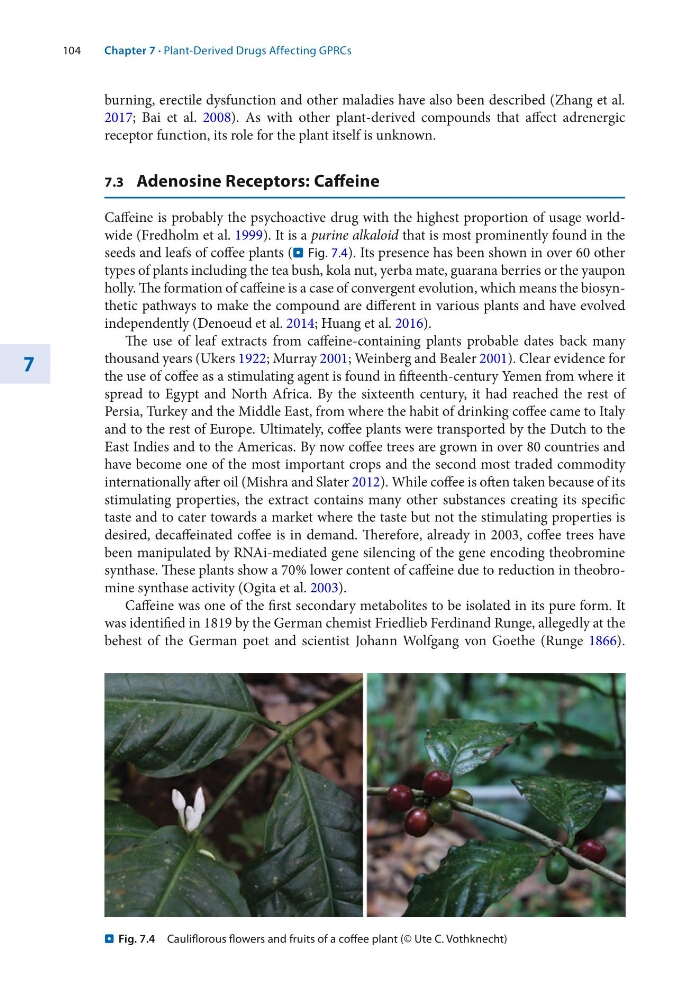
seeds and leafs of coffee plants (. Fig. 7.4). Its presence has been shown in over 60 other
types of plants including the tea bush, kola nut, yerba mate, guarana berries or the yaupon
holly. The formation of caffeine is a case of convergent evolution, which means the biosynthetic pathways to make the compound are different in various plants and have evolved
independently (Denoeud et al. 2014; Huang et al. 2016).
The use of leaf extracts from caffeine-containing plants probable dates back many
thousand years (Ukers 1922; Murray 2001; Weinberg and Bealer 2001). Clear evidence for
the use of coffee as a stimulating agent is found in fifteenth-century Yemen from where it
spread to Egypt and North Africa. By the sixteenth century, it had reached the rest of
Persia, Turkey and the Middle East, from where the habit of drinking coffee came to Italy
and to the rest of Europe. Ultimately, coffee plants were transported by the Dutch to the
East Indies and to the Americas. By now coffee trees are grown in over 80 countries and
have become one of the most important crops and the second most traded commodity
internationally after oil (Mishra and Slater 2012). While coffee is often taken because of its
stimulating properties, the extract contains many other substances creating its specific
taste and to cater towards a market where the taste but not the stimulating properties is
desired, decaffeinated coffee is in demand. Therefore, already in 2003, coffee trees have
been manipulated by RNAi-mediated gene silencing of the gene encoding theobromine
synthase. These plants show a 70% lower content of caffeine due to reduction in theobromine synthase activity (Ogita et al. 2003).
Caffeine was one of the first secondary metabolites to be isolated in its pure form. It
was identified in 1819 by the German chemist Friedlieb Ferdinand Runge, allegedly at the
behest of the German poet and scientist Johann Wolfgang von Goethe (Runge 1866).
. Fig. 7.4 Cauliflorous flowers and fruits of a coffee plant (© Ute C. Vothknecht)
Chapter 7 · Plant-Derived Drugs Affecting GPRCs
7
burning, erectile dysfunction and other maladies have also been described (Zhang et al.
2017; Bai et al. 2008). As with other plant-derived compounds that affect adrenergic
receptor function, its role for the plant itself is unknown.
7.3 Adenosine Receptors: Caffeine
Caffeine is probably the psychoactive drug with the highest proportion of usage worldwide (Fredholm et al. 1999). It is a purine alkaloid that is most prominently found in the
seeds and leafs of coffee plants (. Fig. 7.4). Its presence has been shown in over 60 other
types of plants including the tea bush, kola nut, yerba mate, guarana berries or the yaupon
holly. The formation of caffeine is a case of convergent evolution, which means the biosynthetic pathways to make the compound are different in various plants and have evolved
independently (Denoeud et al. 2014; Huang et al. 2016).
The use of leaf extracts from caffeine-containing plants probable dates back many
thousand years (Ukers 1922; Murray 2001; Weinberg and Bealer 2001). Clear evidence for
the use of coffee as a stimulating agent is found in fifteenth-century Yemen from where it
spread to Egypt and North Africa. By the sixteenth century, it had reached the rest of
Persia, Turkey and the Middle East, from where the habit of drinking coffee came to Italy
and to the rest of Europe. Ultimately, coffee plants were transported by the Dutch to the
East Indies and to the Americas. By now coffee trees are grown in over 80 countries and
have become one of the most important crops and the second most traded commodity
internationally after oil (Mishra and Slater 2012). While coffee is often taken because of its
stimulating properties, the extract contains many other substances creating its specific
taste and to cater towards a market where the taste but not the stimulating properties is
desired, decaffeinated coffee is in demand. Therefore, already in 2003, coffee trees have
been manipulated by RNAi-mediated gene silencing of the gene encoding theobromine
synthase. These plants show a 70% lower content of caffeine due to reduction in theobromine synthase activity (Ogita et al. 2003).
Caffeine was one of the first secondary metabolites to be isolated in its pure form. It
was identified in 1819 by the German chemist Friedlieb Ferdinand Runge, allegedly at the
behest of the German poet and scientist Johann Wolfgang von Goethe (Runge 1866).
. Fig. 7.4 Cauliflorous flowers and fruits of a coffee plant (© Ute C. Vothknecht)
Chapter 7 · Plant-Derived Drugs Affecting GPRCs