

105
7
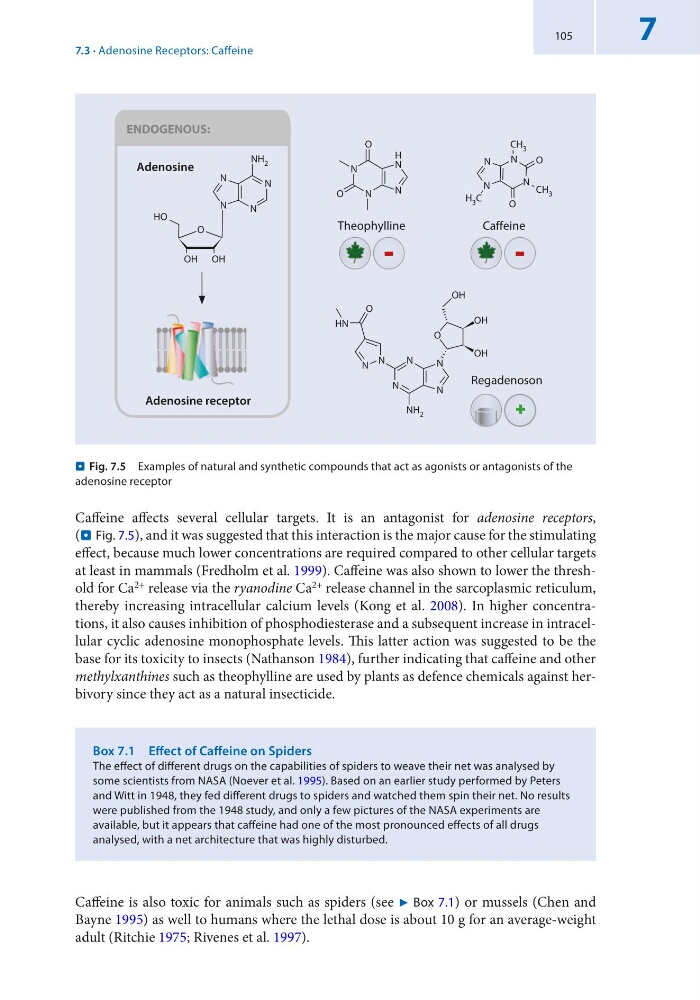
Caffeine affects several cellular targets. It is an antagonist for adenosine receptors,
(. Fig. 7.5), and it was suggested that this interaction is the major cause for the stimulating
effect, because much lower concentrations are required compared to other cellular targets
at least in mammals (Fredholm et al. 1999). Caffeine was also shown to lower the threshold for Ca 2+ release via the ryanodine Ca 2+ release channel in the sarcoplasmic reticulum,
thereby increasing intracellular calcium levels (Kong et al. 2008). In higher concentrations, it also causes inhibition of phosphodiesterase and a subsequent increase in intracellular cyclic adenosine monophosphate levels. This latter action was suggested to be the
base for its toxicity to insects (Nathanson 1984), further indicating that caffeine and other
methylxanthines such as theophylline are used by plants as defence chemicals against herbivory since they act as a natural insecticide.
Caffeine is also toxic for animals such as spiders (see 7 Box 7.1) or mussels (Chen and
Bayne 1995) as well to humans where the lethal dose is about 10 g for an average-weight
adult (Ritchie 1975; Rivenes et al. 1997).
Box 7.1 Effect of Caffeine on Spiders
The effect of different drugs on the capabilities of spiders to weave their net was analysed by
some scientists from NASA (Noever et al. 1995). Based on an earlier study performed by Peters
and Witt in 1948, they fed different drugs to spiders and watched them spin their net. No results
were published from the 1948 study, and only a few pictures of the NASA experiments are
available, but it appears that caffeine had one of the most pronounced effects of all drugs
analysed, with a net architecture that was highly disturbed.
HO
N
N
N
N
N
N
O
O
N
N
N
N
N
N
H
H 3 C
CH 3
CH 3
NH 2
OH
O
O
O
OH
HN
O
OH
OH
OH
N
N
N
O
N
N
N
NH 2
Adenosine receptor
Adenosine
ENDOGENOUS:
Regadenoson
Theophylline
Caffeine
. Fig. 7.5 Examples of natural and synthetic compounds that act as agonists or antagonists of the
adenosine receptor
7.3 · Adenosine Receptors: Caffeine
7
Caffeine affects several cellular targets. It is an antagonist for adenosine receptors,
(. Fig. 7.5), and it was suggested that this interaction is the major cause for the stimulating
effect, because much lower concentrations are required compared to other cellular targets
at least in mammals (Fredholm et al. 1999). Caffeine was also shown to lower the threshold for Ca 2+ release via the ryanodine Ca 2+ release channel in the sarcoplasmic reticulum,
thereby increasing intracellular calcium levels (Kong et al. 2008). In higher concentrations, it also causes inhibition of phosphodiesterase and a subsequent increase in intracellular cyclic adenosine monophosphate levels. This latter action was suggested to be the
base for its toxicity to insects (Nathanson 1984), further indicating that caffeine and other
methylxanthines such as theophylline are used by plants as defence chemicals against herbivory since they act as a natural insecticide.
Caffeine is also toxic for animals such as spiders (see 7 Box 7.1) or mussels (Chen and
Bayne 1995) as well to humans where the lethal dose is about 10 g for an average-weight
adult (Ritchie 1975; Rivenes et al. 1997).
Box 7.1 Effect of Caffeine on Spiders
The effect of different drugs on the capabilities of spiders to weave their net was analysed by
some scientists from NASA (Noever et al. 1995). Based on an earlier study performed by Peters
and Witt in 1948, they fed different drugs to spiders and watched them spin their net. No results
were published from the 1948 study, and only a few pictures of the NASA experiments are
available, but it appears that caffeine had one of the most pronounced effects of all drugs
analysed, with a net architecture that was highly disturbed.
HO
N
N
N
N
N
N
O
O
N
N
N
N
N
N
H
H 3 C
CH 3
CH 3
NH 2
OH
O
O
O
OH
HN
O
OH
OH
OH
N
N
N
O
N
N
N
NH 2
Adenosine receptor
Adenosine
ENDOGENOUS:
Regadenoson
Theophylline
Caffeine
. Fig. 7.5 Examples of natural and synthetic compounds that act as agonists or antagonists of the
adenosine receptor
7.3 · Adenosine Receptors: Caffeine